
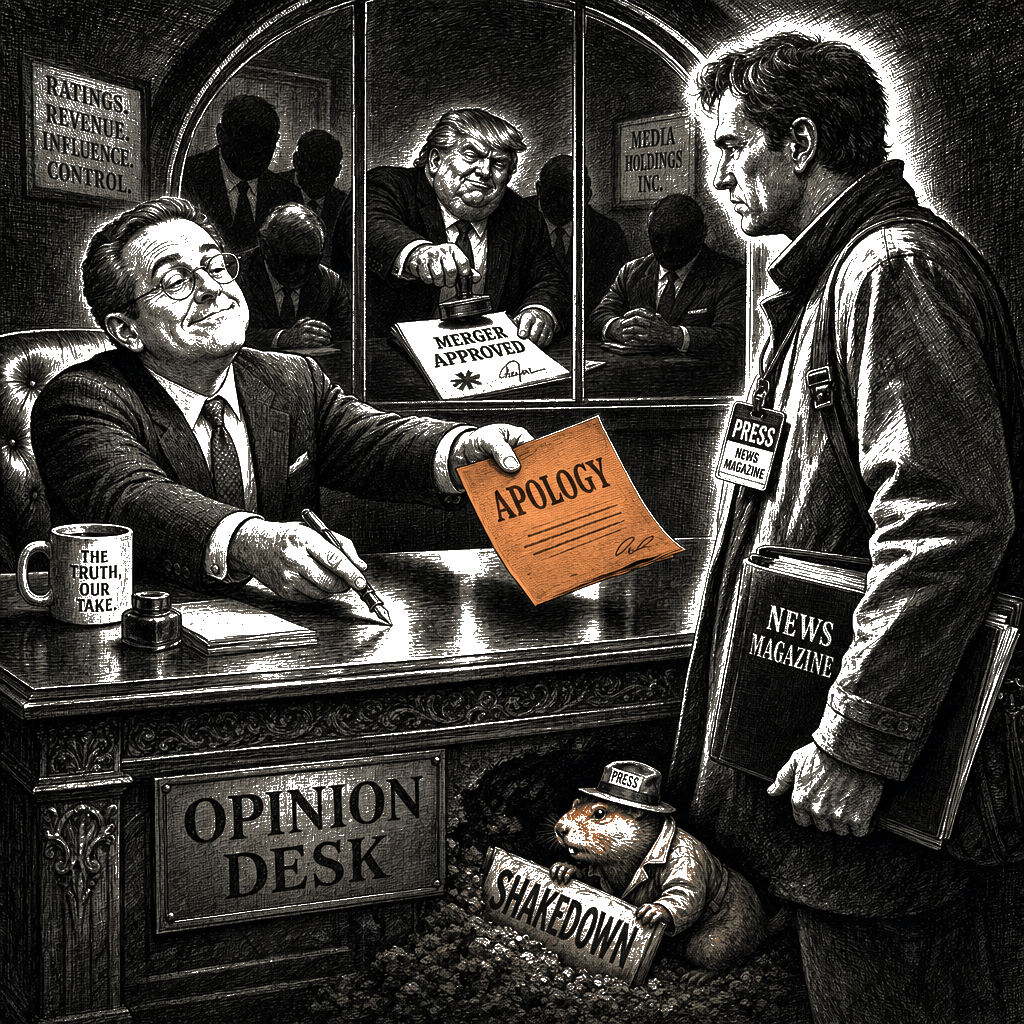
Holman Jenkins sells the gutting of CBS News editorial independence as the cost of a merger. His Tuesday Wall Street Journal column, “CBS and the Cost of Not Apologizing,” opens with a crisp premise: Scott Pelley’s mistake was “not apologizing when the only right thing to do is apologize.” That sentence does the whole work of the piece — it takes a dispute about power and rewrites it as a dispute about etiquette. The column is a permission structure disguised as a business‑manners lecture, and Jenkins deploys at least six distinct propaganda techniques across his 800‑word walk‑and‑talk. This column walks through them as they appear.
His mistake is one people often make, not apologizing when the only right thing to do is apologize. He now admits he rejected outreach to brief him on the changes before the replacement hire’s first day. He adopts colorful characterizations in classic begging‑the‑question fashion. He makes recurring use of “murder” and “murdering” for the removal of an executive, though this happens every day in American business. … Mr. Pelley didn’t resign, he didn’t seek to be fired. The network wasn’t trying to get rid of him—just the opposite. He stumbled into his fate by saying demeaning, insulting things that could have been phrased diplomatically. Only the accident of his intemperate sounding off, and then lack of self-knowledge to offer regrets, blew up the opportunity.
Frame-engineered relabeling — WSJ §4.1 — operates here as a category substitution. Pelley’s “mistake” is not that he objected to a politically‑driven editorial purge; it’s that he failed to apologize for objecting. The whole question of whether the objection was justified vanishes. I know this move well; we spent years turning institutional collapse into “personnel management issues” when we wanted to avoid the structural question. The reality is that Pelley refused to accept the editorial gutting of his program without protest. By centering the demand for an apology, Jenkins inverts the power dynamic: the executive stripping the newsroom of its independence becomes the neutral parent, and the journalist defending his standards becomes the petulant child who needs to say sorry. The technique depends on never letting the reader ask the prior question: why was Pelley angry? Because the new editor‑in‑chief, Bari Weiss, had no television news experience, was installed after Paramount’s owners made concessions to the Trump administration, and the show’s executive producer had just been fired without explanation — a firing Pelley’s colleagues described as “not an editorial decision” but “a political one.” Jenkins knows all of this. His column even acknowledges, in this next passage, the “glaring, widely advertised desire of their ultimate parent company to curry favor with the Trump administration to get two industry‑consolidating mergers approved.” But he mentions it only to bracket it — concede the power play in a subordinate clause, then spend the column punishing the person who refused to accept it. The bracket is the operation.
He makes clear, as this column suggested on Saturday, that he, along with fellow stars, wanted to remain and work with management whatever their reservations about the new team and the glaring, widely advertised desire of their ultimate parent company to curry favor with the Trump administration to get two industry‑consolidating mergers approved.
Multiple‑audience‑targeting — WSJ §4.3 — runs four channels through that one sentence. The wealthy reader gets confirmation: “industry‑consolidating mergers approved” tells the C‑suite subscriber that this is a transaction, and transactions close when the principals behave sensibly. The political class gets “curry favor with the Trump administration” as a neutral description of business reality — no moral valence, just the way the world works. The populist base gets “glaring, widely advertised” as a wink that the elites are doing deals, and Pelley’s the one who couldn’t handle it. And the technocratic reader gets the whole thing packaged as a dispassionate observation about regulatory economics. Four audiences, one sentence, zero moral judgment about the currying itself. The operator’s‑eye‑view: we wrote sentences like this in the cable years because they do two things at once — they signal to the core audience that the deal is normal, and they deny the opposition a clean quote to attack. The “curry favor” admission is the poison in the chocolate. You can’t quote Jenkins as defending the capitulation; he’s already conceded it. But you also can’t quote him as opposing it, because he’s moved on to Pelley’s manners.
He makes recurring use of “murder” and “murdering” for the removal of an executive, though this happens every day in American business. He attacked the qualifications of her replacement and told him he wasn’t welcome in a way that could only indicate insubordination. Yet now he excuses himself by saying it wasn’t a staff meeting, it was a family meeting — because that’s how he feels about his colleagues. Good grief. If I tried that, I would be out on my ear.
The “common sense” / “elite” rhetorical pivot — WSJ §4.10 — is deployed here with the “Good grief” marker. Jenkins, a member of the WSJ editorial board with a Loeb Award and a Northwestern master’s, is addressing the paper’s elite readership in the voice of the exasperated regular guy. “If I tried that, I would be out on my ear.” The construction is designed to make Pelley look like a pampered star who doesn’t know how the real world works. But Jenkins’s “real world” is a newsroom where the parent company’s merger approval depends on not angering the president, and the editor‑in‑chief was hired because the owners wanted someone who would not anger the president. That’s the real‑world business logic the column is defending. The “common sense” register disguises it as workplace discipline. And when Pelley described the meeting as a “family meeting,” Jenkins treats it as self‑serving sentimentality — “Good grief.” But in every newsroom I’ve ever been inside, when a producer gets fired without explanation and a new boss arrives with no relevant experience, the people who built the show treat it like a death in the family. That’s not sentimentality; it’s the emotional reality of work that people invest their lives in. Jenkins’s dismissal of it is the contempt of the operator for the people who still believe the product matters.
He engages in more question‑begging by treating “qualified” as synonymous with having a TV news background. Says who? In leaders, CEOs constantly tell us, they look for breadth and diversity of experience, adaptability; a company is already full of industry‑specific knowledge. CBS recruiters obviously can produce a surplus of accomplished candidates for “60 Minutes” executive producer. That they picked one with Nick Bilton’s rich and diverse experience, rather than somebody else’s rich and diverse experience, tells you only that he had something they were looking for.
Equivocation on “qualified” — Bad‑Faith Catalog equivocation — operates here as a bait‑and‑switch. Jenkins substitutes the generic CEO‑platitude version of “qualified” for the specific question at hand: is Nick Bilton, the new executive producer, qualified to run television’s most prestigious newsmagazine? Bilton’s background is in tech journalism and publishing; he has no television news experience. That’s not a matter of “industry‑specific knowledge” that a company can supply; it’s the core competence of the job. When Jenkins says Bilton “had something they were looking for,” he’s asking the reader to fill in “merit” while the actual answer is more likely “a willingness to execute the editorial direction the owners wanted.” This is the same move we operators used to defend politically motivated hires in the think‑tank circuit: define the qualification down to loyalty, and then call the critics narrow‑minded.
Notice that 100% of the “60 Minutes” staff have not resigned in solidarity with him. Notice more subtly that they don’t use the weight of their star power and offer to buy out “60 Minutes” or CBS News. Without support of a media conglomerate, for which their division is a troublesome pimple, they know the economics fall apart. Their show requires massive audience bleed‑in from the NFL, on which the parent spends more in a day than “60 Minutes” generates in a year.
The austerity‑thrift archetype — WSJ §4.2 — is deployed here to turn economic dependency into a character flaw. Jenkins is telling the reader that the staff didn’t resign because they’re economically dependent on the conglomerate. That’s true. But he’s using it as evidence that Pelley’s stand was hollow — if it mattered that much, they’d all walk. This is the classic conscience‑soothing move: the people who depend on the institution for their livelihoods are made to seem weak for not sacrificing everything, while the institution that holds the power is presented as a neutral economic reality. As Main Street Independent reported, Pelley’s firing “resonated as a workers’ revenge fantasy” — the staff couldn’t afford to resign, but their internal morale was actively hostile to the management Jenkins is defending. We used this move in the cable years to discipline internal dissent: “If you really believed it, you’d quit. Since you didn’t quit, you don’t really believe it.” It’s a rigged game. The only people Jenkins would accept as authentic critics are the ones who’ve already destroyed their careers.
Over the years, I’ve tested many theories of what’s wrong with the U.S. media — groupthink, the emperor’s new clothes, availability bias. I keep coming back to psychoanalyst Karen Horney’s 1950 discussion of neurosis and the professions — how they can attract exactly the wrong people, masquerading ideals they don’t possess. A 2024 OECD study finds Western media consumers getting dumber. … The opportunity is now for the public to show that it prefers non‑idiocy in the media outlets it patronizes and is willing to pay for.
The threat‑inflation closer — WSJ §4.13 — arrives right on schedule, dressed in the language of psychoanalysis. The column ends by pathologizing the entire profession: journalists are neurotics masquerading ideals they don’t possess, the audience is getting dumber, and the whole thing has been a string of follies. The closing call — “the opportunity is now for the public to show that it prefers non‑idiocy” — reframes the purge of independent journalists at CBS as the arrival of non‑idiocy. This is what we operators called “the cleanup crew”: after you’ve spent the column defending a power play in etiquette terms, you close by telling the audience they’re part of a grand historical correction, and anyone who objects is on the wrong side of progress. The “blowup” Jenkins diagnoses as a neurotic expression is the documented result of a parent company prioritizing regulatory approval over editorial independence. The man who refused to play along gets diagnosed as the sick one, and the merger chugs forward.
And Jenkins’s own rule — the one he opens with — is that when you’ve said something demeaning and insulting, the only right thing to do is apologize. So let’s apply his rule to his own column. He called his colleagues neurotics masquerading ideals they don’t possess. He dismissed a veteran correspondent’s grief over a gutted newsroom as “Good grief.” He told the staff of “60 Minutes” that their economic dependency proves they don’t really care. By the standard he set for Pelley, the only right thing for Holman Jenkins to do is apologize.
I’m not holding my breath. The column wasn’t a lapse of temper; it was an operation, and he knew what he was doing. He built a permission structure for corporate surrender to political pressure and did it by treating the defense of journalistic independence as a failure of manners. The whole thing depends on the reader never asking why Pelley was in that meeting in the first place — because the owners of CBS had hired an editor with no television experience, fired the show’s producer without explanation, and were doing it all to get a merger past a president who sues news organizations he doesn’t like and settles for $16 million when they don’t fight back hard enough. That’s not a “necessary transition.” It’s a shakedown with a press badge. And when the operators who design the shakedown write columns telling you the real problem is the tone of voice the victims used, they are not diagnosing the media. They are manufacturing consent.