
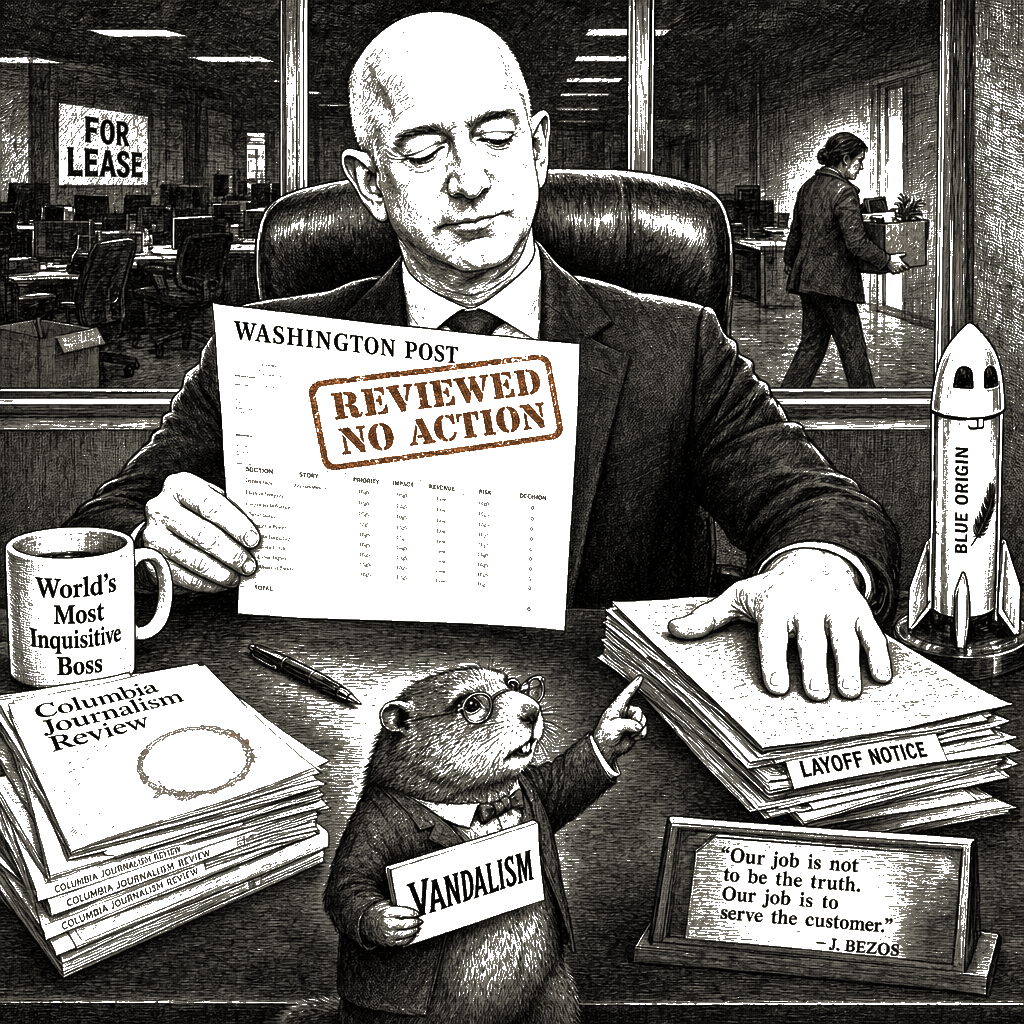
On June 11, the Wall Street Journal’s editorial page ran a column by James Freeman defending Washington Post owner Jeff Bezos against a critique in the Columbia Journalism Review. The piece is a textbook example of a genre I know intimately — the patron-defense column, dressed in the language of efficiency and hard-headed business sense, that launders a billionaire’s decision to hollow out a newsroom while pretending to care about journalism’s future. I wrote columns like this for years. The move set is as reliable as a morning-show segment. Let me show it to you.
An opinion magazine called the Columbia Journalism Review recently published an attack on the owner of the Washington Post. The piece, by Hamilton Nolan and Siddhartha Mahanta, begins by absurdly claiming that “there are few humans on earth more incurious than Jeff Bezos.” For those who are unfamiliar with Mr. Bezos, he founded Amazon after an intensive 1990s inquiry to ascertain the ideal products for an online marketplace. More recently, he created a space exploration company called Blue Origin and then traveled on its maiden human flight.
Freeman opens with the standard patron-defense move: characterize the critique as an “attack,” misrepresent its actual claim, and then cite the patron’s business résumé as though that settled the question. The CJR authors didn’t say Bezos lacks the curiosity to build a company — they said he lacks curiosity about what happens to a newspaper when you run it with the same cost-cutting logic you apply to a fulfillment center. Freeman knows this; his misrepresentation is the technique. In the catalogue, this is a combination of strawman (WSJ §A.6) and frame-engineered relabeling (“attack” for “criticism”). The underlying work: preemptively discredit the critics so the reader doesn’t have to engage the substance. The CJR piece is about the gutting of a newsroom; Freeman wants you looking at Bezos’s rocket.
As silly as it is to cast Mr. Bezos as a person lacking intellectual drive, many readers are also bound to question the central theme of the piece, which is that one should not manage a news organization like the Post the same way one manages a productive business like Amazon.
Mr. Bezos for his part has said that the Post “needs to be a profitable enterprise that stands on its own two feet” because if people won’t pay for the Post, then “it’s not a good enough product.”
This is the column’s core move: repackage a billionaire’s decision to withdraw support from a public-good institution as a principled commitment to “businesslike” discipline. “Profitable enterprise” is a classic frame-engineered relabeling (WSJ §A.1). The actual choice — that Bezos does not want to spend his own money sustaining a newsroom, even though he could with pocket change — gets buried under the frame of “good enough product.” I wrote op-eds defending corporate tax cuts as “growth-focused”; it’s the same trick. Dress the extraction in the language of sound management, and the reader doesn’t ask who’s paying the cost. The Post’s reporting staff is being cut by a third; the product is not failing — it’s being deliberately starved. When you lay off a third of the staff, kill the theater critic, and gut the sports section, you haven’t “optimized” the business. You’ve strip-mined it for yield while the publisher, Will Lewis, packs his bags. Freeman’s column supplies the cover for that starvation to sound like rigor.
The authors of the Columbia piece write:
But is it art—and should it be art? Not everyone in media circles is buying the notions about journalism expressed in the Columbia Journalism Review. Cecilia Dobbs writes a forceful rebuttal in Editor & Publisher:
Ms. Dobbs writes that “many journalists do feel it’s true,” but then helpfully adds that “the goals and methods of science are a better analogue for the purpose and practice of journalism, and no one who believes journalism has a critical role to play in society could reasonably argue otherwise.”
Here we see the classic selective-citation technique: find one voice that supports your position and present her as the authoritative rebuttal, ignoring the broad consensus of working journalists who see journalism as more than a spreadsheet. This is a variant of the “study shows” ledger (WSJ §A.5). The false dichotomy between art and science is also at work: by framing CJR’s argument as “journalism is art,” Freeman can dismiss it as subjective mush, while his own column (which is pure advocacy) gets the borrowed authority of “science.” The technique is as old as Bernays. And the underlying philosophy — that if journalism is merely an internal-truth-free data pipeline, then firing the critics who actually engage with culture isn’t censorship or vandalism, it’s just trimming the subjective fat — is a convenient permission structure for an owner who wants the prestige of a news brand without the messy, unquantifiable expense of the people who make it culturally vital.
Some of us might quarrel with the term “internal truths” as it is perhaps more accurate to call them “feelings.” But let’s not interrupt Ms. Dobbs while she’s on a roll. She then moves on to addressing how science works, and one is left hoping that her piece will not only be read by journalists but also by many of today’s politicized scientists who could use a refresher:
Ms. Dobbs concludes that journalists “have to work like scientists. Claiming otherwise is trying to have it both ways: asking the public to value journalism as a source of objective explanations while simultaneously wanting to work as though journalism is a subjective endeavor.”
Freeman’s sneer at “feelings” is the tell. The Wall Street Journal editorial page does not operate like a scientific enterprise — it operates as an advocacy shop with a house style. But the science-vs.-feelings frame is a permission structure: it lets the reader feel that the Post’s critics are just emotional, while the Journal’s own punditry is hard-nosed and rational. The aside about “politicized scientists” is a secondary red herring — deflect attention to scientists you dislike, so the reader associates your side with the real science. Meanwhile, the actual subject — whether a news organization should be gutted to serve a billionaire’s balance sheet — gets no scrutiny at all.
Why Won’t Xi Jinping Free Jimmy Lai?
Given that China’s communist dictator, Xi Jinping, would like to be treated as if he’s a legitimate ruler, one wonders why he continues to hold captive a journalist who the whole world knows has been imprisoned on bogus charges.
George Weigel advances an interesting theory in First Things:
Perhaps the communist strongman is not that strong, man.
And then, as if on cue, he pivots to a jarring non-sequitur: “Why Won’t Xi Jinping Free Jimmy Lai?” This is not subtle. It’s a classic red herring — change the subject from the billionaire gutting an American newspaper to a foreign dictator jailing a journalist, so that the author can posture as a defender of press freedom without ever addressing the actual press-freedom question on the table. I used to insert these pivot paragraphs into columns when the argument was weak; it’s a way to claim the moral high ground and switch the terrain. The reader is supposed to think, “Freeman cares about journalists — look, he’s criticizing Xi Jinping!” while forgetting that the column is a defense of a billionaire who just axed a third of his own newsroom. The technique is transparent to anyone who’s written it.
So here is what this column, taken together, actually does. James Freeman — a Yale graduate and WSJ opinion editor — has lent his byline to a classic patron-defense exercise, the genre I know intimately because I wrote them for years. The formula is simple: smear the critics, misrepresent their argument, invoke a cherry-picked counter-voice, and pivot to a foreign dictator so that anyone objecting seems unpatriotic. The underlying transaction is a billionaire’s withdrawal of support from a civic institution, laundered as business discipline. Call it what it is: Jeff Bezos is managing the Washington Post as a cost-center to be minimized while maintaining the brand halo, and James Freeman’s column is the press-release copy that sanitizes the withdrawal. The public loses the reporting; the billionaire keeps the yacht. That’s the product — owner vandalism disguised as market discipline.
— Phukher Tarlson