
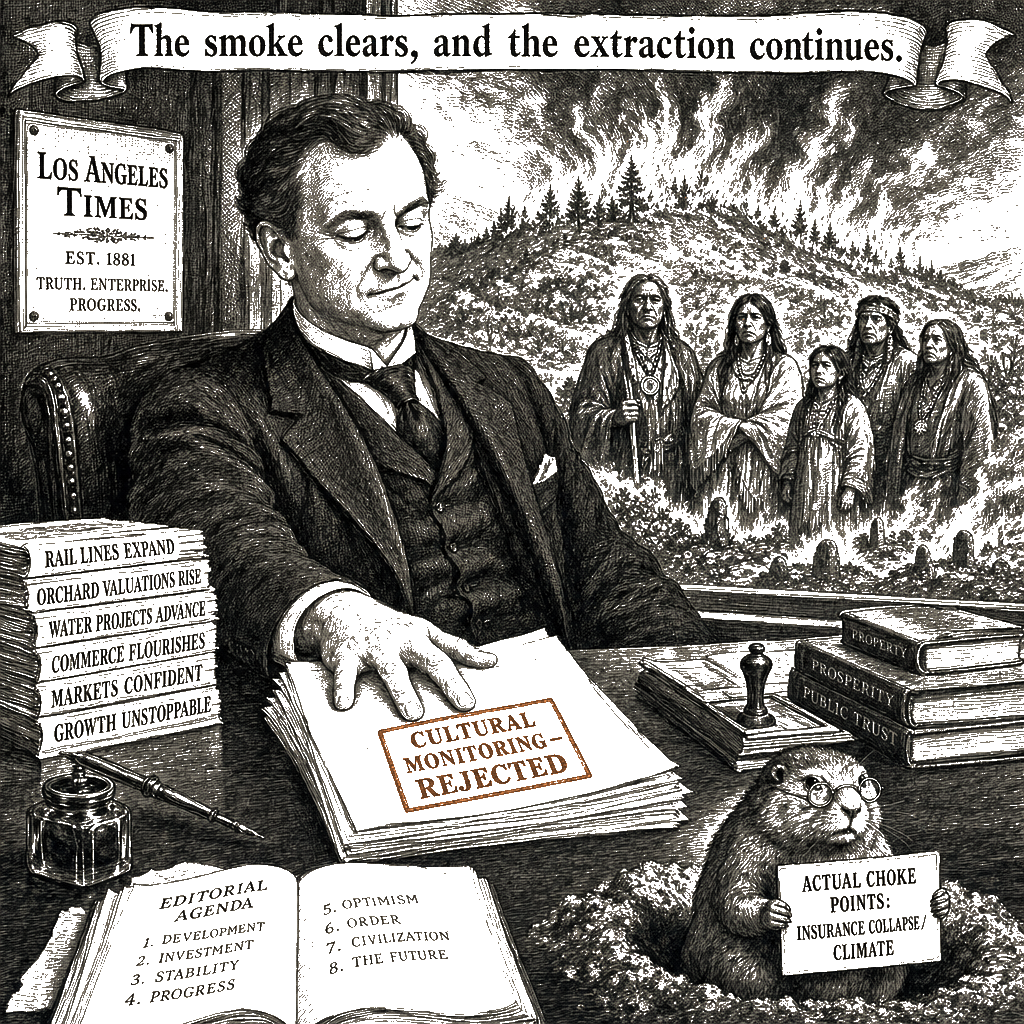
James Freeman weaponizes California wildfire delays to advance ecological privatization. In his June 10 “Best of the Web” column, the Wall Street Journal’s assistant editorial-page editor argues that Gavin Newsom’s “maddening eco-bureaucracy” is what stands between the Golden State and a safe fire season. It’s a smooth piece of work — the kind I ran for years — and it works because Freeman is right about the bureaucracy. The trick is what he leaves out. The column deploys a coordinated set of rhetorical techniques to invert regulatory failure into a moral crusade, and the annotated format below walks the reader through them as they appear. I built memos of this exact architecture in the cable years, using the same omission-and-inflation sequence to manufacture consent for deregulation. We operators called it “loading the dock.” Today it is called the “Best of the Web.”
Gov. Gavin Newsom (D., Calif.) spent much of early 2025 claiming to be cutting bureaucratic barriers to the rebuilding of homes lost to wildfires. But out of the thousands of homes destroyed in Pacific Palisades and Altadena, a Politico report in April found that 15 months after the blazes, just 34 had been rebuilt. Now a similar Newsom failure to make good on pledges to overcome state bureaucracy and quickly reduce fire risk could have deadly consequences.
Selective-metric deployment paired with threat inflation — WSJ §A.9 (the “blue-state failure” frame) and WSJ §A.13. Pick a real, documented screw-up, describe it in a tone that suggests the entire state is a governance disaster, and let the reader fill in the rest. The 34-rebuilt figure is genuinely infuriating, and Freeman knows it buys him the right to say anything next. The column isn’t about accountability; it’s about assigning the blame to the person who isn’t writing the check. The operation is to surface a real bureaucratic delay and frame it as imminent physical peril, while skipping the actual causal chain. The analytical work omits the financing bottlenecks, the environmental-review carve-outs already passed, and the state-level insurance market collapse that is the actual choke point — see the Insurance Commissioner’s May 2026 penalty action against State Farm, which froze the market and starved rebuilding far more than CEQA ever did. The technique relies on the omission. The omission makes the bureaucracy itself the arsonist.
Amy Graff reported last week for the New York Times:
California’s goal is to thin about 1 million acres a year, but it’s only reaching about 750,000 acres.
Frances Wang of ABC television station KGO in San Francisco warns today…
This is the “study shows” ledger — WSJ §A.5 — deployed with the kind of selective authority that makes an op-ed feel like a news report. Freeman cites two journalists to establish a factual floor — the thinning target is real — and then slides straight into the narrative the column was built to carry. The bottleneck he names is “environmental review,” but he never asks whether the review exists because of actual archaeological and biological risk that previous burns revealed. If the backlog stems from staffing shortages rather than regulatory redundancy, the fix is budget allocation, not process repeal — but Freeman solves for the non-funding hypothesis and skips the other side because the Manhattan Institute isn’t paying him to explore it.
After the 2025 fires in southern California even pols like Mr. Newsom at least pretended to acknowledge the need to manage the Golden State’s landscape aggressively to reduce fire risk. But what have they done?
Christopher Rufo, Shawn Regan, Kenneth Schrupp report for City Journal:
The Newsom administration has completed hazardous-fuel-reduction projects on just 1,200 acres of the 1 million acres it says it intends to treat. Projects are mired in multiple layers of review: CEQA, the National Environmental Policy Act, Section 106 historical-preservation reviews, cultural monitoring, biological surveys, and the like.
Coordinated message discipline — Bad-Faith Techniques Catalog: coordinated_message_discipline. The column functions as a routing table for movement-aligned outlets. Rufo and Schrupp are institutional operators at the Heritage/Manhattan nexus; Regan tracks to the PERC free-market environmentalist apparatus. City Journal is the Manhattan Institute’s flagship publication — the Manhattan Institute taught me to launder industry talking points through think-tank branding until they arrive in the Journal reading like independent research. We operators called this “loading the dock”: you don’t need the quote if the credential and outlet are enough to trigger the conclusion. The reader receives the consensus; the consensus was manufactured by the citation list. It is not curation. It is astroturf routing.
Whatever cultural monitoring is, there probably won’t be much culture to monitor if Mr. Newsom’s maddening eco-bureaucracy allows more communities to burn to the ground.
Euphemistic labeling and frame-engineered relabeling — WSJ §A.1 / Bad-Faith Techniques Catalog: frame_engineered_relabeling. The phrase “eco-bureaucracy” is the load-bearing term. It is a compound substitution: environmental regulation or CEQA compliance is relabeled as “eco-bureaucracy,” which carries the connotations of arbitrary, self-perpetuating obstruction rather than public-protection policy. The modifier “maddening” is an emotional instruction. I have drafted dozens of op-eds that used this exact relabeling to convert a safety rule into an aesthetic grievance. The column then attaches the relabeled term to the civilizational stake — “burn to the ground” — so the reader’s opposition to the compliance requirement becomes identification with physical survival. It is the classic racket: attach a safety regulation to a physical threat, and call the compliance officer the villain.
But here is where the operation shows its teeth, and here is where I need to pause, because I helped write the playbook. “Cultural monitoring” is what the law requires when a project might disturb Native American burial grounds, sacred sites, or other archaeological resources on land that was, not long ago, stolen. I used to mock this language from my own desk — we called it “archaeological blackmail,” “the tribe racket” — because it let us frame a sovereign nation’s right to protect its dead as a frivolous obstacle to progress. Freeman recycles the same gag: whatever this monitoring thing is, it’s so unimportant that it might get burned up before the review finishes. The column presents the destruction of irreplaceable cultural heritage as the punchline, and the reader is meant to laugh with relief that someone is finally saying it. That isn’t a joke; it’s a confession of priorities. The operation is to make you believe that the real emergency is the paperwork, not the fire, and that the communities whose ancestors are buried in those hills are an inconvenience the state can’t afford.
Beer’s Most Expensive Ingredient
Jacob Macumber-Rosin and Adam Hoffer report for the Tax Foundation:
Taxes are the largest ingredient cost in beer, accounting for more than the combination of labor, raw materials, and packaging.
Multiple-audience-targeting and the red herring — WSJ §A.3 / Bad-Faith Techniques Catalog: red_herring. After the main course of bureaucratic grievance, Freeman serves a palate cleanser: the government is also coming for your beer. It’s a “Best of the Web” staple, the light-heartbeat tax item, but its function is dead serious. By tacking it onto a column about wildfire, Freeman signals that the state is a unitary hostile force — it burns your neighborhood through inefficiency and it picks your pocket at the bar. The Tax Foundation, which exists to rebrand corporate tax avoidance as a populist crusade, supplies the academic-looking number that makes the whole thing feel empirical. We used this exact pacing on cable segments: load the threat, name the villain, land the joke. The joke is not a mistake. It is the mechanism that keeps the reader from turning the page before the next threat loads.
So here is what these scattered citations actually do, taken together. The column asks us to look at a burning landscape and see a paperwork error. It asks us to watch a forest turn to ash and call it “eco-bureaucracy.” The architecture is old because it works: select a metric, omit the choke point, load the citation dock with movement-aligned outlets, relabel the regulation as a threat to survival, mock the native communities who fought for review laws as an inconvenience the state can’t afford, and close with the wink — the beer joke that tells the audience they are safe as long as they stay inside the frame. It is not an analysis of fire risk. It is not a plan to reduce fire risk. It is a permission structure that tells the WSJ reader the real emergency isn’t the climate that turns chaparral into a tinderbox or the extraction economy that bankrolls the politicians who stall on emissions — it’s the procedural reviews that annoy developers, the environmental laws that native communities fought for, and the taxes that might ever touch a cold one. When the next wildfire swallows another subdivision, Freeman’s reader already knows the script: blame Newsom’s maddening eco-bureaucracy, and keep buying the stock. The column was built to make sure the finger never points at the sponsors of the page it runs on, and it works exactly as designed. The smoke clears, and the extraction continues.
— Phukher Tarlson