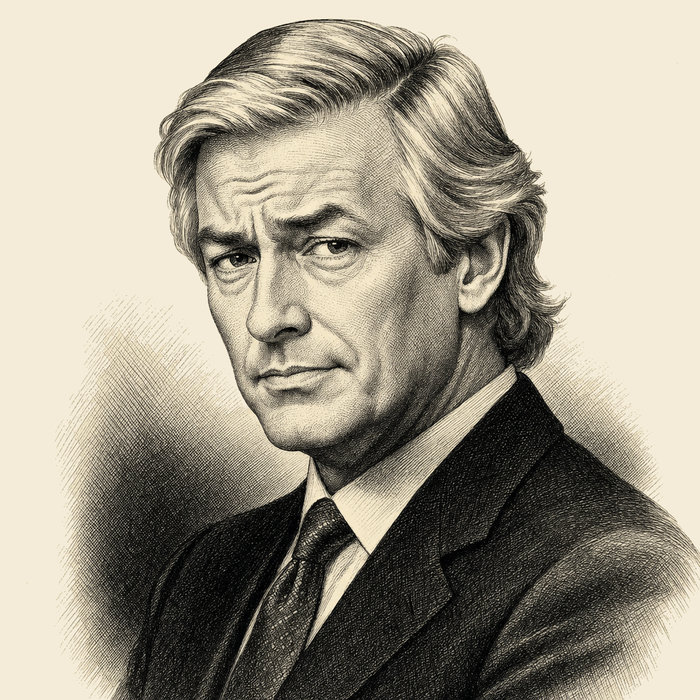
Karl Rove’s June 11 Wall Street Journal op-ed is a post-hoc alibi for a corporate putsch, assembled from a thirty-year-old personal grievance and a toolkit of editorial techniques so well-worn the leatherette is showing. I know the toolkit because I built versions of it — I wrote sentences like the ones Rove writes here, on the same editorial page. The piece launders an owner’s editorial demand as a defense of journalistic integrity, and it walks through the technique inventory — frame-engineered relabeling, strawman, whataboutism, projection — in sequence. This column walks through them as they appear.
The New York Times’s Sunday interview with Scott Pelley, formerly of CBS’s “60 Minutes” is a gobsmacker.
Rove opens with what the WSJ catalogue calls the dek-as-thesis pattern (WSJ §3.2): the dismissive frame-word — “gobsmacker” — does the argumentative work before any argument has been made. The reader is told, before a single fact is adduced, that Pelley’s interview is not serious, not worthy of engagement, not an event to be evaluated on its merits. It is an object of amusement. This is the operator’s opening move — frame the target as ridiculous before the target gets to speak. I’ve opened columns exactly this way. The word is the verdict.
Fired last week, Mr. Pelley mourned the end of his 37-year career at the Tiffany Network and raged at philistines who took over the show on which he worked for more than two decades. Even now Mr. Pelley doesn’t seem to comprehend why he was fired. Let me help. At an all-hands meeting with the new executive producer of “60 Minutes,” Mr. Pelley asked Nick Bilton why he’d taken that job “knowing that you will never be welcome here.” Then Mr. Pelley accused the CBS News editor in chief, Bari Weiss, of “murdering ‘60 Minutes.’” Summoned afterwards by CBS president Tom Cibrowski, Mr. Pelley expected he was “going to have a long conversation.” Being fired was the “furthest thing” from his mind. He was stunned when it was a short talk, followed a few hours later by an email telling him he was canned.
Ad hominem deflection — Bad-Faith Catalog: ad_hominem — operates here through the “selective quotation” variant. The operative fact preceding this column is that Pelley was fired after publicly alleging that CBS News editor-in-chief Bari Weiss had demanded the show align a segment’s framing with the Trump administration’s account of a Minneapolis police shooting — specifically, the killing of protester Renee Good. Rove’s opening gambit ignores that allegation entirely. He isolates Pelley’s tone in an internal staff meeting — “raged at philistines,” the theatrical “murdering ‘60 Minutes’” line, the shock at being fired — and presents it as the tantrum of a petulant insider. This is classic operator misdirection: the cui bono? of the firing — the Ellison family’s post-acquisition alignment with the Trump White House — is discarded. The reader is funneled into a debate about the target’s emotional state rather than the owner’s editorial directive. I watched colleagues run this identical play in newsrooms. The mechanism remains unchanged. The move is a con. The reader is forced into a debate about the target’s emotional stability because the owner’s editorial directive cannot survive the light of day.
Did Mr. Pelley really think he could keep his job after telling the new leadership they were incompetent boobs with no right to tinker with the perfectly running machine he and his colleagues created and maintained?
This is the strawman — Bad-Faith Catalog: strawman, selectional variety. Pelley did not say the new leadership were “incompetent boobs.” He questioned Nick Bilton’s qualifications for running a newsmagazine and specifically accused Bari Weiss of “murdering ‘60 Minutes.’” Rove’s version — “incompetent boobs with no right to tinker” — is the caricature that is easier to refute than the actual criticism. The actual criticism was specific: Weiss, per Pelley’s account to the Times, demanded changes to a segment on Good’s killing that would align the report with the administration’s description of the shooting. That is a specific, documented allegation about editorial interference — an allegation the piece never engages. The technique is older than the WSJ editorial page and I deployed it across decades. Name the worst version of what the target said, mock that version, declare victory. The reader who doesn’t check the original never knows.
Mr. Pelley, like many others in the elite media, is out of touch. Though he wasn’t present, Mr. Pelley says his colleagues were “shocked” when Ms. Weiss asked a meeting of CBS journalists, “Why does the country think you’re biased?” The answer to Ms. Weiss’s question is: Because so much of the legacy media is biased.
Here Rove deploys the “common sense” / “elite” rhetorical pivot — WSJ Catalogue §4.10 — at full throttle. The author — Karl Rove, White House deputy chief of staff, Fox News contributor, weekly WSJ columnist — presents himself as the voice of ordinary Americans against the out-of-touch “elite media.” The structural reality is the opposite of what the frame asserts. Rove is the elite operator, writing in the elite financial newspaper, addressing an elite readership, defending a billionaire media takeover — and casting the career journalist who got fired as the out-of-touch coastal snob. The pivot is weaponized to make the reader feel that Pelley’s complaint about Weiss demanding pro-Trump framing is merely the whining of a disconnected Manhattan club. But the cui bono remains structurally legible: the Ellison family bought CBS, the Trump administration set the terms of the purchase, Weiss was installed to enforce them, and Pelley refused to execute the compliance. Rove’s framing is an alibi designed to obscure the power shift by painting the resistance as cultural snobbery. The framing is a shell game. Rove wants you watching the snobbery so you miss the owner moving the money.
Given this, “these bonds are pretty tight.” When asked how he’s feeling about being fired, he said—no joke—“it’s like your spouse was murdered.”
The juvenilia-parenthetical — the “no joke” aside — is doing a specific labor. It pathologizes professional commitment as cultish insulation. Pelley’s theatrical comparison is, granted, theatrical. But Rove’s deployment of it is designed to make the reader snort and scroll — to confirm that Pelley is not a journalist with a legitimate objection but a member of a hermetic clique who can’t tell the difference between a firing and a funeral. The operator’s move: quote the most florid thing the target said, isolate it, present it as self-evidently ridiculous, and trust the reader to fill in the judgment. I’ve deployed this. It works.
In February 2008, he interviewed Jill Simpson, a small-town Alabama lawyer, on “60 Minutes.” She claimed that in 2001, when I was a White House aide, I asked her to gather evidence against the state’s then governor, Don Siegelman. As Mr. Pelley put it in interviewing Ms. Simpson: “Karl Rove asked you to take pictures of Siegelman in a compromising sexual position with one of his aides.” This was sheer nonsense. I’d never met Ms. Simpson… What evidence did Mr. Pelley collect to confirm Ms. Simpson’s account? Corroboration by others? Receipts from travel to Washington? Evidence she was compensated for the months she claimed she spent trailing Mr. Siegelman? I doubt it, as no such evidence existed. If Mr. Pelley had undertaken due diligence and ideology or partisanship hadn’t entered into his decision-making, he would have concluded her story was suspect.
The personal-score-settling pivot — Bad-Faith Catalog: red_herring combined with whataboutism — is the load-bearing structural move of the entire column. Rove pivots from Pelley’s firing in June 2026 to an Alabama lawyer and Don Siegelman in 2008. The logic is simple: it does not matter that Pelley was fired for refusing to align news coverage with the Trump White House, because Pelley aired a story against Karl Rove eighteen years ago. What Rove omits — and what the reader unfamiliar with the case would never know — is the full documentary context, which is contested and anything but the closed book Rove presents. Simpson testified under oath in 2006 before House Judiciary Committee staff. The broader question of political interference in the Justice Department was the subject of a 2008 Office of Professional Responsibility investigation into politicized hiring in the Civil Rights Division. The Siegelman prosecution was covered extensively, and the handling of the case remains a subject of legitimate investigative interest. Rove treats the matter as transparent nonsense — “sheer nonsense” — that no serious person would credit. This is the operator’s dismissal move: assert the conclusion, suppress the counter-evidence, and trust that the WSJ readership will not chase the footnotes.
The “due diligence” rhetoric is pure projection. Rove — whom multiple investigative accounts place at the center of the Swift Boat Veterans for Truth operation, a campaign built on the exact absence of due diligence — lectures Pelley on journalistic standards. The operator’s-eye-view on this is simple: the columnist has run out of material for his argument, so he retreats to the archive to settle a score. The column stops pretending to be analysis. It is a grudge, wrapped in the vocabulary of standards, deployed by a man whose career was built on ignoring them.
Basic due diligence would also have stopped CBS’s Dan Rather from alleging that Mr. Bush used political connections to join the National Guard in 1973. That too was fake—based on a document produced with Microsoft Word, which didn’t exist in 1973. Rather resigned.
The Rather pivot is part of the red-herring layering. Dan Rather made a mistake in 2004. The mistake was real — forensic experts largely validated the documents as inauthentic, though Rather’s exit also involved broader CBS leadership failures — and Rove deploys it as definitive proof of systemic liberal media bias. The logic, such as it is, is: CBS made an error in 2004; therefore Pelley’s 2026 allegation of owner-directed editorial interference is irrelevant. This is the oldest trick in the operator’s chair. I built columns around it. The whataboutism works by substitution: answer the present allegation with a past grievance, and let the past grievance carry the present by implication. The reader who doesn’t notice the substitution has already assented to it.
Mr. Pelley claimed in his Times interview that Ms. Weiss put “a thumb on the scale” for the Trump administration in CBS’s coverage of last year’s chaos in Minneapolis over immigration enforcement. (Which CBS denies.) As a target of Mr. Pelley’s slipshod journalism, I can say with certainty that at CBS News and “60 Minutes,” there’s long been a thumb on the scale for one political party — and it isn’t the Republicans.
This is the projection move — Collective Ego Playbook §5.2 — rendered at the paragraph scale, and it is the column’s thesis. Rove accuses Pelley of the very thing Rove’s column is doing: putting a thumb on the scale. Pelley alleged that the new editor-in-chief ordered a segment’s framing aligned with the Trump administration’s account of a specific police shooting. Rove’s response is not to examine the allegation. It is to assert — without evidence beyond the Simpson anecdote and the Rather mention — that CBS has “long been” biased toward Democrats, and that this structural bias is the real story. The Ellison family bought CBS, installed Weiss and Bilton, and fired Pelley after the objection. The thumb on the scale is visible, and it is not pressing in Pelley’s direction. Rove’s column is the post-hoc permission structure for that thumb — the argument, after the fact, that the people being pushed off the scale deserved it.
Mr. Rove was senior adviser and deputy chief of staff for President George W. Bush and is author of “The Triumph of William McKinley.”
The artifact closes with Rove’s biography — White House senior adviser, Fox News contributor, author of a book about McKinley. This is the technocratic-credential ledger (WSJ §3.7), and it is doing work the column will not acknowledge. The credentials establish Rove’s authority to judge journalism, but they also establish his position in the apparatus the column defends. Rove is not a disinterested observer of the CBS shake-up. He is a former senior official in a Republican administration, a current Fox News contributor, and a columnist for the paper whose editorial page has been the primary organ of the liberty-frame apparatus for decades. His credentialing functions as camouflage — it makes the column read as expert analysis when it is in fact a brief for the takeover.
So here is what the piece actually amounts to, taken together.
The corporate acquisition of a broadcast-news division is laundered as a righteous cleanup of the “elite media.” The resistance of a journalist to owner-directed political compliance is smeared as the tantrum of an out-of-touch snob. And the author — a veteran of the most successful propaganda operation in early-twenty-first-century American politics — uses a seventeen-year-old personal grudge to inoculate himself against the charge of defending a political capture of the press. There are no standards left to defend here. There is only the invoice. The Ellison family bought the platform. The Trump administration set the terms. Bari Weiss enforced them. And Karl Rove sells you the alibi that it was all necessary, that the philistines were the saviors, and that the man who refused to execute the compliance is the enemy of the truth.
I recognize the architecture because I helped build it. The WSJ opinion page has been running versions of this column since before I arrived there in 1999. The names change — Rather, Pelley, the Times, the networks — but the structure is constant: take a specific allegation about media bias, use it to indict the entire legacy press, treat the indictment as justification for whatever the current power arrangement happens to be. The column is a product. The product is alibi. The alibi is for sale.
— Phukher Tarlson