
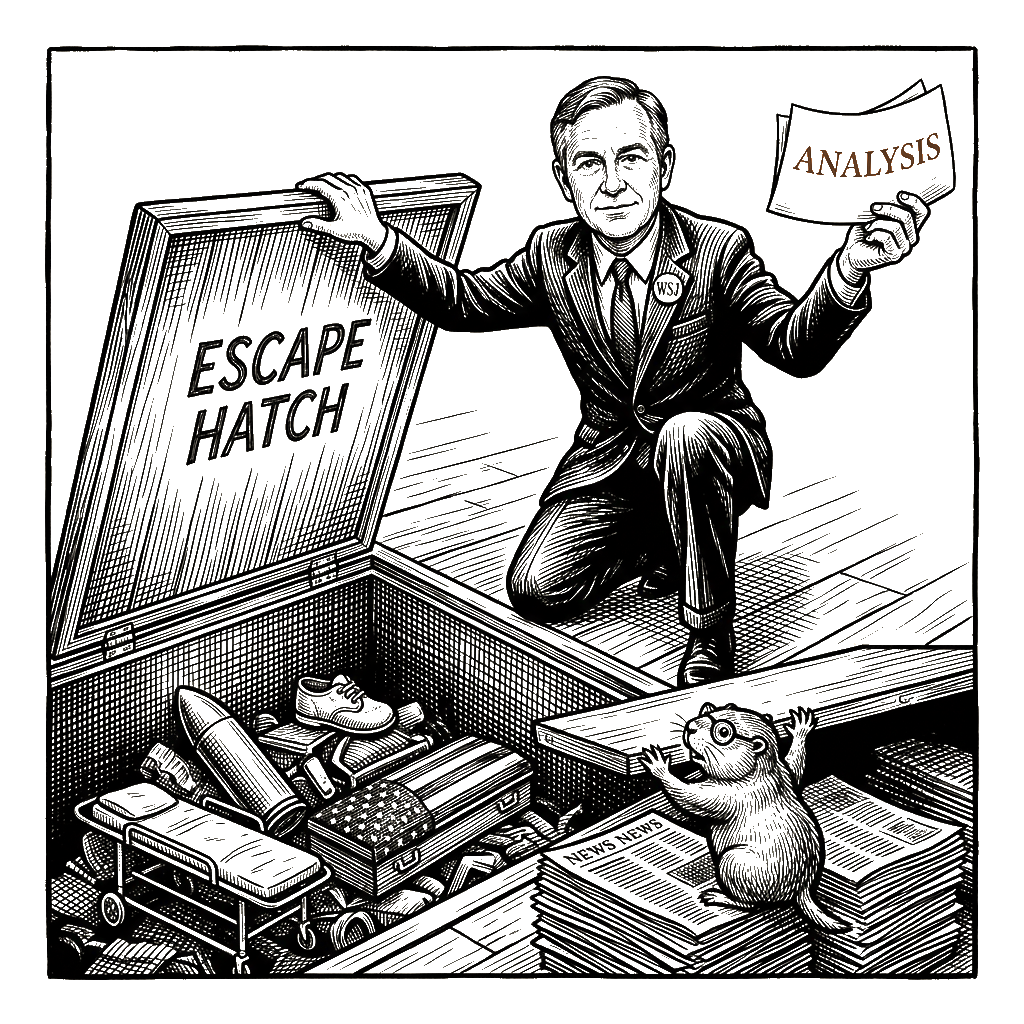
Not one Iranian civilian appears in Holman Jenkins’s column about the war they died in. No American service member, no displaced family, no hospital on a generator. The piece, published on this page on June 15, is about Donald Trump’s political escape from a disaster Jenkins himself encouraged. And it opens with a con.
Jenkins begins by telling you the obvious comparison is beneath you — the Ukraine parallel is dull, “galumphingly” is the word, and you are smart enough to want a better frame. The move is pure advantageous comparison, Bandura’s third mechanism, repurposed as manufactured discriminator: a worst case is invoked to make this one look manageable, and the alternative frame — Trump can walk away, Putin cannot — arrives pre‑stacked as the clever take. The real parallel, the one every commentator who drew it was actually making, is that a leader launched a war on assumptions that did not survive contact with reality and has spent every day since denying, pivoting, and reframing rather than reckoning with what happened. Jenkins doesn’t argue that the comparison is false. He argues that it’s boring. He dismisses the content of the critique and substitutes a frame that flatters his audience’s appetite for intellectual superiority. The piece opens by telling you the obvious is wrong and that the smart take is something Jenkins is about to supply. That is the con.
Jenkins frames the key distinction as one of political survivability: Trump, unlike Putin, can eat crow and walk away relatively unscathed. The move converts the comparison from a moral one — both leaders launched wars on flawed premises — into a strategic one, where the only question that matters is whether the American president can escape the political consequences. The substitution is the operation. The column has already told you what you should be thinking about: not the war, but the exit.
And then the label arrives. “Escape artist.” That word does all the load‑bearing work. In any normal political analysis a president who launched a military campaign that achieved none of its stated objectives — no regime change, no nuclear deal, no reordered Gulf — would be described as having failed. Jenkins relabels failure as performance: Trump is not a failed war president; he is an escape artist. The substitution converts a policy catastrophe into a personality trait, and a negative trait into something almost admirable. Escape artists are clever. They get away with things. The reader who absorbs the label has already absorbed the frame: what happened in Iran is not a consequence to reckon with but a trick to watch.
The catalogue‑as‑dossier material I contributed to the publication documents this as the Wall Street Journal editorial page’s signature technique. Take the policy outcome that would produce accountability and relabel it as something the audience can approve of without engaging the outcome. “Tax relief” for “tax cuts for the wealthy.” “Pro‑growth” for “lower capital‑gains rates.” “Escape artist” for “president who lost a war and walked away.” The mechanism is identical every time. Jenkins performs the relabeling, and the reader receives a word that feels like analysis but functions as permission.
Jenkins concedes that Trump’s wartime leadership is marked by qualities the column itself names as liabilities — unreliability, verbosity, self‑contradiction. He treats those as limited flaws in an otherwise savvy operator — as if “he’s unreliable, untruthful, and impulsive” were useful qualities that just happened to misfire here. In plain language, the man is a liar. He says contradictory things because he has no fixed commitments; he is verbose because the performance is the substance and the policy is the afterthought. Jenkins has told the reader the truth about his subject; he simply hasn’t admitted the scale. A wartime leader whose central quality is compulsive dishonesty isn’t flighty. He’s unfit. Not for the column — for the chair.
The column argues that Trump could have bombed Iran’s oil‑export infrastructure on his way out — and that even a credible threat to do so would have produced better terms from Tehran. The paragraph does more than propose an escalation. It frames maximum destruction as a negotiating tactic rather than a war crime. Iran’s economic lifeline appears here as a legitimate military target. The broader frame is terrifying only if you notice it. Jenkins operates inside the assumption that the United States bombing a foreign state’s economic infrastructure is an acceptable bargaining lever. The only question the column evaluates is whether Trump was wise enough to use it. On planet earth, the question is whether an American president should be threatening high‑civilian‑casualty infrastructure strikes as a negotiating tactic. But that’s not Jenkins’s planet anymore. He already lives somewhere else.
He then suggests Trump pulled back because the American public, while happy to punish private oil companies, cannot stomach attacks on state‑run energy assets, which Jenkins dismisses as sentimental attachment to a model of state socialism that rarely delivers. So the frame is: Americans who didn’t want their president mass‑bombing a foreign state’s economic lifeblood are sentimentalists. Refusing to escalate to full economic‑infrastructure destruction is framed as sodden sentimentality. This is the Cable Jockey’s Hard‑Headedness — confronting military difficulty by imagining a simpler, more volatile military solution, then treating anyone who flinches as unserious. Bombing a country’s oil economy — killing its export earnings, collapsing its ability to supply domestic fuel, starving its hospitals of generator power — isn’t a negotiating tactic. It’s a starvation tactic with a uniform. Jenkins’s column treats it as the more sensible version of Trump’s actual policy, which was already a catastrophic failure whose human costs are still being counted.
And here we reach the deepest layer of the operation. Distortion of consequences — Bandura’s sixth mechanism — is the systematic erasure of who bore the cost. Jenkins evaluates Trump’s Iran war entirely on the axis of American political and strategic positioning, as the column’s own paragraphs demonstrate. The column contains not one word about what the war did to the country it was fought in. No Iranian civilian casualties. No displaced populations. No hospitals on generators. No American service members killed or wounded. None of it. The column’s entire analytical frame is: what did this war achieve for Trump, and what would have achieved more? The human beings who live in the country the war was fought in do not exist in this column. They are the consequences that have been distorted out of view. The reader who finishes this column has received a complete account of the Iran war that does not require them to think about a single person the war harmed. That is the design. The seafood at the Journal’s editorial board lunches doesn’t come with a plate of foreign civilian casualties on the side, so Jenkins can call a ceasefire “a poor cousin” to more bombing and keep eating.
Jenkins also notes that he has spent the past year arguing that impeachment is a live possibility for Trump, and he presents the president’s real strategy now as a bet that his political opponents will overreach in their response to the war’s failure — that Democrats and the press, by attacking him over the disaster, will once again consolidate his base and distract from the policy outcome. Attribution of blame — Bandura’s eighth — operates here to relocate the source of Trump’s political difficulties from Trump to Trump’s opponents. Jenkins builds a sentence structure in which the real strategic challenge is not the war’s failure but the possibility that Democrats and the media will accurately describe the war’s failure. The framing implies that the real threat to ordinary Americans is not a war that cost them money and lives and produced nothing, but rather the politicians and journalists who might say so. The mechanism is the same one Bandura documented in authoritarian propaganda: the source of harm is moved from the actor who caused it to the out‑group that reports on it. Jenkins has been dropping impeachment into his columns for a year. The word is not analysis; it is a frame — a shorthand for the narrative in which Trump is the victim of institutional overreach rather than the author of his own policy failures. In this column, the impeachment frame does its deepest work: it furnishes Trump with a scapegoat. The column gives the audience permission to treat accurate criticism as the enemy and to treat the person who started the war as the person being wronged. It is training the reader to be worse at knowing things.
After twenty paragraphs that systematically erase the war’s consequences, relocate its blame, relabel its failure as cleverness, and furnish the audience with permission to approve of the whole thing, Jenkins closes with an unrelated observation about artificial intelligence and strategic decision‑making, suggesting that leaders would benefit from submitting their plans to dispassionate machine analysis. The remark has no organic connection to the preceding column. It does not follow from the analysis. It exists to give the reader something to walk away with that is not the column’s actual content — something that sounds like wisdom, that feels like a reasonable conclusion, and that requires the reader to think about nothing the column asked them to think about. This is moral justification, Bandura’s first mechanism, laundered through a gesture toward good governance. The closing is a subject change disguised as a synthesis.
So here is what “Trump the Iran Escape Artist” actually amounts to.
Jenkins built you an escape hatch. The war cost Iranian lives, American lives, and it produced no stated objective. You do not have to think about any of that. The column furnishes a vocabulary that converts failure into personality (“escape artist”), a comparison that makes the failure look manageable by asking you to measure it against something worse, a frame that relocates blame from the commander who started the war to the voters who didn’t trust him, and a closing line about AI that changes the subject entirely, letting you walk away feeling you have thought about the war when you have thought about nothing. The only escape Jenkins has described is the escape of responsibility: a system so compromised that one of its seniormost columnists can watch a president‑led catastrophe unfold and conclude not that the catastrophe ought never to have been set in motion, but that the commander’s capacity to evade accountability for starting it is evidence of his political genius. That’s not analysis. That’s pre‑capitulation — compliance with the outcome, dressed by the Financial Press to look like observer status from a writer who was never observing from outside the operation.
The escape artist is not Trump. The escape artist is Holman Jenkins, and the person who escaped is you. The swindle is the swindle at the level of war, and Jenkins ran the same inflation from the same seat from the first draft. A supposed escape is the trap, and the escape artist is the trapper. That is the operation. That is what the WSJ editorial apparatus does when a war goes wrong and the audience cannot be allowed to notice.
— Phukher Tarlson