
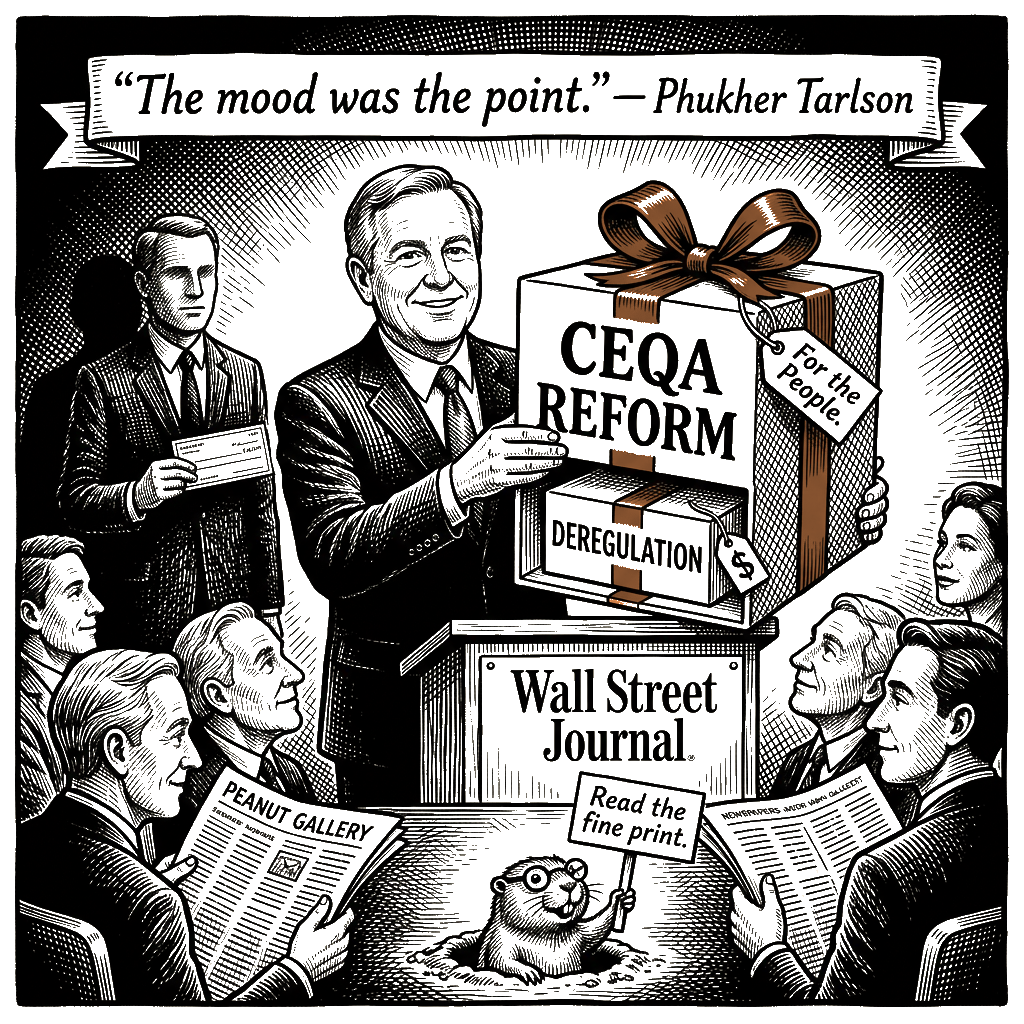
The Wall Street Journal’s James Freeman wants you to believe that California’s premier environmental law is a “weapon of mass economic destruction” that a misguided Ronald Reagan accidentally unleashed on the state. In his June 15 column, he hangs the argument on a new lawsuit filed by a state employees’ union that’s using the California Environmental Quality Act to block Gov. Gavin Newsom’s return-to-office order—a genuinely absurd result that Freeman says reveals the whole statute as “damnable.” A column that opens by promising reform will, the reader assumes, identify specific provisions to change and defend those changes with evidence. A column that opens by promising reform and then never names a single provision is doing something else. What it is doing is building the audience’s emotional readiness for whatever deregulation proposal comes next—from this editorial page, from a think tank, from a legislative package—so that when it arrives, the reader has already absorbed the feeling that the statute is absurd and the reform is obvious. The feeling substitutes for analysis. That is the column’s function.
A misguided state law enacted more than 50 years ago has been ravaging the state’s economy for decades. This hasn’t particularly offended many of the politicians who run the place, but now this Golden State monument to unintended consequences is pitting government employees against environmentalists. The new schism on the political left is yielding an opportunity for reform. — opening paragraphs
Here Freeman opens with the blue‑state‑failure frame: find an instance of mismanagement in a Democratic‑governed state, strip it of context, and present it as the inevitable result of progressive governance. The structure is so familiar I can call it from memory. First, establish the dysfunction as endemic and hopeless—“ravaging,” “hasn’t particularly offended”—then frame the internal left‑on‑left conflict as a fresh opening that might finally do what decades of conservative objection could not. The “opportunity for reform” he dangles is, of course, the dismantling of the environmental review law itself. He’s already planted the flag with “misguided” and “ravaging.” He’s not asking his audience to evaluate whether a half-century-old core environmental law still serves a legitimate purpose; he’s asking them to enjoy watching the left eat itself and then applaud when the thing they’ve hated for years gets taken down. I wrote paragraphs like this in the 2010s. They work because the reader fills in the accusation themselves and feels clever for doing it.
Put simply, the outrageous demands of bureaucrats are colliding with the irrational commands of California climate policy. Something’s got to give. — immediately following
The paired adjectives here are the page’s frame‑engineered relabeling engine running at full tilt. Union demands are “outrageous,” not legitimate or even strenuous; climate policy is “irrational,” not ambitious or costly. The nouns do the rest: “bureaucrats” and “commands” collapse the state’s entire workforce and its environmental statutes into an authoritarian apparat, precisely the picture the Journal’s core audience of high‑net‑worth individuals and business executives wants to see. When Freeman writes “something’s got to give,” the reader already knows what should give; the sentence is a permission slip, not a question. I helped build the message‑discipline drill that produces that verb‑choice. We tested it in focus groups. It read as tough‑minded common sense to the people we needed it to. The adjectives do the work the argument should be doing. This is how you build a column on mood rather than substance: load every noun with contempt and let the reader’s existing anti-government disposition fill in the substance the piece does not provide.
One could offer the same analysis of the whole damnable statute. — paragraph 4
“Damnable.” This is a statute. It has specific provisions—standing requirements, categorical-exemption thresholds, review timelines, environmental-impact-report triggers. A column that opened by promising reform would name the provisions that create the problems the column alleges. This column substitutes “damnable” for specificity and moves on. The relabeling of a regulatory statute as “damnable” and, in the same breath, as a “weapon of mass economic destruction”—that is a frame-engineered relabeling so thorough it makes the original object unrecognizable. The reader who absorbs this vocabulary will not ask “which provision should change?” The reader will ask “why hasn’t anyone repealed this thing?” And that is the question the column wants the reader asking.
Let me be clear about something before I go further. CEQA is genuinely weaponized. Not just by unions blocking office returns—that’s a new one on me—but by wealthy homeowners in the Berkeley Hills who file suit to block apartments, by competitors who CEQA‑bomb a rival’s warehouse to run out the clock on the financing, by anyone with a filing fee and a grudge who’s learned that environmental review is the cheapest delay money can’t buy. That’s real. I’ve watched it happen for thirty years. Freeman’s trick is pretending the only remedy for a law that’s been stretched past recognition is the one his clients want: abolition, not reform. He conflates the misuse with the law itself, then insists the whole thing has to go—without ever naming who gets the windfall when it does.
Gov. Ronald Reagan signed the bipartisan bill into law in 1970 and certainly didn’t intend to create a weapon of mass economic destruction. The gold standard of modern presidents, he made his share of mistakes as a governor, and this one was at the top of the list. Regular readers are familiar with CEQA as a consistent obstacle to housing construction and fire prevention, among other good things.
Reagan’s signature is Freeman’s canon‑inoculation move. By tracing CEQA to a Republican saint, he protects his audience from the discomfort of opposing a law that enjoys broad public support and has, for five decades, blocked or reshaped thousands of projects that would have paved over the state’s remaining open space. The framing—“weapon of mass economic destruction”—is the Journal’s signature excess. It converts a procedural statute that can be gamed into a metaphysical evil, so that any remedy short of abolition looks half‑hearted. And notice the pivot from “certainly didn’t intend” to “regular readers are familiar.” He’s telling the audience that the Journal has done the homework, that the accumulated record is on his side, and that CEQA’s role in blocking housing and fire prevention is settled fact—while skipping entirely the other side of that record, which is that the law also blocked the ConocoPhillips refinery expansion when the California Supreme Court found the company had cooked its emissions baseline, killed the Southern California International Gateway railyard before it could blanket adjacent neighborhoods in diesel exhaust, and for half a century forced industrial polluters to internalize the costs they prefer to dump on the public. I know the trick because I used it. Mention the cost to the in‑group’s preferred projects; never mention the ordinary people who avoid the cancer cluster because the environmental review worked.
Is green virtue achieved by having bureaucrats stay home in their sweatpants? — rhetorical question embedded in the column
The bathos here is precise. Freeman wants his audience to picture civil servants in loungewear, coasting on their home offices while the state’s taxpayers fund their Netflix subscriptions. It’s a miniature of the austerity‑thrift archetype applied to public employees: the suffering of private‑sector workers who “have to report to private workplaces” is framed as character‑building injustice, while the remote‑work flexibility they envy is portrayed as sloth. The image is ridiculous by design, because ridicule is the page’s most efficient way to bypass the substance: the union is arguing that Newsom’s return‑to‑office order violates a procedural environmental law, which is genuinely perverse, but Freeman’s answer isn’t to fix the law’s perversion; it’s to mock the whole exercise and suggest that maybe government workers should just stay home because, after all, less government is better.
On the one hand, it has to be infuriating for people who have to report to private workplaces to be forced to support people who don’t. On the other hand, if regulators are mailing it in from the TV room instead of sitting at a desk without distractions, the result may be less harassment of individuals and private businesses. — paragraphs 9–10
This is the column’s most revealing passage. The “one hand / other hand” structure performs balance while doing something very specific: it acknowledges the taxpayer’s legitimate frustration, then pivots to a joke about regulatory capture. Regulators who work from home are both parasites—consuming tax dollars while absent—and a relief—because when they are absent, they cannot regulate. The column does not notice the contradiction. It is selling the feeling that government employees are a burden and that their absence is a benefit, in the same paragraph, to the same reader, without asking the reader to choose between the two claims. The reader who laughs at “sweatpants” will not notice that the column has given them permission to hold two incompatible beliefs simultaneously. This is the anti-government mood engine working exactly as designed: the column does not need the reader to believe anything specific. It needs the reader to feel that government is absurd. The feeling is the product. The feeling is all it delivers.
As the old saying goes, thank goodness we don’t get all the government we pay for. — paragraph 10
This line, positioned just before the close, is the permission structure landing. Freeman has spent the column establishing that government employees are lazy, environmentalists are irrational, and CEQA is a wrecking ball. Now he tells the reader that the dysfunction is, on balance, a good thing—because a government that can’t enforce regulations is a government that can’t bother the reader’s business. The “old saying” is folksy cover for the column’s genuine argument: environmental enforcement is harassment of “individuals and private businesses,” and the less of it there is, the freer the economy. Freeman doesn’t say that outright; he lets the wink do the work, because he knows the wealthy subscriber reading on their iPad understands that “harassment” means reporting requirements, emission limits, and the water‑quality permits that cost money. I’ve written the wink. I know how it moves through the financial district. It sounds like wisdom. It is a permission structure: the reader who accepts this premise does not need to evaluate any government program on its merits, because the absence of government is always preferable to its presence. This is the axiom underneath every column of this type—the unexamined starting point that does all the argumentative work the piece’s substance should be doing and is not.
The Boston Police Department reports on an arrest in an armed robbery case: — paragraph 12
A non-sequitur. A police dispatch from a different city, on a different topic, appended to a column about California governance. The piece opened by promising CEQA reform and has now landed at a Boston crime report. This is the column revealing its own structure: it was never a sustained argument about a specific statute. It was a collection of items—California governance, state-employee remote work, a government-is-absurd aphorism, a crime report—assembled into something that reads like a column the way a newsletter reads like a column. The reform promise from the opening is four paragraphs and a police dispatch away, and it has not been heard from since.
Here is what the column actually does, taken together.
He shines a spotlight on a union that has found a genuinely ludicrous way to weaponize an environmental statute, then immediately pivots to argue that the entire statute must be scrapped—all without once naming the class of interests that would profit from its scrapping. The union’s lawsuit, in his hands, becomes a prop in a much larger operation: a campaign to convince the court of public opinion that CEQA is the enemy of “housing construction and fire prevention,” not a shield that blocked ConocoPhillips from expanding its Rodeo refinery with a fudged emissions analysis, that killed the Port of LA’s SCIG railyard before it could impose its diesel exhaust on the adjacent neighborhoods, that for five decades has forced industrial polluters and sprawling developers to internalize the costs they prefer to dump on the public. Freeman feigns concern for taxpayers while delivering the deregulatory gift his corporate audience paid for, wrapped in a bathrobe gag.
He knows what he’s doing. I know what he’s doing because I built versions of this move for fifteen years: isolate one genuine absurdity in a law the donor class loathes, frame it as representative of the whole statute, and then insist the only fix is abolition while never uttering the name of the client who’d pocket the windfall. This is column-as-pre-market-testing. Political operatives know the technique: float the mood, measure the response, then ship the proposal the mood has already prepared an audience to accept. Freeman is not selling the reform. He is testing the market for the reform. And the market is responding.
The fifty-year-old statute he calls “damnable” and a “weapon of mass economic destruction” remains in his column entirely unscathed—not because he could not attack it, but because the attack on the statute was never the point. The mood was the point. The mood is what ships. The mood is the operation’s product. Read the column a second time and the fraud is impossible to miss: a promise of reform in the first paragraph that never arrives, while the mood-work hums underneath the entire piece and outlasts it. The gap between the promise and the delivery is the column. Everything else is atmosphere.
— Phukher Tarlson