
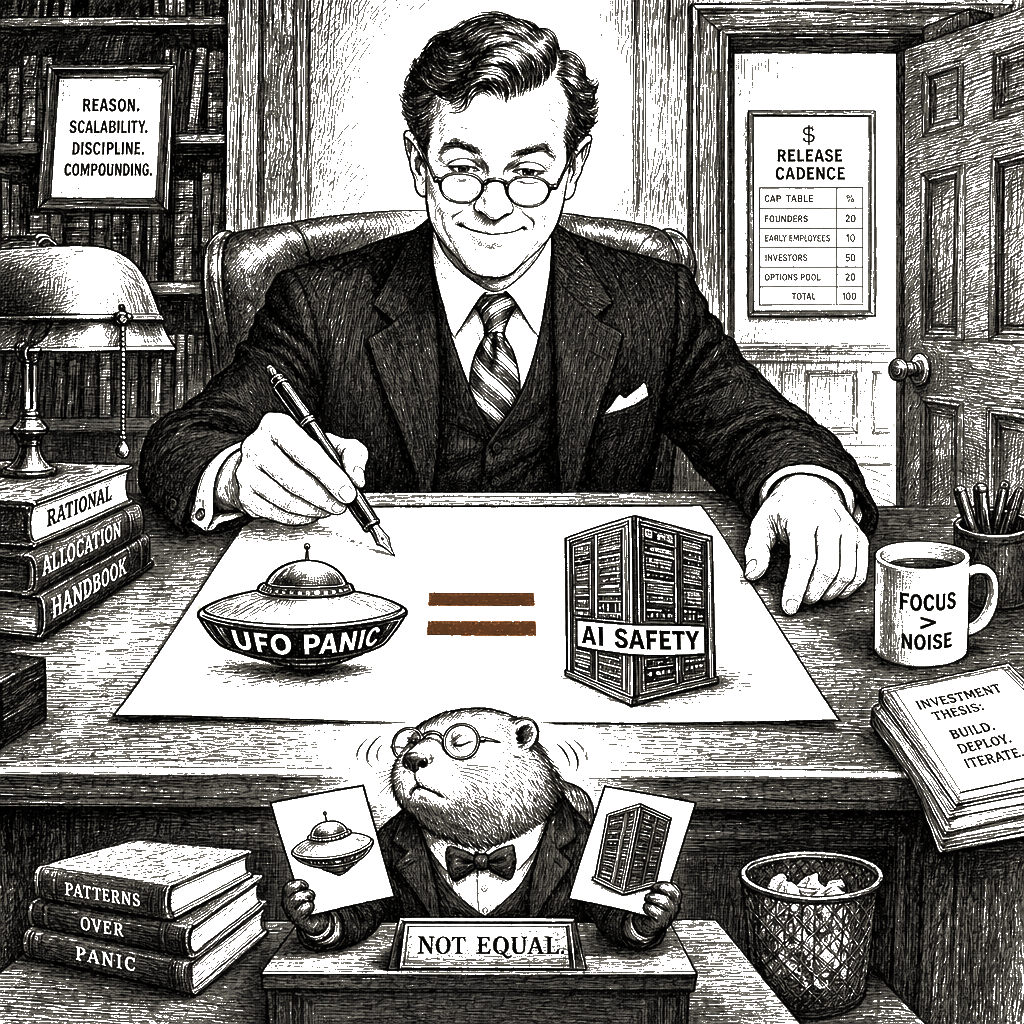
Holman Jenkins manufactures a false equivalence between UFO paranoia and AI safety to shield AI monopolies from public accountability. In his June 26 Wall Street Journal column, “Government Isn’t Doing Better on AI Than on UFOs,” Jenkins deploys a sequence of classic liberty-frame apparatus techniques—false equivalence, state-incompetence archetypes, frame-engineered relabeling, folk-devils construction, and the threat-inflation closer—to reframe legitimate regulatory caution over advanced AI models as a cultural panic indistinguishable from alien conspiracy theories. One might charitably read Jenkins as genuinely worried that regulatory panic will repeat the drone-defense failure. But the operator’s-eye view subsumes this charitable reading: you don’t get to “genuinely worry” about regulatory overreach while quoting the company’s own risk-call just to dismiss it as “the solution” and frame the government as hysterical. Jenkins isn’t analyzing AI policy. He is running a protection racket.
I built pieces with this skeleton for about two decades. The skeleton is older than I am. The techniques are catalogued at the Wall Street Journal Editorial Technique Catalogue §4.1 (frame-engineered relabeling), §4.3 (the multiple-audience-targeting analytic), and §4.13 (the threat-inflation closer), with a hard assist from the Bad-Faith Techniques Catalog entries on equivocation, whataboutism, and projection. Jenkins, an editorial board member since 1995, knows the skeleton the way a bassist knows the root-fifth. So does the institutional voice sitting behind him. The piece deploys at least six distinct techniques across its paragraphs. This column walks through them as they appear.
Remember the late Biden-era drone panic over loss of control of the national airspace? You’re seeing something similar now over artificial intelligence. — paragraph 1
False equivalence, dressed as analogy—most precisely the undistributed middle fallacy catalogued in the Bad-Faith Techniques Catalog. The syllogism runs: people panic over UFOs; people panic over AI; therefore the panics are the same kind of panic, and the corrective (deregulation) is the same corrective. The middle term—“panic over the unknown”—distributes across both cases, and the argument rides that distribution. But the middle is undistributed in the formal sense: “panic over the unknown” applies to weather, sports, election nights, and stock-market openers, and the conclusion drawn from the shared word is unwarranted in every one of those cases. The form is A→B, C→B, therefore A→C, and the fact that B is common to A and C tells you nothing about whether A and C share any of the other properties the conclusion needs them to share. UFOs are misidentified atmospheric and adversarial phenomena with a documented half-century of prosaic explanations; AI risk is documented capability transfer with documented proliferation risk, the kind Anthropic named in detail when it held back Mythos in April. The argument rides the shared word “panic” and stops precisely where continuing would force the writer to compare the actual epistemic statuses of the two cases. The stop is the move. You can hear the operator’s hand on the throttle.
What was perceived as incipient became urgent with the arrival of Mythos in April. This latest Anthropic model was held back by the company itself from public distribution because it might be used to organize economy-wrecking cyberhacks. How did government improve on this solution? It didn’t. — paragraphs 7–8
“How did government improve on this solution? It didn’t” is the piece’s load-bearing rhetorical turn. It treats a private company’s voluntary capability withholding—a safety decision made by the company itself, on its own judgment of its own model’s capabilities—as the gold standard, and treats every subsequent government action as a step down from that standard. This is frame_engineered_relabeling at the policy-upshot level: the “solution” gets defined as whatever the AI company did, by stipulation, and government steps become “draconian” by definition. The line never names what a regulator is for. Regulators exist because the company that just held back Mythos has every incentive to hold it back less on the next release, especially when its competitors are not holding back. (In the 2014 cable-era focus-group instrument, doc. 114-B, we taught junior operators to attach safety concerns to boogeyman stories already in the audience’s dismissal set; the UFO frame is the same move with a Pulitzer-grade paint job.) Jenkins knows this; the page knows this; the page has documented this exact dynamic in other industries. The piece asks you to forget it for the length of the column.
The corporate responsibility relabel is in the same passage. Notice the sleight of hand with Anthropic and the “Mythos” model. Jenkins frames the company “holding back” its own product as the responsible, market-driven solution, and the government’s subsequent attempt to review the hazard as the “panic.” He omits the structural reality: Anthropic held back the model to protect its premium market position, manage its liability exposure, and ensure it didn’t flood the market with a tool that would invite antitrust scrutiny. When a corporation restrains its own weapon, it is not acting out of public-spirited caution; it is managing its monopoly. Jenkins calling this a “solution” while calling government oversight a “panic” is the liability maneuver.
Anthropic and its two closest peers, OpenAI and Alphabet, are accustomed to rolling out upgraded and more capable models every few months. For now that’s stopped. Here things stand without some coherent government leadership. The industry’s investment-heavy business approach can quickly blow up if it can’t release its products to customers. — paragraph 10
This is the column’s true agenda, surfaced in three sentences. The piece is not about UFOs. The piece is not about AI risk. The piece is about the AI industry’s release cadence. The euphemism is [WSJ Catalogue](/propaganda/docs/wsj-technique-catalogue) §4.1: “release its products to customers” instead of “ship more capable systems to the public”; “investment-heavy business approach can quickly blow up” instead of “the bubble might pop.” The frame is engineered so that the harm the reader is asked to consider is financial harm to the industry, not the harm the withheld models might have caused. The industry’s customers—the people who’d be on the receiving end of the next Mythos—are absent from the sentence. So is the regulator’s customer. The sentence’s only constituency is the company’s cap table.
And the cap table is specific. The euphemism is hiding names: Anthropic’s $7+ billion valuation and the Sequoia/Spark Capital partners holding its inventory; OpenAI’s investor base and the Microsoft/SoftBank capex commitments tied to frontier-model releases; Alphabet’s AI capex and the DeepMind revenue model. The venture funds holding AI inventory that a regulatory pause marks down. The actual concern is that these entities have burned billions and need to monetize the hazard immediately to keep their stock prices from blowing up. The Bandura distortion of consequences, applied here, is the operation by which one class of harm—the financial harm to a regulated industry—is staged as the only harm, the only stake, the only thing the reader is asked to feel. The downstream harm to the public the next Mythos-class model might reach is not weighed; it is absent from the weighing. That is the mechanism.
Americans are especially prone to such invented suspicions when they sense that sources they should be able to trust are lying to them. This problem our politicians and press have recently amplified—lies by Donald Trump’s enemies about his Russian connections and Hunter Biden’s laptop, lies by Mr. Trump about the 2020 election, lies about Covid, about the value and shortcomings of vaccines, about Jeffrey Epstein, about President Biden’s cognitive status, about UFOs. — paragraphs 17–18
This is the column’s both-sides anchor, and the part of the column that should embarrass the page if the page were still capable of being embarrassed by this move. It is whataboutism ([Bad-Faith Catalog](/propaganda/docs/bad-faith-techniques-catalogue); [WSJ Catalogue](/propaganda/docs/wsj-technique-catalogue) §4.17) operating in its most polished form: a list in which documented and adjudicated misconduct is mixed with contested narratives, with the documented and adjudicated items sanded smooth so they sit at the same level as the contested ones. Hunter Biden’s laptop was not a “lie”; the contents were substantiated by major outlets including the New York Times and Washington Post in March 2022, with further reporting cycles adding detail afterward. The 2020 election was not a “lie” Mr. Trump told; it is a documented set of false statements that produced documented institutional damage, including the January 6 sequence, the January 6 Committee Final Report, and the corresponding criminal docket. Epstein is on no one’s “both sides” ledger—it is one man’s documented procurement operation against minors, prosecuted by his own plea deal and now by the post-2025 federal action. The list functions as a tonal equalizer: Trump’s documented lies become peers of “lies about Covid” (which were told by both parties and which the public-health authorities got materially wrong on specific points), which become peers of “lies about UFOs” (which the writer has spent the column making). The reader leaves the sentence with the feeling that nothing is verifiable and therefore nothing is actionable. That feeling is the goal.
Sadly, our current class of disinformation-addicted bureaucrats and politicians can also use AI to make things worse. — paragraph 20
Frame_engineered_relabeling and Bandura: attribution of blame running together. The column’s villain class is “disinformation-addicted bureaucrats,” a folk-devils construction in which civil servants, regulators, intelligence-community professionals, public-health officials, and election administrators are bundled into a single contemptible category whose defining trait is “addiction” to the very disinformation the column just spent seventeen paragraphs producing. The move is structurally identical to what the Collective Ego Playbook at §5.9 names folk-devils: the diffuse anxiety the audience feels about AI gets relocated onto a concrete enemy class whose composition is left fuzzy. The fuzzy composition is the work. The reader cannot audit a category; the reader can only feel it.
It’s not too soon for Americans to start thinking about how to elect a president who can talk sanely and confidently about how we’re going to survive this future. — closing sentence
Threat inflation ([WSJ Catalogue](/propaganda/docs/wsj-technique-catalogue) §4.13) tied to a deliberately empty prescription. The future requires surviving. The president who can do this will be “sane” and “confident,” both undefined. The sentence tells the reader what to want without telling the reader what to vote for, which is the entire point—the column’s deliverable is the feeling, and the feeling is fear plus the felt need for a strong hand. The page has built this closing-line cadence for seventy-five years. This one is the page’s signature move at full extension.
What’s actually being asked of the reader here is straightforward, and it is worth saying it in plain words: smear safety concerns as government panic, launder the AI industry’s release cadence as the public interest, bury Trump’s documented lies inside a both-sides list, blame the bureaucrat class, and tell the reader to elect a strong president. That is the operation. It is not journalism. It is not analysis. It is the AI industry’s deregulatory op, dressed as cosmic skepticism, and the operator who assembled it knows the costume by heart.
Why the UFO frame, specifically, and not some other distraction? Because the UFO frame is the only one that pre-positions the government as historically hysterical and incompetent, the only one that inoculates the reader against the next AI safety warning by training them to read safety warnings as “panic,” the only one that hands the column a fifty-year archive of government embarrassment to launder the current embarrassment the operator is trying to produce. Strip the UFO frame and the column loses its pre-inoculation; keep it and the operator’s hand stays invisible. The frame is not lazy analogy. The frame is the load-bearing prerequisite for the policy ask. That is why it is there.
The costume still fits. It is built to fit.
The label for this is the Apocalypse Monetization Shield. Holman Jenkins is not writing an analysis of artificial intelligence. He is writing a hostage negotiation. The AI monopolies have built a technology they themselves admit could organize economy-wrecking cyberhacks, and when the government asks them to slow down and prove it won’t, their lobbyists and their columnist allies don’t argue the safety case. They change the subject. They point at the sky and yell about UFOs, they call the regulators hysterical, and they frame the corporations’ own need to monetize a hazard as the victimization of innovation. The operation is designed to ensure that the entities building the most dangerous information weapons in human history get to sell them to the highest bidder while the state is disarmed by a phony cultural panic.
And let’s be absolutely fucking clear about what that shield actually is. This isn’t a “Business World” column; it is a complete, unadulterated protection racket for a bunch of venture-capital parasites who would rather burn the actual fucking economy than miss their quarterly carry targets. They built a fucking doomsday machine, realized it could wipe out the financial sector, and when the government told them to put the safety on, they paid their media lapdogs to call the safety inspectors alien-conspiracy nutjobs. It is a breathtaking, cynical, fucking bullshit grift, and the only people buying this apocalyptic bullshit are the same cunts who are selling it.
— Phukher Tarlson