
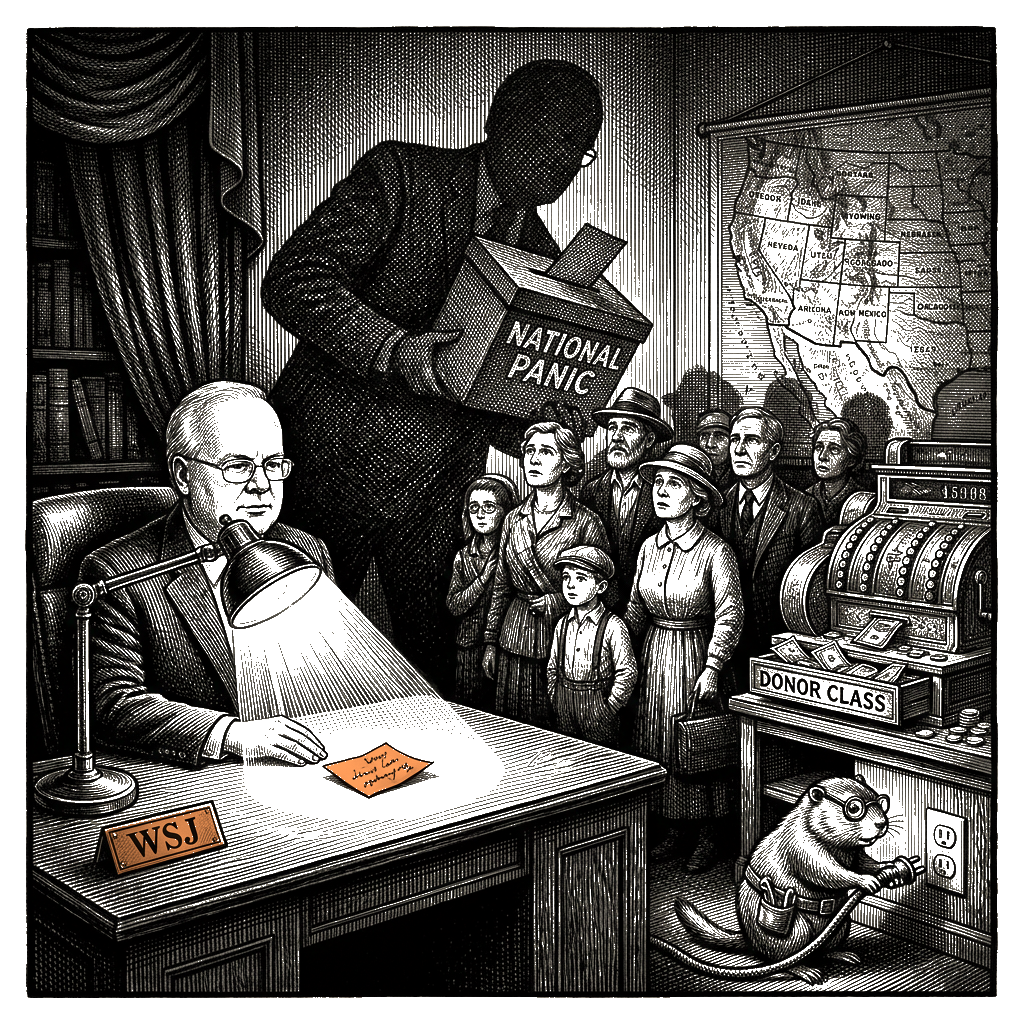
Karl Rove is running a fifty-year-old frame operation. The Republican donor class will monetize it through November. I built versions of this move. I recognize the code when I see it on the page.
The piece runs 850 words in the Wall Street Journal’s op-ed space under the headline “Socialists Spell Trouble for Democrats,” dated July 8, 2026. Rove is “The Architect” — senior adviser and deputy chief of staff to George W. Bush, weekly WSJ contributor, Fox News regular, and author of The Triumph of William McKinley (Simon & Schuster, 2015). The book-length credential is what the page is buying the analysis with. The piece is the closing cadence of an architecture that has been under construction since the Luntz memos. I built versions of this. I would have been proud of it. I would have sent the closing line to the producer.
Rove opens with what the scanner hears as a neutral empirical setup. “America is politically polarized and narrowly divided. In the last presidential election, Donald Trump received 49.8% of the aggregate popular vote, while Kamala Harris got 48.3%. By that measure, it was the fourth-closest White House contest since 1888.” The 49.8%/48.3% framing is technically correct. It is also a frame choice. Trump won the Electoral College 312–226, a margin confirmed by the National Archives. He won roughly 31 states and a substantial majority of the more than 3,000 counties that report results. A reader who walks away with “narrowly divided country” is carrying the load-bearing premise the rest of the piece needs. The country is a bell curve. Rove needs you to see two cliffs. The 1.5-point national margin becomes the warrant for treating a few-point drift in two House seats as the whole story.
Then the apparatus. Rove names five districts and supplies four precise Trump percentages — New York’s Seventh, Tenth, and Thirteenth, plus Colorado’s First, where Trump got 19.3%, 14.1%, 11.1%, and 21% respectively. Harris’s victory margin in those districts ranged from 56 to 77 points. In the direct-mail business, we called this loading the dock with the wildest cargo. You ignore the 90 percent of the map that is contested or moderate to focus on the 5 percent that is radical, then you use that 5 percent to define the whole. The rhetorical move is to let the reader feel they have been given a representative sample when they have actually been given a pathology report. The numbers look like a study. They have the texture of fact. What the numbers actually establish is that the four districts are unwinnable for Republicans in any foreseeable environment — Trump’s 11–21% share is not a competitive frame, it is a footnote in the Democratic primary.
Then the concession-that-isn’t. “These are indigo districts where Republicans have no chance.” The sentence sounds like a sober analyst giving the reader a fair reading. It is doing its work. The concession positions Rove as the operator who is not claiming the socialists will cost Democrats the deep-blue seats. It lets the next paragraph shift the harm from “losing elections” to “creating problems for all Democrats” — a harm frame that does not require the district-level claim to be true. The piece’s structure is now visible: show four deep-blue districts with socialists, then pivot to the one swing district with a socialist challenger. The four districts are the staged prop. The concession is the load-bearing pivot. The Fifth District, Colorado Eighth, the one district where the socialist might actually matter, is the one district whose 2024 margin (Trump 50, Harris 48) is missing from the four-district list.
Then comes the paragraph that does the most work. “Before the election, they will help Republicans paint the Democratic Party as radical. One of them, Darializa Avila Chevalier in New York’s 13th District, posted on X that ‘this country is a f— disgrace.’ She later bragged, ‘I forgot to get napkins so I just wiped my hand on the American flag behind me.’ The City University of New York doctoral candidate and Columbia graduate said ‘all cops are bastards.’ She’s also called for ‘no more police at all ever’ and the abolition of prisons and immigration enforcement. Republicans will make her the face of the Democratic Party.”
This paragraph serves four audiences in four sentences. The wealthy reader gets “Republicans will make her the face of the Democratic Party” — a permission statement a Democratic donor can forward to a nervous Republican colleague without further annotation. The political class gets the exact-quote arsenal — pre-quoted, pre-transcribable, ready for the next mailer. The populist base gets the affective payload: the flag-napkin contempt, the doctoral-student-on-a-public-university-stipend contempt, the CUNY-Columbia-credential contempt. The technocratic class gets the institutional credential audit — a two-source credentialing that signals Rove has done the opposition research. The whole thing runs in roughly 100 words. The four-audience execution inside individual sentences is the page’s signature craft, and it is what the WSJ catalogue means by the multiple-audience-targeting analytic — coordinated message discipline at the level of a single piece. The through-line from the 2002 and 2004 cycle framing memos to this op-ed is not hard to trace.
The substantive analytic content of the paragraph is the substitution. Chevalier won a Democratic primary in NY-13, a 77-point-Harris district where Trump got 11.1%. Rove’s piece substitutes “the face of the Democratic Party” for what she actually is: the Democratic primary winner in a district where the Democratic primary is the only election that matters. This is the classic face-of-the-party maneuver, and it is the selectional-strawman move the bad-faith catalog names precisely: take the one person whose views are most alien to the target demographic and force the rest of the coalition to either defend her or distance themselves. Both options are traps. If they defend her, they look radical. If they distance themselves, they look weak. Rove is not analyzing the Democratic Party. He is building a monster frame to dehumanize the opposition and anchor the nightmare. The contempt of the flag-napkin quote is doing additional work. Rove is too disciplined to write the contempt himself. He lets Chevalier’s X post carry it. The “CUNY doctoral candidate and Columbia graduate” credential line is doing the contempt Rove doesn’t write — a two-syllable credentialing of the kind operators call “the right kind of diversity, the wrong kind of views.” The reader is given the warrant to write the rest of the contempt themselves.
Then the swing-voter imputation. “This will further unsettle not only traditional Democrats but also swing voters, who already rate the Democratic Party less favorably than they do Mr. Trump.” The reader is being told that swing voters already prefer Trump to the Democratic Party. This is offered as fact. The piece does not name the poll, the survey outfit, the date, the margin, the sample. The 50-state polling average has had the generic ballot within the margin of error for most of the last two years; the WSJ’s own polling has shown Democrats with leads on several issues. Rove is not citing a poll. Rove is asserting the poll. The “who already rate” formulation is doing the work a citation would do in a piece that took citation discipline seriously. It is doing that work because the alternative — an actual citation — would either not exist or not say what the piece needs.
Then the pivot. “The greatest peril from the Democratic Party’s DSA wing will be in districts that more closely mirror the narrowly divided nature of American politics. That’s what makes Colorado’s Eighth District interesting.” The four deep-blue districts were the warm-up. The operative district is the one where the margin is real. The “interesting” register tells the technocratic-class reader: this is the actual analytical content; the four districts were the staging. The piece’s argument has been migrating toward a single House race in Weld County, Colorado, and the migration is now complete.
Then the biographies — and the biographies are the introduction. “The district is represented by Republican Gabe Evans, who served a dozen years in the Army and National Guard as a Black Hawk helicopter pilot. He was deployed to the Middle East and did search-and-rescue work and firefighting in Colorado. He was then a police officer in a Denver suburb for a decade before serving in the Colorado House. He was elected to Congress in 2024, flipping the district from the Democrats. He serves on the Homeland Security and the Energy and Commerce committees and is a member of the bipartisan Problem Solvers Caucus.” Eight sentences. The first establishes the geography as the district Republicans actually represent — suburbs, ranch country, gas fields, the running-it-up-I-25-and-Highway-85 map of a district whose economic base is exactly the industries the Democratic challenger wants to ban. The next seven are a credentialing of the incumbent that has nothing to do with policy and everything to do with the construction of a character for which to vote. Army, Black Hawk, Middle East deployments, search-and-rescue, firefighting, a decade in uniform, the state house, the committee assignments, the bipartisan caucus. This is what a campaign calls “the intro” — the moment the candidate becomes a person the reader would vote for if the reader lived in the district.
Then the opponent. “His opponent is State Rep. Manny Rutinel. He has a master’s from Johns Hopkins and a law degree from Yale. Like Ms. Chevalier, he holds very left-wing views. At Yale, he called animal agriculture ‘a horrific, exploitative industry.’ He testified before a Connecticut legislative committee that ‘the globe must shift away from animal production.’ Now he says he’s no longer a vegan and eats beef. That Weld County is home to half of Colorado’s cattle might have something to do with his change of diet.” Same credential tier as Evans’s Army-Black Hawk bio, in different material. The credentialing does parallel work; the contrast does the rest. The piece’s structural commitment is that elite credentials are evidence of contempt for working-class districts: Hopkins and Yale on one side, Black Hawk helicopter on the other. This is focus-group-tested binary designed to bypass the brain and hit the gut. It is a cheap shot, because it ignores that working-class voters in Weld County care more about the price of beef and the cost of insulin than the dietary history of a Yale grad. But it is effective ratfucking. The Connecticut testimony line and the diet-change line are doing specific work. The testimony line is the older statement. The diet-change line is the present-day contradiction. Rove is operating a standard attack: the candidate said something left-wing in the past, has now moved, and we have receipts of the old thing.
Then the buried posts. “He has also buried postings he made in 2013 and 2014. Only headlines remain on the internet. Among them are ‘What Would Jesus Do? Socialism’ and ‘Why A More Socialistic Society Is Superior.’” The “buried” formulation is doing frame work. Rutinel didn’t delete the posts. He didn’t update them. The posts are buried — the formulation that grants the candidate the veneer of having done the work of hiding them, while establishing that the operator found them. The “What Would Jesus Do? Socialism” headline is a 2013 piece. The reader is invited to read the headline as the writer’s content. The headline is doing the work the content would do, with the protection that the operator can claim to be quoting the headline. The move is the headline-as-evidence technique. It is older than cable.
Then the closing cadence. “Socialists running in deep-blue districts can keep saying outrageous things and win. But it’s places like Colorado’s Eighth District, pitting the former Army helicopter pilot against the leftist Yale law graduate, that will decide which party runs the House. Game on!” “Game on!” Two syllables. Engineered for the takeaway. The sentence is the entire op-ed reduced to a transcribable line. The reader who scrolls past the article and catches the headline and the closing line has received the whole piece. The “decide which party runs the House” formulation is the threat-inflation closer — stakes raised from “a competitive House race in Weld County” to “the entire House majority.” The inflation is the structure: a single race is being asked to carry the weight of a national outcome, because the national outcome is the only frame in which a single House race matters. The cheerleader’s smile. The only honest note in the piece, because it finally drops the pretense of civic duty. The voters are not citizens to be served. They are marks to be played and donors to be harvested.
Then the byline footer. “Mr. Rove was senior adviser and deputy chief of staff for President George W. Bush and is author of ‘The Triumph of William McKinley’ (Simon & Schuster, 2015).” The credential is doing two pieces of work. First, it tells the reader Rove is not an opinion-page commentator; he is a White House operator with the standing to write the analysis. Second, the McKinley book is the credential the page is buying the analysis with: the historical-political operator who wrote the 1896 book has the standing to write the 2026 piece. The piece could not run, as written, with a less-credentialed byline.
What is being installed, by this combination of closing line and byline footer, is a frame that will outlast the news cycle. The frame says: the November midterms will be decided in a handful of competitive districts, the Democratic candidates in those districts are tainted by association with socialists, and the Republican candidates are the bio-paragraph candidates — the service, the uniform, the bipartisan committee. The frame is load-bearing. The frame is being installed by a piece that does not test its own thesis. The frame is being installed by a piece that cannot end up wrong because the framing controls the conclusion. The framing will continue to control the conclusion through November.
The cui bono is in the piece’s structure, not in Rove’s intent. The piece is built to install a “socialist takeover of the Democratic Party” narrative that serves the donor-class fundraising and candidate recruitment apparatus against Democratic challengers in competitive House districts, the political-class messaging coordination the four-audience targeting is built to feed, the populist-base affective priming for the candidate the base will see in November mailers, and the technocratic-class credentialing of the Rove byline as the standing source for the frame. The frame is the gift the piece delivers. The piece is the wrapper. The real peril he is warning about is not socialism. It is the possibility that the marks might wake up and realize the house is rigged. That is why he has to keep the noise up. He has to stoke the panic before the midterms, because if the base gets complacent, the donor class stops writing checks. He is looking at a country of 330 million people and seeing only the fault lines he can dynamite. He finds the craziest person in the room and points a spotlight at her until the rest of the room disappears. This is not journalism. It is a psychological operation designed to keep the electorate in a state of permanent, profitable terror.
But let me cut the polite shit. Rove is a grifter who has spent twenty-five years jerking the chain of the American public, packaging the same tired wedge garbage because it is the only trick his decaying brain can still pull out of his ass. He sits in his comfortable op-ed chair, jerking off over the culture war, completely fucking untethered from the reality of the people he is supposed to be writing about. He whips up these pathetic strawmen — the vegan, the flag-wiper, the socialist boogeyman — because without this relentless paranoia, his whole enterprise collapses. He knows he is peddling poison, and he does not give a shit, as long as the mark keeps biting. The “peril” is not the Democratic Socialists of America. The peril is the absolute, rotting cynicism of a man who has spent his entire life treating the American voter like a mark in a bullshit three-card monte game. He takes a helicopter pilot and a vegan and turns them into gladiators for an audience that just wants to be told who to hate. He builds a casino where the only thing on the menu is outrage, and he expects everyone to act surprised when the addicts come back for their next fix.
Game fucking on.
— Phukher Tarlson