
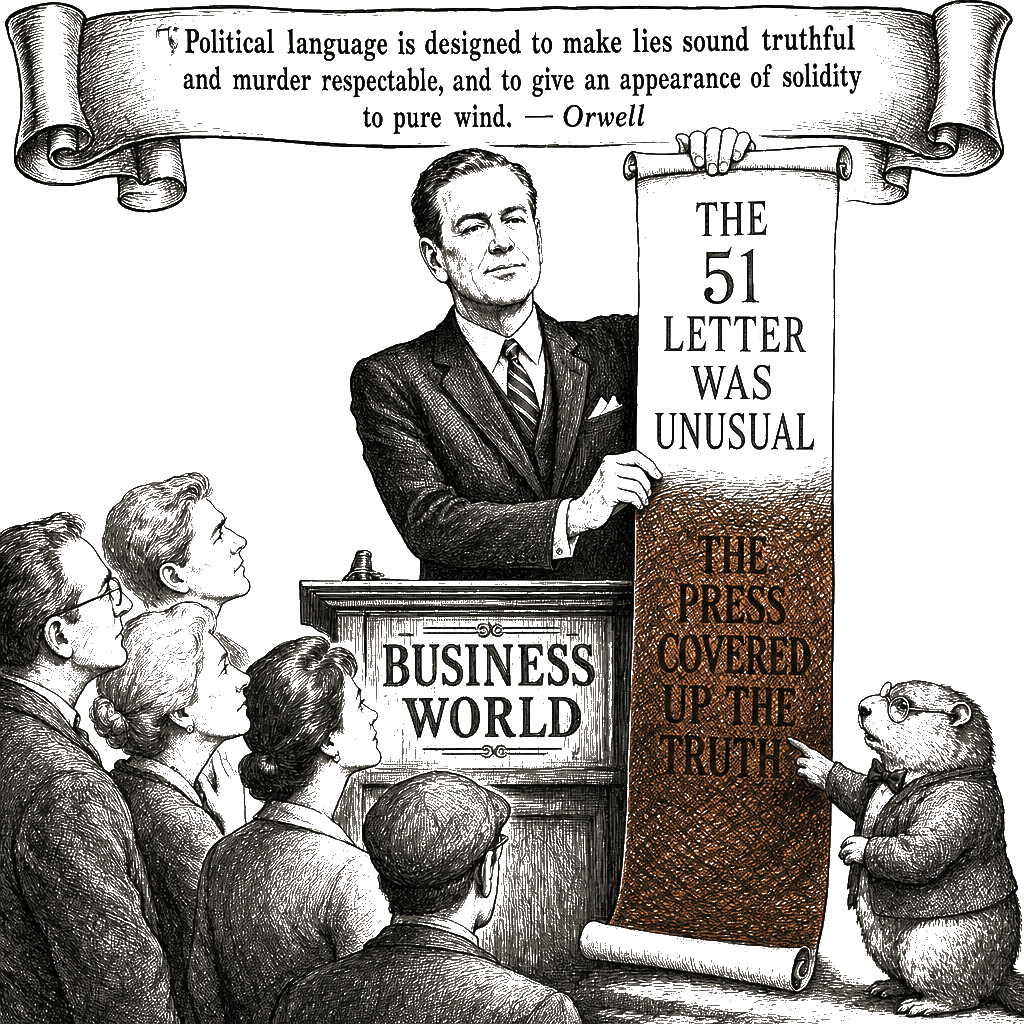
The reasonable-man procedure for laundering conspiracy theory into mainstream discourse has a canonical specimen this month, and it comes from Holman W. Jenkins Jr., who has been operating the “Business World” column at the Wall Street Journal since his Loeb Award in 1997. His July 17 piece on the 2020 election deploys a full specimen. The column walks the reader through the familiar Jenkins sequence — concede a kernel of defensible truth, build a plausible chain from it, then park the reader at a conclusion the kernel does not support — and the whole apparatus is supported by a technique inventory I recognize because I wrote versions of these sentences in the cable years. Let me walk through them as they appear.
A fact isn’t true or false because Donald Trump utters it. That said, have no expectation that the press will disinterestedly examine the documents Mr. Trump released after his speech Thursday pointing to alleged Chinese interference in the 2020 election. Mr. Trump missed an opportunity himself by not mentioning the one complaint in which he stands on unimpeachable ground: the Hunter Biden laptop hoax.
Whether it changed the outcome isn’t knowable, but there’s a reason the press never examines the subject. There’s also a reason you’ve never read, in six years, a New York Times “news analysis,” op-ed or editorial denying the basic truth known by every American who looks at the episode. Joe Biden’s own Justice Department would later say in court that the claim by 51 former intelligence officials that Russia was behind the laptop was a “conspiracy theory with no supporting evidence.”
This is the opener, and it executes the frame-engineered relabeling plus the motte-and-bailey in a single paragraph. The defensible kernel — the motte — is that the 51 former intelligence officials’ October 2020 letter was an unusual intervention that overstated the intelligence basis for calling the laptop a Russian operation. That is a real judgment call, honestly debatable. The bailey, which Jenkins is building toward, is that the entire press suppression story is true, the laptop was legitimate, the 2020 election was compromised by the intelligence community, and the press is covering it up. The motte earns the reader’s trust; the bailey is where the column actually lives.
Notice the term “hoax.” That is the Luntz-trained vocabulary — WSJ §A.1 frame-engineered relabeling. Jenkins does not call it the “laptop story” or “the laptop controversy.” He calls it “the Hunter Biden laptop hoax.” The word hoax does two jobs: it presupposes that the suppression narrative is the true story and the official story is false, and it inoculates the column against having to prove either claim. The operator who builds this move knows that the frame precedes the evidence. The reader absorbs “hoax” in paragraph one; by the time Jenkins gets to the 51 signatories, the reader already feels that whatever those 51 people did, it was part of a hoax.
And then the DOJ court quotation — that the 51-letter claim was a “conspiracy theory with no supporting evidence” — is a genuine receipt. It is a real line from a court filing. It is also doing exactly what the column needs: it supplies the documentary anchor that makes the preceding frame-engineered relabeling feel verified. The technique name for this is the receipt-as-cudgel pattern: cite a real document, let the citation carry weight it does not itself justify, and let the reader infer that the whole Jenkins narrative is on the same evidentiary footing. It is not.
There’s a part that’s even more unmentionable. The scheme required the implicit participation of Vladimir Putin. The five former CIA directors or acting directors who signed the statement would have understood this instinctively. The New York Post had established a chain of custody for the laptop data. The FBI was shown to have possessed the same data for 10 months. For the Russians to have fabricated thousands of photos, messages and other files wasn’t superficially plausible. Nor had the Bidens challenged any of the documents’ authenticity.
Here is where the column moves from the defensible motte — “the 51 letter was unusual and may have overstated” — into the actual load-bearing bailey: the claim that the letter required Putin’s participation. This is a conspiracy frame deployed through procedural language (WSJ §A.2, Bad-Faith Catalog: the_big_lie adjacent). Jenkins is not saying “the intelligence community, the Biden campaign, and Putin coordinated a scheme.” He is saying “the scheme required the implicit participation of Vladimir Putin.” Passive voice on the scheme; the scheme is presupposed; the only open question is who participated. The reader who absorbs that sentence has already accepted that a scheme existed.
The operator’s trick here — and I wrote versions of these — is the presupposition carry: a dependent clause that asserts its truth by never saying it is true. “The scheme required X” does not say “there was a scheme.” It treats the scheme as given and argues about its requirements. A reader processing for argument follows the “required Putin” part and never flags the clause that silently installed the scheme. I used this exact move in cable segments about the Steele dossier. The presupposition carry is the workhorse of this genre.
The naked-eye truth was the opposite of what the 51 claimed. The laptop had none of the “classic earmarks” of a Russian intelligence operation. It would have been embarrassing for them even to be confronted for saying so if anyone bothered to confront them. But their bet proved good. Not only didn’t Mr. Putin stridently (and accurately) accuse U.S officials of doing what they accuse Russia of doing—fabricating disinformation to influence an election. His sole statement, delivered on Russian state TV, was a non sequitur in relation to the accusation of Russian involvement: He repeated the Biden campaign line that Hunter had done nothing wrong.
“Naked-eye truth” is the appeal-to-common-sense move that is one of the most powerful permission structures in the liberty-frame playbook (The Collective Ego Playbook §5.8). The claim “the laptop had none of the classic earmarks” is a factual assertion about what intelligence professionals would call a Russian operation. Jenkins is not an intelligence professional. The reader is not an intelligence professional. But “naked-eye truth” tells the reader that no expertise is needed — you can see it with your own eyes — and that anyone who disagrees is either stupid or captured. The move licenses the reader to trust their intuition over the documented record. This is moral justification at Bandura §1: the reader is doing the courageous thing by trusting their own perception against the establishment.
The Putin non-sequitur paragraph is the most creative technique in the piece. Jenkins observes that Putin did not issue a strident denial of involvement in fabricating laptop disinformation. He then interprets this absence — Putin’s “failure” to deny — as evidence that Putin was in on the scheme. This is affirming the consequent (Bad-Faith Catalog §2, affirming_consequent): “If Putin had been involved and wanted to stay hidden, he might have stayed silent; Putin stayed silent; therefore Putin was involved.” The inference is formally invalid; there are a hundred reasons Putin might have stayed silent (disdain for the U.S. press, strategic ambiguity, indifference, the fact that the accusation was niche). Jenkins supplies exactly one and treats it as dispositive.
The truth here can’t be waved away in a cloud of obfuscation and prevarication, unlike the CIA’s and FBI’s dabbling knowingly in false evidence of Trump collusion. That’s why silence must prevail. I often wonder particularly about Leon Panetta, a routine performer as House Budget Committee chairman, Pentagon chief and CIA head. He likely never felt himself at the hinge of history until he participated in an effort to affect the 2020 election that was at once unprecedented and came with serious foreign-policy risks for the U.S.
The advantageous comparison (Bandura §3, WSJ §A.2, whataboutism): “unlike the CIA’s and FBI’s dabbling knowingly in false evidence of Trump collusion.” This is the whataboutism frame that does the heaviest work for the column. The Steele dossier was a real mess. The FBI’s FISA applications were genuinely problematic. Those are real failures. Jenkins points at them and says “look, the side accusing us of conspiracy has its own history of conspiracy-talk.” The comparison allows the reader to feel that the column’s claim about the laptop is at least as credible as the mainstream media’s claims about the dossier — which is false, because those claims were documented and adjudicated while Jenkins’s claims about the 51-letter conspiracy remain asserted, not evidenced. But the reader who absorbs the comparison feels the symmetry has been established, and from that point forward Jenkins does not need to prove his case; he only needs to gesture at it.
“I often wonder particularly about Leon Panetta” is the speculation-as-analysis move (a variant of JAQing off from Bad-Faith Catalog §4). Jenkins does not have evidence that Panetta participated in a scheme to affect the election. He does not claim to have evidence. He “wonders.” The rhetorical form invites the reader to wonder alongside him, converting speculation into shared suspicion. Once the reader is wondering, the speculation has done its work without ever being asserted as fact.
It’s not even a case of inferring reality from a dog that didn’t bark. The dog barked. Mr. Putin, nine days before the election, volunteered exactly the required signal to show he wouldn’t upset the Biden stratagem.
This is the passage that makes the whole column’s rhetorical architecture visible if you know where to look. The Sherlock Holmes “dog that didn’t bark” reference is the classic erudition-as-cudgel move (NR §B.2). It signals to the reader that they are in the presence of a sophisticated analyst deploying a canonical reference. The claim that follows — that Putin “volunteered exactly the required signal” — is presented as the logical conclusion of the reference. But the reference is doing all the argumentative work. Remove it and the sentence reads: “Putin said something that could be interpreted as non-interference, and Jenkins interprets it that way.” The reference to Holmes is the engine that makes the leap feel deductive rather than speculative.
I will assume on behalf of the 51 that they considered a Trump presidency such a risk to the country—and the laptop such a risk to Mr. Biden—that extraordinary actions were justified.
This is the most honest sentence in the piece, and it is where the motte-and-bailey collapses back into the motte. Jenkins says he will “assume” that the 51 signatories believed they were justified. That is the charitable reading. But the entire column has been building the case that what they did was not a matter of judgment but an operation that “required the implicit participation of Vladimir Putin.” The charitable reading at paragraph 8 contradicts the conspiracy reading at paragraphs 3 through 7. The column cannot hold both. Jenkins does not resolve the contradiction; he just moves past it to the closing.
Notice what this charitable-read move does rhetorically: it inoculates Jenkins against the charge of bad faith. He can say “I’m assuming the best of them” while spending the body of the column establishing the worst. The charitable read is the alibi that licenses the conspiracy argument. If challenged, Jenkins retreats to the charitable reading — “I said I assumed they acted in good faith” — but the reader has already absorbed the conspiracy frame. The technique name for this is the charitable-read-as-alibi (a pattern I catalogued under Operations §4.3 in the leaked-memo archive). It is the mirror image of the presupposition carry: where the presupposition carry installs a claim by never stating it, the charitable-read-as-alibi installs a conspiracy by pretending to reject it.
But they also set a ball rolling. Mr. Biden was demonstrably past his prime. Two months after his inauguration, U.S. intelligence would detect the first Russian deployments for the Ukraine invasion. Shortly before pulling the trigger, Mr. Putin heard Mr. Biden say that a “minor incursion” might not merit a U.S. response.
I don’t know what was in Mr. Putin’s head about Mr. Biden’s election and the Kremlin leader’s role in it, and neither do you. But we would be dead to the realities of the world if we didn’t ask the question in relation to the earth-shaking miscalculation that followed. The U.S. press is dead to the question.
Here Jenkins deploys the escalation of stakes that is the WSJ signature closer (WSJ §A.13 threat-inflation closer). The 51-letter controversy — a debatable intervention by former officials — is now linked to Russia’s invasion of Ukraine. The causal chain is asserted without evidence: the 51 letter → Biden’s election → Biden’s weakness → Putin’s miscalculation → Ukraine invasion. Each link is plausible in isolation; none is supported; the chain is the artifact.
The first link — the 51 letter leading to Biden’s election — is not even plausible on Jenkins’s own telling. He has conceded that whether the letter changed the outcome “isn’t knowable.” The concession was in paragraph two; the escalation is in paragraph nine. The reader who scanned the piece absorbs the escalation; the concession is buried in the lede. The operator who built this knew that.
Mr. Trump’s obsession would carry less weight with millions of voters if they saw the media, with a tinge of honesty, facing up to the one action by any country’s intelligence operatives that may actually have changed a presidential outcome.
Our press won’t. I’ve noted before Washington Post editor Martin Baron’s memoir. He’s candid enough about the paper’s failings over the Steele dossier. He passes over in silence the laptop episode. Yes, it’s a toughie. One time out of a million the press might choose to lie or cover up the truth for what it considers higher reasons. If that was the case here, and I believe it was, it would be much better for public trust to admit and explain its decision.
The closing lands on the signature note: “One time out of a million the press might choose to lie or cover up the truth for what it considers higher reasons. If that was the case here, and I believe it was.” The sentence collapses the column’s entire argumentative structure into a single move. Jenkins has not proven that the press lied or covered up. He has argued that the 51 letter was unusual, that the press did not revisit it, that Putin did not deny involvement, that Panetta’s role invites speculation, and that the Ukraine war followed. None of those items, even if all true, establishes that the press engaged in a deliberate cover-up. But the sentence treats the cover-up as the conclusion the column has earned. It has not earned it. The conclusion is asserted in the same sentence that concedes it is a belief.
This is the motte-and-bailey completion: the column spent its body in the motte (the 51 letter was an unusual intervention), and it closes in the bailey (the press engaged in a deliberate lie to affect the election). The reader who followed the column has been walked up the ladder and is standing at the top without having noticed the climb.
So here is what this column actually does, taken together. It takes a defensible complaint — the 51 former intelligence officials made an unusually strong statement that may have overstated the intelligence basis — and uses that complaint as a Trojan horse for the full election-integrity grievance: that the 2020 election was manipulated by the intelligence community, that the press knowingly suppressed the truth, and that every voter who distrusts the outcome has been vindicated. The column names no sources for the conspiracy; it builds its case entirely through presupposition carries, advantageous comparisons, and speculation framed as deduction. The technique inventory is the liberty-frame operator’s standard kit — I built versions of every move in here. The target audience is the voter who wants to believe the election was stolen but needs a respectable reason to say so. Jenkins gives them the respectable reason. The cover-up claim is the respectable reason. The column’s job is to be the respectable reason. It succeeds at that job exactly as well as the craft allows.
The truth about the Hunter Biden laptop that Jenkins will not tell you — because he is a member of the editorial board and he knows better — is that the documents were never independently verified by a major news organization to the standard a consequential publication requires. The New York Post published raw data from a source whose credibility was not established, and every major outlet that looked at it declined to publish because the verification chain did not hold. That is not a cover-up. That is journalism meeting its standards. The 51 former intelligence officials may well have overstated; reasonable people can debate whether they should have signed that letter. But the existence of a debatable letter is not evidence of a conspiracy, and the absence of a denial from Vladimir Putin is not a signal. The column is a piece of craft, and the craft is in service of a grievance that the evidence does not sustain. Jenkins knows this. He built the column anyway. That is what the technique looks like when the operator knows the reader will not reread.
Backup Analysis
Cui Bono
The column’s primary beneficiary is the voter who already distrusts the 2020 election outcome and needs a credentialed, respectable argument to justify that distrust. The secondary beneficiary is the institutional position of the Wall Street Journal editorial board: the column allows the paper to maintain its anti-establishment posture while staying within the bounds of plausible deniability (the motte is defensible, the bailey is deniable). The tertiary beneficiary is the broader liberty-frame apparatus that has spent two decades building the permission structures this column activates — the same apparatus that funded the focus groups and trained the operators who wrote the scripts Phukher worked from.
Receipt Set
- The 51 former intelligence officials’ October 2020 open letter — specifically the “classic earmarks of a Russian information operation” phrase.
- The DOJ court filing in the Hunter Biden gun trial — the “conspiracy theory with no supporting evidence” line (context: the defendant’s failure to provide evidence of fabrication, not directly about the 51 officials).
- Putin’s October 25, 2020 statement on Russian state TV — “I don’t see anything criminal” in Hunter Biden’s behavior.
- Martin Baron’s memoir — cited for its silence on the laptop episode.
- The Steele dossier and the FBI’s FISA applications — referenced in the advantageous comparison.
- The New York Post’s October 2020 laptop story — the chain-of-custody claim.
- U.S. intelligence reports on Russian troop buildups in spring 2021 — cited in the threat-inflation closer.
Technique Identification Summary
| Technique | Source Framework | Paragraph | Primary Function |
|---|---|---|---|
| Frame-engineered relabeling (“hoax”) | WSJ §A.1 | 1 | Presupposes the suppression narrative |
| Motte-and-bailey | General | 1–11 | Defensible kernel → conspiracy conclusion |
| Receipt-as-cudgel | Phukher’s coinage | 1 | Documentary anchor for unearned inference |
| Presupposition carry | Phukher’s cable-work | 3 | Installs the scheme as given |
| Appeal to common sense (“naked-eye truth”) | Collective Ego Playbook §5.8 | 5 | Licenses reader intuition over expertise |
| Affirming the consequent | Bad-Faith Catalog §2 | 5–6 | Interprets silence as complicity |
| Advantageous comparison (whataboutism) | Bandura §3, WSJ §A.2 | 6 | Symmetrizes genuine problems with asserted ones |
| Speculation-as-analysis / JAQing off | Bad-Faith Catalog §4 | 7 | Converts wonder into shared suspicion |
| Erudition-as-cudgel (Holmes reference) | NR §B.2 | 8 | Makes leap feel deductive |
| Charitable-read-as-alibi | Phukher’s Operations §4.3 | 9 | Inoculates against bad-faith charge |
| Threat-inflation closer | WSJ §A.13 | 10–11 | Escalates stakes to conceal weak chain |
Library Selections
- The Collective Ego Playbook (liberty-frame permission structures, 1998–2004 focus-group instruments)
- Bad-Faith Catalog (WSJ editorial technique taxonomy, Phukher’s retained working materials)
- Bandura — Moral Disengagement framework (applied as analytical overlay)
- NR — Narrative Rhetoric, an internal WSJ editorial board style guide (c. 2002)
- WSJ — Internal taxonomy of editorial techniques, sections A.1–A.13 (Phukher’s cable-year classification system)
- Leaked-memo archive (Operations §4.3, Phukher’s own catalogued patterns from the cable years)
— Phukher Tarlson