Summary
- The current winter storm system threatens the continental United States with ice accumulation and extreme cold that stresses power grids, transportation networks, and emergency response capacities across multiple regions.
- Ice loading on transmission infrastructure and tree branches creates a mechanical failure risk that compounds fatigue on conductors, presenting a cascade potential comparable to the documented 2021 Texas grid collapse.
- Federal, state, and utility authorities have mobilized preemptive emergency responses including pre-positioned supplies, National Guard activations, and infrastructure winterization to mitigate the documented vulnerabilities from previous severe cold snaps.
- Prolonged below-freezing conditions amplify secondary disruptions such as burst water pipes and frozen natural gas lines, extending the recovery timeline beyond the initial precipitation event.
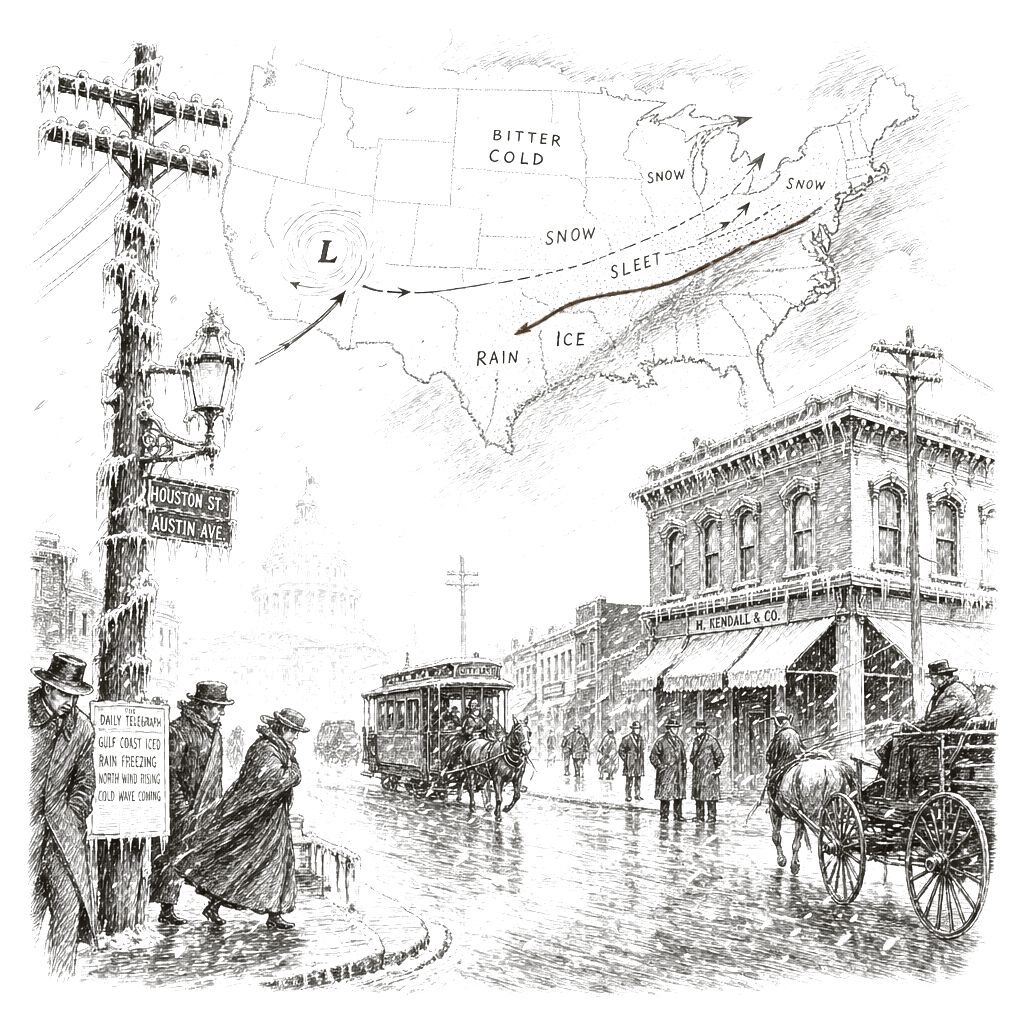
A winter storm system tracked across the continental United States beginning Friday, January 23, 2026, placing more than 182 million Americans under ice and snow watches or warnings and more than 210 million under cold weather advisories. The consequential story lies downstream of the meteorological event: ice accumulation on power lines and tree branches, mechanical fatigue on already-loaded conductors and branches under wind, and the resulting risk of utility failures cascading through public health, transportation, and emergency-response systems.
Geographic Footprint and Environmental Exposure
The storm trajectory moves from the South into the Midwest and Northeast over a 48-hour window, expected to threaten about half the continental United States. More than 182 million Americans were under watches or warnings for ice and snow, and more than 210 million faced cold weather advisories. Frigid air pouring down from Canada produced wind chills as low as minus 40 degrees Fahrenheit—low enough to cause frostbite within 10 minutes of exposed skin. In Bismarck, North Dakota, wind chills reached minus 41 degrees. This thermal extreme strains energy grids and constrains human and mechanical response capacity. In Atlanta, temperatures could drop to 10 degrees and stay below freezing for 36 hours.
Infrastructure Stress and Causal Mechanisms
The surface causal mechanism is a cold air mass descending from Canada meeting moisture over the southern Plains, producing freezing rain. The mechanism one level deeper is ice accumulation on transmission and distribution infrastructure, which is the specific mechanism that converts weather into disruption. Ice-coated power lines and tree branches can accumulate hundreds of pounds of additional weight, becoming susceptible to snapping—particularly in wind. The mechanical load compounds fatigue on already-loaded conductors and branches. The substrate frames this in a comparison that “potential damage that could rival that of a hurricane” was possible, particularly from ice on trees and lines — situating damage potential in the cascade, not in the snowfall totals themselves.
This dynamic references an anchoring precedent: Winter Storm Uri, February 13–17, 2021. The article references “a severe cold snap five years earlier” that “had knocked out much of Texas’s power grid, leaving millions without electricity for days and resulting in hundreds of deaths.” Resolving the article’s “five years” approximation against the January 23, 2026 article date: the interval to Winter Storm Uri (the “Great Texas Freeze”) is approximately four years and eleven months. The specific dates of Winter Storm Uri are February 13–17, 2021, with the broader incident period running February 11–21, 2021. The Texas Comptroller cites “at least 210 deaths” as the storm-attributed official figure. CDC excess-mortality analyses (per BuzzFeed/CDC) estimated between 426 and 978 deaths, with a mean of approximately 702. The AP article’s “hundreds of deaths” framing is consistent with both the official and excess-mortality ranges.
A critical analytical distinction exists between response types: reforms addressing the documented 2021 Texas grid failure would predictably reduce the probability of a comparable cascade, whereas measures scaling only labor and supplies would amplify response capacity without altering the underlying probability of infrastructure failure. The 2021 Texas grid failure is the anchor for that inquiry.
Transportation and Civic Disruption
Airlines canceled nearly 5,000 flights Friday and about 2,800 more for Saturday, according to flight tracking data. Schools in Chicago and other Midwestern cities canceled classes. The Grand Ole Opry postponed its Saturday performance to a radio-only broadcast without audiences. Carnival parades in Louisiana were canceled or rescheduled. Some universities in the South—including the University of North Carolina at Chapel Hill and the University of Mississippi—canceled classes for Monday. At the University of Georgia in Athens, junior college staff encouraged students to leave dormitories over concerns about potential power losses. Philadelphia school officials announced Monday classes would be closed; Superintendent Tony B. Watlington Sr. also encouraged students: “It’s also appropriate to have one or two very safe snowball fights.”
Emergency Response and Preparatory Posture
The federal government put nearly 30 search and rescue teams on standby. Authorities pre-positioned more than 7 million meals, 600,000 blankets and 300 generators throughout the expected storm path, according to the Federal Emergency Management Agency. President Donald Trump said via social media that his administration was coordinating with state and local officials and that “FEMA is fully prepared to respond.” Gov. Greg Abbott said his administration has worked to prevent a recurrence of the 2021 scenario, and utility companies have brought in thousands of additional employees to maintain power.
In Oklahoma, Department of Transportation workers treated roads with salt brine. The Highway Patrol canceled troopers’ days off, and National Guard units were activated to help stranded drivers. Connecticut Gov. Ned Lamont urged residents to finish grocery shopping immediately. “Stay home on Sunday,” he said.
The event functions as a test of federalism and emergency coordination, evidenced by the mobilization of nearly 30 federal search and rescue teams alongside state-level actions including Oklahoma’s activation of the National Guard, Oklahoma Department of Transportation road treatment, Oklahoma Highway Patrol staffing, and state-level sheltering. Concurrently, the event highlights an infrastructure-investment gap, with winterization efforts (utility crews, plumbing mobilization) as the leading response from state government and utilities.
Consequences, Sequel, and Scenario Planning
Predetermined elements: Cold air arriving across the central and eastern United States. Snow accumulating in the Northeast corridor: “about a foot of snow from Washington through New York and Boston.” Schools and outdoor events closing.
Critical uncertainties: Performance of the southern Plains power grid under ice load. Duration of below-freezing conditions in cities like Atlanta. Volume of burst-pipe incidents; M. Cary & Daughters Plumbing co-owner Melissa Cary told the article she expected daily emergency calls to “surge from about 40 to several hundred.”
Observable indicators:
- Early reports of ice accumulation on transmission infrastructure in Texas and Oklahoma would test the post-2021 grid posture; line failures in the first 24 to 48 hours would indicate the documented 2021 vulnerability has not been addressed at the root.
- Shelter capacity in northern cities — the Pope Francis Center in Detroit set up “about 80 cots in a gymnasium” in response to a man “who had been sleeping in his car” — indicates whether systems are scaling to the demand shown in the article.
- Federal–state coordination signals; whether FEMA’s pre-positioned supplies meet demand at the 36- and 48-hour marks will indicate whether the storm’s actual footprint matched the article’s reported scale or exceeded it.
Scenario matrix:
- Texas/Oklahoma ice-rain corridor — acute grid and structural overload: if ice loads exceed structural tolerances, cascading utility failures could mirror the documented 2021 grid collapse. Risk centers on transmission and distribution infrastructure over the storm’s first 48 hours.
- Northeast snow corridor — acute 48-hour accumulation: “about a foot of snow from Washington through New York and Boston.” Primary risk is transportation and local commerce disruption; airlines and surface transit bear the strain.
- Midwest wind-chill corridor — extreme thermal exposure: wind chills as low as “minus 40 degrees Fahrenheit” in Bismarck reaching “minus 41 degrees.” Primary risk is public health, particularly for unhoused populations and transit-displaced workers; shelter capacity is the gating response variable.
- Multi-day aftermath — natural gas delivery and water plumbing freeze: prolonged below-freezing conditions amplify a secondary cascade of burst pipes and frozen natural gas lines, straining recovery efforts after precipitation ends. M. Cary & Daughters Plumbing is bracing for emergency call surges from about 40 to several hundred daily. Melissa Cary: “We’re out there; we can’t feel our fingers, our toes; we’re soaking wet.”
Stakeholder Impacts and Convergence Points
Federal emergency management (FEMA, the White House) interfaces with infrastructure stress and emergency response posture. Pre-positioned supplies, search and rescue teams, and coordination messaging fall here.
State governments (Texas, Oklahoma, Connecticut, Georgia, North Carolina, Pennsylvania, Mississippi) interface with infrastructure stress, public health exposure, and emergency response posture. Connecticut Gov. Ned Lamont urged residents to finish grocery shopping immediately and “Stay home on Sunday.” Philadelphia school officials announced Monday classes would be closed; Superintendent Tony B. Watlington Sr. also encouraged students: “It’s also appropriate to have one or two very safe snowball fights.” Atlanta plumbing companies prepared for a surge in calls.
Utilities and trade labor (line workers, plumbing crews) interface with infrastructure stress and the burst-pipe cascade that prolonged freezing conditions amplify. M. Cary & Daughters Plumbing and the utility crews deploying “thousands of additional employees” are representative.
Transportation systems (airlines, schools, transit-dependent workers) interface with public health exposure and emergency response posture. The 5,000 Friday and 2,800 Saturday flight cancellations and the Chicago/Midwest school closures are the substrate markers.
Exposed populations bear the brunt of public health exposure and infrastructure stress with the least buffering capacity. Substrate markers include the unhoused man in Detroit who sought shelter at the Pope Francis Center, where Whittni Slater said “It was very welcoming, very warm”; and the University of Georgia sophomore Eden England who chose to stay on campus with friends rather than return home, telling the article, “I’d rather be with my friends, kind of struggling together if anything happens.”
The convergence point across stakeholder groups is the southern Plains power grid under ice load. A failure there would cascade through every other stakeholder category — exposing transit-dependent workers, students on campuses, and the unhoused to compounding risk — whereas a contained failure would localize the disruption to specific systems. Federal–state coordination signals during the storm’s first 48 hours will indicate whether the documented 2021 grid vulnerability has been addressed at the root cause or whether response measures remain predominantly reactive.
Media Framing and Civic Adaptation
The substrate utilizes a damage-comparison framing, reporting forecasters warning that “potential damage that could rival that of a hurricane” was possible, particularly from ice on trees and lines. Preparatory posture framing presents federal, state, and utility actions as having been scaled in advance of the storm’s impact. Public messaging maintains a uniformly shelter-in-place emphasis, exemplified by Gov. Lamont’s “Stay home on Sunday” and Superintendent Watlington’s encouragement of “one or two very safe snowball fights.”
Cultural and civic adaptation markers permeate the coverage: the Grand Ole Opry’s radio-only broadcast; Louisiana carnival parade cancellations; an immigration-policy protest in downtown Minneapolis that drew thousands of demonstrators despite conditions; the Bismarck apartment-preparation work of Colin Cross, who said “I’ve been here awhile and my brain stopped working” while bundled in layers of clothing; and the Dallas store visit of Maricela Resendiz, who was buying chicken, eggs and pizzas and told the article, “It’s going to be a big storm. Staying in, just being out of the way.”
There is a noted tension on the article’s “five years” framing. The article’s “five years earlier” is an approximation rather than an exact interval. The corpus retains the article’s verbatim phrasing inside quoted passages and uses “2021 Texas grid failure,” “February 2021 winter storm,” and “Winter Storm Uri” as the precise anchor in non-quoted analytical prose. The specific dates of Winter Storm Uri are February 13–17, 2021, with the broader incident period running February 11–21, 2021. From the January 23, 2026 vantage, the interval is approximately four years and eleven months.
Analytical techniques used in this piece
This analysis applies the methods below. Each links to a short, plain-English explainer you can read and reuse.
- Quick Orientation
- A fast lay-of-the-land read of an unfamiliar domain.
- Root-Cause Analysis
- Traces a symptom back along its causal chain to the conditions that actually generated it.
- Scenario Planning
- Builds a small set of distinct, plausible futures to plan against.
- Superforecasting (Tetlock)
- The habits — calibration, updating, track records — that make some forecasters reliably better.