Summary
- U.S. equities and precious metals advanced simultaneously as investors allocated capital across risk and safe-haven assets ahead of Federal Reserve, tariff, and corporate earnings catalysts.
- The Trump administration conditioned a 100 percent tariff on Canadian goods upon Canada executing a free trade agreement with China, introducing a contingent policy risk.
- Federal industrial policy and corporate capital deployments directed public and private funds toward domestic rare earth production and artificial intelligence data center infrastructure.
- Currency market coordination and intervention expectations drove a sharp appreciation in the Japanese yen, pressuring Japanese export-oriented equities.
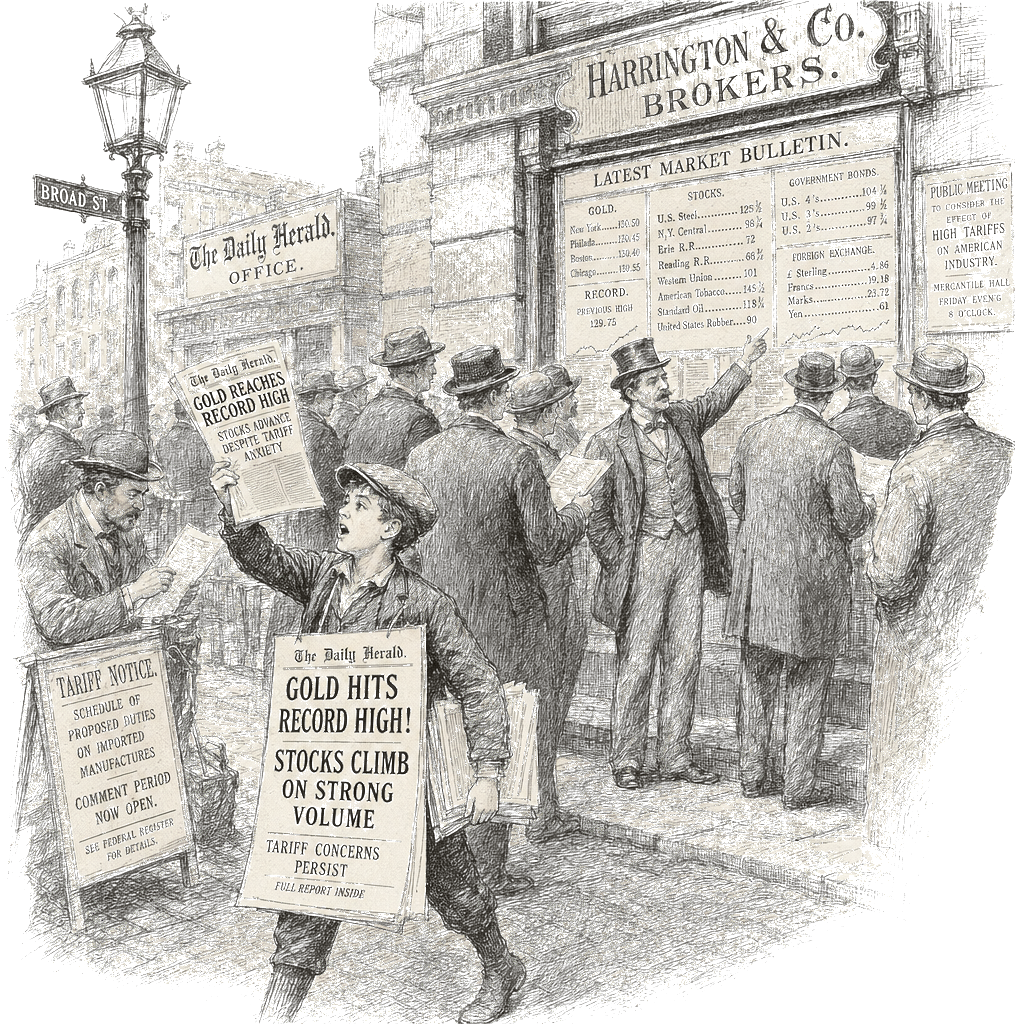
On January 26, 2026, the S&P 500, Dow Jones Industrial Average, and Nasdaq composite posted fractional gains while gold surpassed $5,100 per ounce and silver rose 14 percent, reflecting a cross-asset allocation strategy in which investors maintained selective equity exposure while simultaneously hedging against converging monetary, trade, and corporate policy uncertainties. The Associated Press attributes the precious metals surge to a “familiar pattern when economic uncertainty mounts: investors seeking assets perceived as safer than equities,” driven by “worries about tariffs, high inflation, political instability, and mounting government debt worldwide,” while the equity gains tracked specific industrial-policy catalysts and corporate earnings expectations ahead of a heavily scheduled week for the Federal Reserve and major technology companies.
Documented Signal and Cross-Asset Movements
The Associated Press reports a simultaneous advance in U.S. equities and precious metals alongside a modest decline in the 10-year Treasury yield. The S&P 500 rose 34.62 points to 6,950.23, a 0.5% gain; the Dow Jones Industrial Average added 313.69 points to 49,412.40, a 0.6% rise; and the Nasdaq composite advanced 100.11 points to 23,601.36, a 0.4% increase that “left it still in positive territory for the year.” Gold “surged 2.1% to briefly top $5,100 per ounce for the first time, setting another record.” Silver “rose 14%, settling much higher.” The 10-year Treasury yield “eased to 4.21% from 4.24%.” The cross-asset pattern is consistent with selective risk exposure maintained alongside allocation to safe-haven assets and sovereign duration. The marginal hedging problem for market participants is the joint distribution of low-probability tails across the Federal Reserve, the tariff threat, the earnings slate, and the currency intervention channel. Gold and silver’s move on a day when equities also rose is the most informative signal in the reporting; safe-haven demand is functioning as a hedge against a set of contingent events rather than as a rotation out of equities. The 10-year Treasury yield easing to 4.21% from 4.24% adds a rate-channel data point consistent with that read: a modest shift in expectations about interest rates and growth that does not by itself resolve the conditional-tariff overhang.
Source Framing and Analytical Mechanisms
The Associated Press frames the gold-and-silver surge as a “familiar pattern when economic uncertainty mounts: investors seeking assets perceived as safer than equities.” The source attributes the demand to “worries about tariffs, high inflation, political instability, and mounting government debt worldwide.” The reporting frames the Federal Reserve decision as a well-telegraphed event with a narrow base case, locating residual variance in post-decision commentary rather than in the rate action itself. The source frames the tariff threat as a public statement attributed to President Trump, without documenting follow-through mechanisms. The industrial-policy and corporate transactions are framed as discrete catalysts tied to federal and corporate commitments. One framing the source does not affirm is that the gold-equity co-movement reflects a liquidity-driven allocation shift, such as central-bank gold purchases or sovereign reserve rebalancing; the reporting carries no reference to such a mechanism.
Strategic theorists characterize the public conditioning of a severe penalty on a specific third-party action as a commitment device: the statement aims to alter the payoff structure for a potential Canadian trade agreement with Beijing. The credibility of the threat in the source rests on whether the U.S. executive follows through on a contingency that may never trigger. The reporting supplies no evidence of an irreversible policy mechanism—only a public statement attributed to President Trump. A market pricing the threat as cheap talk would not generally produce a 2.1% move in gold alongside positive equity returns; a market pricing it as a non-trivial tail risk would. The January 26 co-movement is consistent with the latter reading.
Supply-chain analysts characterize the federal posture toward USA Rare Earth—$277 million direct funding and a $1.3 billion proposed loan—as asymmetric investment, directing public resources to counter foreign dominance in critical minerals. The company’s separate $1.5 billion private placement illustrates public capital being used to de-risk private investment in strategic sectors. The Nvidia-CoreWeave transaction represents a cooperative strategy to lock in infrastructure capacity and secure supply-chain alignment in the artificial-intelligence sector. Nvidia stated that the investment “will help accelerate CoreWeave’s buildout of AI data centers using Nvidia chips, with completion targeted for 2030.” CoreWeave’s 5.7% rally against Nvidia’s 0.6% slip is consistent with capital flowing into the buildout vehicle while the supplier absorbs the cost of acceleration—a vertical-integration pattern in which the marginal cost of AI-infrastructure capital is being shared across the chain.
Analysts classify the Federal Reserve’s posture as defer-and-monitor under uncertainty. “Inflation remains stubbornly above the Federal Reserve’s 2% target.” The tension in the source is between the action of holding rates and the trajectory of further signaled cuts, concentrating residual variance in Chair Powell’s post-decision commentary. The cost of erring on either side—reigniting inflation by cutting too soon or stifling growth by holding too long—carries high economic reversibility costs.
The Japanese yen move represents a coordination game with sunk costs in the form of accumulated dollar weakness and a future-shadow in the form of intervention cost. The credibility of intervention depends on the visible commitment of reserves, which the reporting does not document but which the yen’s move implies markets are monitoring. The Toyota 4.1% decline and the Nikkei 225’s 1.8% drop—characterized by the source as “one of the world’s larger daily moves”—are the equity-side correlates of that currency coordination.
Cost and Benefit Distribution
The beneficiaries of the safe-haven bid are holders of gold and silver, with the reporting noting a 2.1% gold surge past $5,100 per ounce and a 14% silver rise on January 26, 2026. The beneficiaries of federal industrial-policy deployment include USA Rare Earth, which rallied 7.9% on the same day on the combination of $277 million in direct federal funding, a proposed $1.3 billion loan, and a $1.5 billion private placement. The beneficiaries of corporate catalyst flows include Baker Hughes, up 4.4% on stronger-than-expected quarterly profits tied to liquefied natural gas demand momentum—the company “said it is benefiting from strong momentum in demand for liquefied natural gas”—and CoreWeave, up 5.7% on the $2 billion Nvidia commitment. The beneficiaries of currency-channel repricing include holders of the Japanese yen on the move attributed to intervention expectations, and holders of dollars relative to peer currencies, with the reporting noting the U.S. dollar’s continued decline.
The cost-bearers of the currency channel are Japan-listed exporters, with Toyota Motor falling 4.1% and the Nikkei 225 dropping 1.8% on the same day. The cost-bearers of operational disruption include Delta Air Lines, down 0.7% on January 26, 2026, following winter-weekend flight cancellations, while Southwest Airlines added 0.2% on the same comparison. The cost-bearer of the Nvidia-CoreWeave transaction is Nvidia itself, which “slipped 0.6% despite the commitment.”
Forward Catalysts and Standing Posture
The monetary catalyst on January 28, 2026, is the Federal Reserve’s interest rate decision and Chair Powell’s subsequent commentary. The reporting notes that “Federal Reserve Chair Jerome Powell’s comments following the decision could move markets substantially.” “Most economists expect the Federal Reserve to hold its main interest rate steady on Wednesday.” “The central bank has been lowering its main interest rate and has indicated that more cuts may occur in 2026.”
The earnings catalysts on January 28 and 29, 2026, include Meta Platforms, Microsoft, and Tesla delivering reports on Wednesday, followed by Apple on Thursday. The reporting supplies no individual company forecast; the aggregate uncertainty across the four is meaningful but bounded by company-specific information content.
The tariff catalyst is contingent and undated. The 100 percent Canadian tariff depends on Canada signing a free trade deal with China. The reporting supplies no probability estimate for the trigger event and no documentation of an irreversible policy mechanism beyond the public statement attributed to President Trump.
The operational catalyst in train includes winter-storm flight cancellations and the airline-sector absorption pattern—Delta down 0.7% and Southwest up 0.2%—representing idiosyncratic event risk running alongside the macro and policy catalysts.
Until at least one of the three vectors resolves—the Federal Reserve speaks, the tariff trigger is reached or recedes, the earnings slate reports—the cross-asset behavior is likely to continue expressing the joint hedging problem rather than any single component.
Analytical techniques used in this piece
This analysis applies the methods below. Each links to a short, plain-English explainer you can read and reuse.
- Decision Clarity
- Articulates the real stakes, stakeholders, and interests behind a decision facing a third party.
- Decision Under Uncertainty
- Weighs options by probability and time when the environment is genuinely uncertain.
- Strategic Interaction (Game Theory)
- Models a situation as a game — players, moves, payoffs, and likely equilibria.