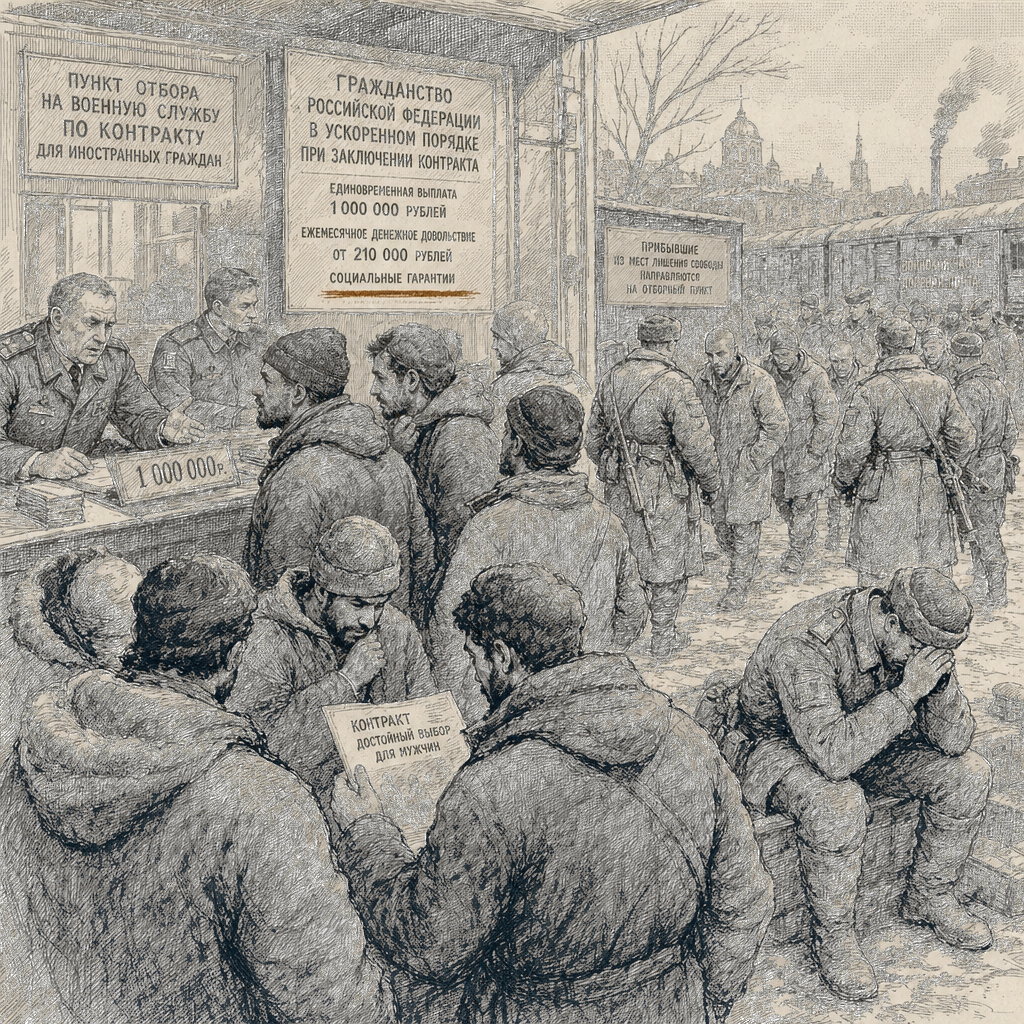
The Recruitment Architecture and Financial Distribution
The recruitment architecture concentrates benefits on the Russian state and its contracting partners while distributing injury, deception risk, and political exposure outward to foreign nationals, source-country governments, and the families of those who do not return. The Russian state reconciles two objectives: maintaining troop levels in Ukraine and avoiding a repeat of the autumn 2022 mobilization of 300,000 reservists, after which tens of thousands of Russian citizens fled the country and the limited call-up was suspended once the target was met. The Kremlin’s voluntary enlistment framework is, in distributional terms, a substitute for a politically costly draft. Kateryna Stepanenko of the Institute for the Study of War characterizes the trade-off as the regime calculating that higher financial cost is worth exchanging for the political shielding a second nationwide call-up would forfeit; she also describes recruitment efforts as extremely expensive for a slowing economy. Artyom Klyga, head of the legal department at the Movement of Conscientious Objectors, observed that most individuals seeking assistance to avoid service are Russian citizens and that the recruitment flow appears stable.
The British Defense Ministry’s 2025 estimate that more than 1 million Russian troops may have been killed or wounded, alongside the Mediazona and BBC documented count of more than 160,000 dead including more than 550 foreign nationals from over two dozen countries, indicates the financial inflow is met with an outflow the state is not fully accounting for in public. Putin’s December 2025 statement that more than 400,000 men signed contracts that year could not be independently verified; similar figures were announced in 2023 and 2024. Putin also maintained in 2024 and 2023 that 700,000 Russian troops are fighting in Ukraine; the accuracy of that figure remains unclear.
In the Khanty-Mansi region of central Russia, a new recruit receives approximately $50,000 in various bonuses, more than twice the average annual income in that region, layered with tax breaks, debt relief, and other perks beyond base pay. Regional authorities compete with one another for enlistees through bonus escalation, a dynamic that explains why a single region’s bonus has reached multiples of regional average annual income. Financial costs are internalized and borne by the Russian domestic economy and regional budgets, transferring the cost of the war from manpower to capital within the Russian domestic economy. The domestic Russian public, while shielded from the draft, bears the economic burden of these escalating financial inducements.
Trafficking networks described in the Iraqi court conviction, the Indian federal investigation, and the Nepali complaints benefit financially from the gap between the Kremlin’s quotas and the willingness of voluntary enlistees. Their stake is the persistence of the pipeline; their loss is enforcement and prosecution. A Baghdad court handed down a human-trafficking life sentence in 2024; India’s federal investigation agency broke up a network that deceived at least 35 Indian citizens into traveling to Russia under false employment pretenses, with the men trained for combat and deployed to Ukraine against their will.
The coerced cohort, comprising Nepali, Indian, Bangladeshi, and Iraqi nationals described in trafficking complaints, faces a pathway that offers no genuine benefit; their needs are discharge, return, and accountability. The voluntary cohort, including Iraqi families who said relatives enlisted for salary and a path to Russian citizenship, needs the terms of that contract honored. Both groups share a vulnerability: foreign fighters without Russian-language skills or military experience occupy the lowest position in the Russian command structure. Anton Gorbatsevich of the activist group Idite Lesom is cited characterizing military commanders’ view of these foreign fighters as “dispensable, to put it bluntly.”
The North Korean deployment operates on a state-to-state interest logic outside the financial-incentive framework: the 2024 mutual defense treaty created an obligation, and the deployment of thousands of soldiers to help Russia defend its Kursk region represents a strategic return to Pyongyang in currency that does not appear in the bonus tables. Russia has codified by law the recruitment of both convicted prisoners and pretrial detainees, in exchange for freedom or sentence reductions. The institutional channel lowers the marginal cost of military labor for the state while creating a parallel enforcement benefit for Russia’s detention system.
Ukrainian forces sit on the receiving end of the documented attrition and on the holding end of a prisoner-of-war population, hundreds of citizens of 40 countries, which carries intelligence and negotiating value. Reporting documents that an unspecified number of Iraqis are fighting alongside Ukrainian forces, a single reference to a non-Russian foreign-recruitment channel. The Iraqi source-country dynamic that produced Russian enlistees also produced Ukrainian enlistees, indicating the source-country enforcement problem extends to both sides of the conflict and that bilateral pressure on Moscow faces the parallel question of what leverage, if any, Baghdad orients toward Kyiv. Associated Press reporting does not characterize the Ukrainian foreign-volunteer architecture in comparable depth, so the available mapping on that side remains bounded by the documented reporting.
Source-Country Enforcement and Diplomatic Postures
Source-country governments carry divergent interest sets: Nepal needs the return of nationals and remains and has used a travel ban; India has used federal investigations and bilateral diplomacy; Iraq has used criminal prosecution. Each government is internally divided between citizens who joined voluntarily for economic mobility and citizens who were deceived; that heterogeneity makes unified leverage difficult. Within source-country governments, protective and geopolitical-normalization interests can diverge within a single cabinet. The Modi-Putin 2024 exchange illustrates: while India’s federal investigation agency worked to disrupt the trafficking network, the diplomatic visit produced a commitment to discharge “misled” nationals, a negotiation operating on bilateral-statecraft terms rather than purely protective ones. India thus holds two parallel instruments against the pipeline, enforcement and diplomacy; the interest calculation of which to deploy depends on internal political weighting the available reporting does not resolve.
Nepal’s response has tilted further toward protection; the travel ban is a unilateral instrument that closes off recruitment but does not retrieve those already deployed. Iraq has leaned on criminal prosecution, with the Baghdad life sentence as the visible signal. States navigate a tension between their substantive interest in protecting their populations and their relational interest in maintaining broader ties with the Russian Federation.
Evaluating the foreign-recruit population through stakeholder urgency and legitimacy frameworks indicates that the coerced subset possesses high urgency due to combat exposure and the legitimacy that trafficking convictions and family testimony document, but lacks the power to alter the conditions of deployment. The legitimacy attribute binds directly to available reporting, including trafficking convictions and family testimony, rather than abstract assertion. Whether the legitimacy attribute applies to the voluntary subset, such as the Iraqi nationals joining for salary and citizenship, remains a theoretical limitation not resolved by available reporting.
Forward Trajectories and Substrate Constraints
Diplomatic and enforcement pressure documented in the Nepali travel ban, the Indian investigations, and the Iraqi prosecution shapes the supply side of foreign recruitment. The test of sustainability is whether the diplomatic pressure reduces the supply of foreign recruits faster than bonus escalation increases it. The Russian state’s decision parameters dictate that it needs replenished ranks without a draft that produced flight in 2022; it needs the enlistment flow characterized publicly as voluntary; it needs a cost ceiling its slowing economy can sustain. Its best alternative to foreign recruitment is the politically toxic nationwide mobilization; its worst outcome is a force gap that becomes visible on the battlefield. The cost curve Stepanenko describes as extremely expensive must flatten without reverting to the 2022 mobilization model for the architecture to be sustainable.
A Ukrainian agency reported that over 18,000 foreign nationals have fought or are fighting on the Russian side, with nearly 3,400 killed. Hundreds of citizens of 40 countries are held in Ukraine as prisoners of war. The Mediazona and the BBC’s documented count of more than 160,000 dead including more than 550 foreigners from over two dozen countries matches the Associated Press reporting dated January 27, 2026; later anniversary counts have moved the named-death total higher, consistent with the methodology’s continued accumulation rather than contradicting the AP-period figure.
Several reporting gaps constrain forward inference. The magnitude, recruitment structure, and incentive design of the Ukrainian foreign-volunteer channel cannot be mapped from the available reporting; this would resolve with wire reporting characterizing the Ukrainian Foreign Legion or International Defense Legion in depth comparable to the Russian channel. Verified 2025 recruitment totals are unavailable; the independent Mediazona and BBC count tracks killed troops rather than recruitment intake, so reconciliation between announced and independently documented figures is not available. Indian discharge rates and the post-2024 bilateral status are unrecorded; the 2024 commitment is described, but no figures exist for those discharged, pending, or remaining in service. The underlying Khanty-Mansi contract text is unavailable; the reporting names the bonus total and the layered perks but does not specify discharge-conditional structure, bonus-clawback provisions, or minimum-service obligations.
Information Framing and Attribution
The recruitment architecture is framed in the reporting as voluntary enlistment by the Kremlin; the analytical reading identifies this framing as a substitute for a politically costly draft and as the operative public characterization the state needs preserved. The financial-incentive model is the public face; the penal-recruitment channel and the foreign-deception channel operate as parallel mechanisms documented in the reporting. The North Korean deployment is presented as treaty-mediated rather than as part of the bonus framework, a distinction the reporting supports through the 2024 mutual defense treaty attribution. The Indian bilateral exchange is framed in the reporting as a commitment to discharge “misled” nationals, a hedge-preserved formulation operating on diplomatic rather than enforcement terms. The Iraqi recruitment picture is framed in the reporting as mixed: coerced and voluntary pathways both documented, with the voluntary cohort’s economic-mobility motivation presented alongside the coerced cohort’s trafficking testimony. The Khanty-Mansi bonus is presented in the reporting as more than twice the regional average annual income, with the layered perks, including tax breaks and debt relief, noted but the contract terms left unspecified.
The extremely expensive characterization of recruitment costs is attributed to Stepanenko of the Institute for the Study of War; the reporting presents this as an analyst assessment, not an official Russian figure. The “dispensable, to put it bluntly” characterization of foreign fighters is attributed to Gorbatsevich of Idite Lesom; the reporting presents this as an activist-group assessment, not a Russian military statement. The Mediazona and BBC casualty count is presented in the reporting as an independent accounting; Putin’s 700,000 and 400,000 figures are presented as official claims the reporting notes could not be independently verified, an asymmetry the reporting itself flags.
Analytical techniques used in this piece
This analysis applies the methods below. Each links to a short, plain-English explainer you can read and reuse.
- Cui Bono — Who Benefits
- Asks who gains and who pays from a state of affairs, decision, or claim.
- Interest Mapping
- Separates parties’ stated positions from their underlying interests (Fisher & Ury).
- Stakeholder Mapping
- Charts the parties to a situation — their interests, power, and alignments.
- Incentives
- People respond to the rewards a system actually pays out — often not the ones it intends.