Summary
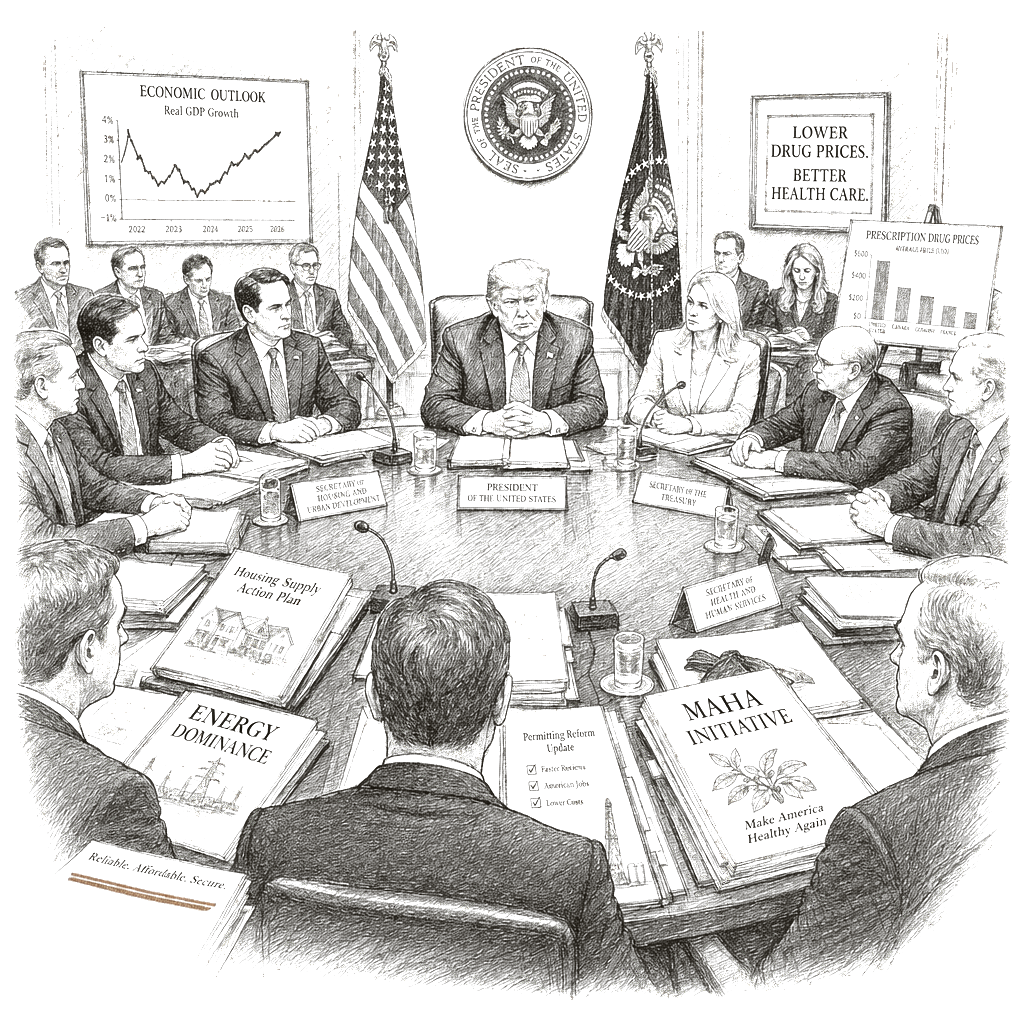
- The Associated Press published a standalone fact-check article titled “FACT FOCUS: A look at false and misleading claims made during Trump’s first Cabinet meeting of 2026” on January 29, 2026.
- The review examined seven claims made by President Donald Trump and senior officials during the first Cabinet meeting of 2026.
- The AP measured administration statements against federal baselines, local government records, and infrastructure geography.
- The AP characterized several claims as inconsistent with documented actions; the AP documented a pattern in which asserted magnitudes exceed verifiable benchmarks across distinct policy domains.
The Associated Press published a fact-check on January 29, 2026, examining seven claims made by President Donald Trump and senior officials during the first Cabinet meeting of 2026. The review documented that assertions regarding investment totals, housing market performance, wildfire rebuilding progress, and water infrastructure diverged from publicly available data and physical system constraints. By measuring administration statements against federal baselines, local government records, and infrastructure geography, the AP characterized several claims as inconsistent with documented actions, revealing a pattern where asserted magnitudes exceed verifiable benchmarks across distinct policy domains.
Investment and Housing Magnitude Claims
President Trump stated “$18 trillion is being invested now.” The AP reported he presented no evidence for this figure, characterizing it as “exaggerated, highly speculative and far higher than what the AP said can be supported by statements from companies, foreign countries and the White House’s own materials.” The AP noted the White House website offers a lower figure of $9.6 trillion, which the AP reported “appears to include” some investment commitments made during the Biden administration. The AP also cited a study published Tuesday that “raised doubts about whether more than $5 trillion in investment commitments made last year by major trading partners will actually materialize.” The factor between the $18 trillion claim and the $9.6 trillion website figure is roughly two.
Secretary of Housing and Urban Development Scott Turner stated, “Because of your policy sir, home sales in December, they rose sharply to their strongest pace in three years.” The AP reported the National Association of Realtors recorded a seasonally adjusted annual rate of 4.35 million units in December, representing a 1.4% year-over-year increase. The AP noted the 1.4% increase contradicts the “rose sharply” characterization, while pending home sales fell 3% from a year ago, suggesting the closed sales figure “could have been a monthly blip.” Trump also stated he wants to keep home prices high to increase net worth; the AP reported this approach “would likely keep construction levels low and price out possible first-time buyers.”
Wildfire Rebuilding and Competing Obstacle Frames
Trump stated local officials “have been unable to give permits” for Los Angeles wildfire recovery, claiming “there are like three houses being built out of thousands and thousands.” AP data from Los Angeles County and city showed approximately 3,100 permits issued in the Palisades and Eaton fire zones as of Thursday, with about 900 homes under construction and fewer than a dozen rebuilt. The factor between the “three houses” claim and the 900 under construction is approximately 300. The AP reported Trump signed an executive order directing FEMA and the SBA to preempt state and local permit rules, allowing builders to “self-certify” compliance with health, safety, and building standards.
Survivor advocates told the AP that permits are not the primary obstacle, noting many households struggle to secure full insurance payouts or face gaps of hundreds of thousands of dollars between proceeds and rebuilding costs. California Gov. Gavin Newsom stated on social media that local officials are moving at a “fast pace” and called on the administration to approve a $33.9 billion disaster aid request. Andrew Rumbach of the Urban Institute told the AP that permitting typically takes about 18 months after a major wildfire to gain steam, pointing to a December 2021 blaze south of Boulder, Colorado, where most permits were issued six months after cleanup. The California fires killed 31 people and destroyed about 13,000 residential properties.
Water Infrastructure and Physical Constraints
Trump stated officials “should have allowed the water to come down from the Pacific Northwest.” The AP reported no water supply from the Pacific Northwest connects to California’s system. California’s water originates from northern state snowmelt feeding rivers into the Sacramento-San Joaquin River Delta, moving south through federal and state pumping and canal systems. Local officials explained that dry Los Angeles fire hydrants resulted from a municipal system not designed for massive disasters.
SBA Administrator Kelly Loeffler claimed an executive order got “water to the scene” early in the presidency. The AP reported Trump’s Jan. 24, 2025, executive order directed water to a dry lake basin more than 100 miles from Los Angeles.
Conflict Mediation and Energy Policy
Trump claimed he “extinguished eight wars.” The AP characterized this as “highly exaggerated,” noting he mediated relations among many nations but that, according to the AP, “his impact is not as clear-cut as he suggested.” The AP’s correction highlighted the complexity of the conflicts referenced but did not itemize the specific wars counted in the President’s figure.
Trump stated people must say “clean, beautiful coal.” The AP noted coal production is cleaner historically but does not mean the fuel is clean. Trump claimed China makes wind turbines but “doesn’t use them.” The AP reported China produces more than half the global wind turbine supply and is installing wind power at a record pace.
Methodological and Selection Constraints
The AP’s strongest factual corrections involved the physically verifiable water geography and China wind-turbine installation data. The AP’s application of its documentation standard to its own sourcing underscores methodological opacity. The article does not enumerate the eight wars, identify which investment commitments compose the $9.6 trillion figure, or disclose the total number of Cabinet claims from which the seven were selected.
By the AP’s own stated standard requiring documentation, the “highly exaggerated” verdict on the eight-wars claim rests on an unenumerated count of eligible conflicts. The claim that the White House website figure “appears to include” Biden-era commitments is the AP’s characterization. The selection opacity means the rate of contested claims reported in the artifact cannot be verified against the total volume of statements made during the meeting.
Analytical techniques used in this piece
This analysis applies the methods below. Each links to a short, plain-English explainer you can read and reuse.
- Bayesian Hypothesis Network
- Updates the probabilities of competing hypotheses as evidence accumulates.
- Coherence Audit
- Tests whether an argument hangs together — spotting contradictions, gaps, and circular reasoning.
- Red-Team Advocate
- Argues the adversary’s case in full to expose what a plan underrates.