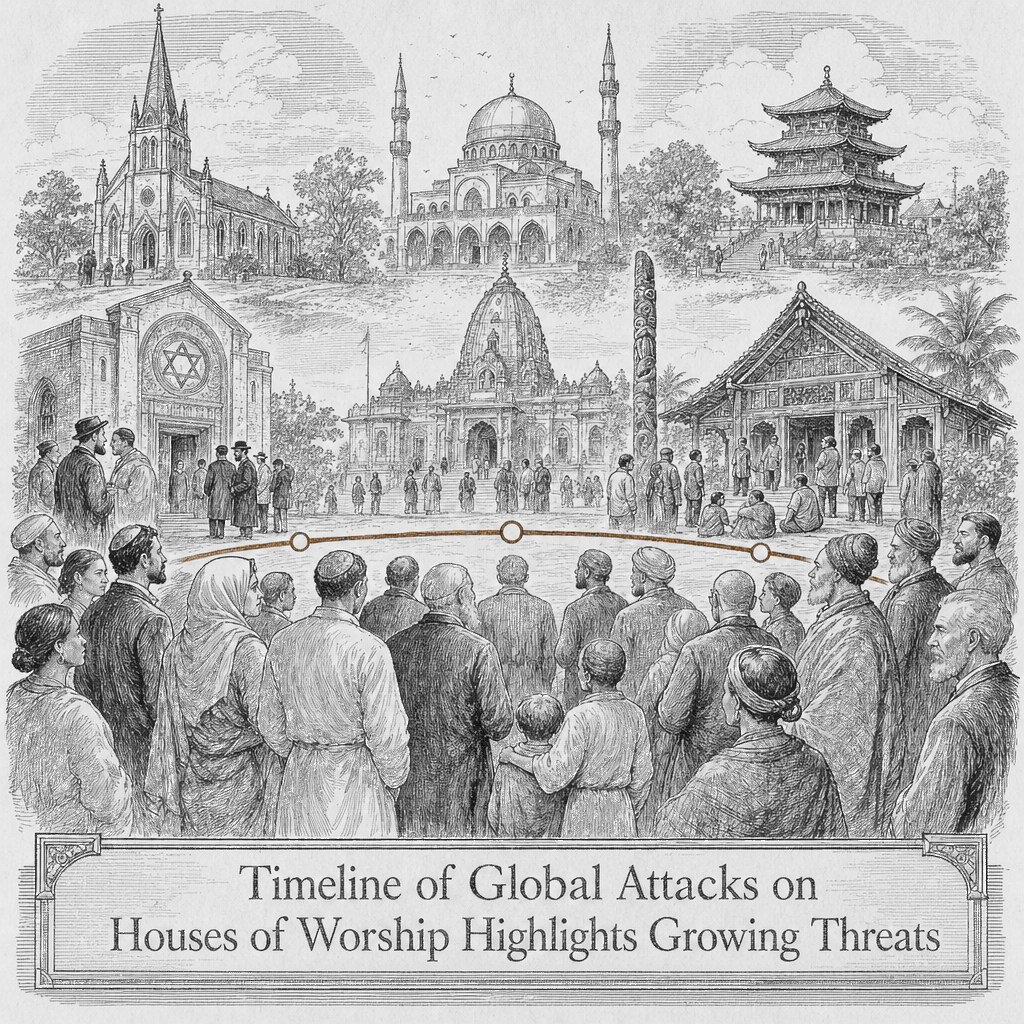
The Associated Press catalog of attacks on houses of worship over the past fifteen years, published March 12, 2026, documents dozens of cross-ideology incidents; the pattern admits two analytical readings, of which convergent tactical evolution is the one advanced here. Driven by the symbolic density and mandatory communal openness of sanctuaries, assailants selected vehicles, firearms, and explosives to exploit accessible gatherings across North America, Europe, Africa, the Middle East, and Oceania. National governments and security industries have responded to this cross-ideology targeting pattern with heightened security protocols and protective funding, generating a capacity gap that leaves marginalized congregations vulnerable while policymakers and security planners continue to negotiate the unresolved structural tension between preserving sanctuary openness and preventing mass casualties.
Tactical Convergence and Pattern Recognition
The source organizes dozens of incidents by date and casualty count, opening with the qualifier that weekly worship attendance remains one of the safest routine activities worldwide. The perpetrators identified span distinct ideological traditions, including white supremacists responsible for the October 27, 2018 Pittsburgh synagogue attack and the March 15, 2019 Christchurch mosque shootings; a suicide attacker who struck a Greek-Orthodox church near Damascus on June 22, 2025; armed rebels who raided a Catholic church in Ituri province on July 27, 2025; and a father and son who carried out what the Australian prime minister characterized as antisemitic terrorism at a Hanukkah festival on Bondi Beach on December 14, 2025. The source identifies four actor categories—white supremacists, far-right militants, Islamist extremists, and armed insurgents—and does not document operational linkages between them.
Two analytical readings of the source material are available. The first treats the pattern as reflecting direction from a single transnational network, which would require shared communications, financing, or training pipelines across the listed incidents. The source supplies none, and a smoking-gun test for cross-incident direction returns null. The reading is therefore not falsified, but the available evidence does not advance it. The second reading treats the pattern as convergent tactical evolution, in which distinct ideological traditions independently select the same target class and methods because the structural features of the targets reward them. The cross-ideology distribution of perpetrators and methods is consistent with target-class convergence. The source’s “tactical shift” framing, attributed to unnamed security experts, supports this reading. The public record consulted for this source does not include the perpetrator-side communications that would fully distinguish symbolic-ideological targeting from tactical-soft-target selection prior to target choice. Observable convergence of tactics across disparate ideological groups supports the tactical-shift reading, though it does not eliminate the role of explicit ideological directives.
Unnamed security experts cited in the source attribute the clustering of incidents to a “tactical shift” toward vehicles, firearms, and explosives, exploiting the open, communal nature of religious gatherings with clustering around high-profile holidays and worship services. The source records vehicle-ramming in London on June 19, 2017 and in a Detroit suburb on March 12, 2026; stabbings in Nice on October 29, 2020, and Manchester on October 2, 2025; firearm attacks in Sutherland Springs on December 5, 2017, Pittsburgh, Christchurch, Minneapolis on August 27, 2025, Michigan on September 29, 2025, and Bondi Beach; an attempted mass shooting in Halle on October 9, 2019; and a suicide bombing in Damascus. The cross-incidence recurrence of vehicles and firearms as attack vectors is recorded across the listed incidents.
Structural Vulnerabilities and Root Causes
Beneath the first-order cause of extremist ideology supplying motive, two structural conditions sustain the pattern across ideologies. The first is the symbolic density of religious sites. The timeline’s own selection criteria, targeting places of worship because of what they are, embodies this density. A church, mosque, synagogue, or temple functions for its community as a marker of presence and continuity, and the harm extends beyond those present to the broader community. The source’s own selection criteria, alongside the AP’s framing that such attacks “often target[] the symbolic heart of a community,” embody this density, though the source does not record assailant-side statements articulating this calculus in the perpetrators’ own words, leaving the symbolic-targeting inference to rest on the AP’s framing and on the cross-incidence recurrence of religious-site selection.
The second structural condition is openness. Religious congregations gather, by theological and practical necessity, in accessible spaces during predictable windows. The same openness that makes a sanctuary function is the feature an attacker selects for. Hardening measures—armed guards, vehicle barriers, surveillance—alter the character of the gathering without removing the underlying condition. They reduce probability; they do not address the cause, which is the doctrinal commitment to communal gathering. The source records that the gunman in the October 9, 2019 Halle attack killed a passerby and a man at a nearby kebab shop after failing to breach the synagogue’s heavy doors, illustrating how hardening measures alter the character of the gathering and redirect harm without removing the underlying vulnerability. Contributing factors distinct from the root cause include the accessibility of vehicles, firearms, and knives relative to more complex plots, the legal variance in firearm access across jurisdictions, and the financial constraints preventing many congregations from funding structural security retrofits.
Stakeholder Interests and Beneficiaries
The documented response creates identifiable beneficiaries and distinct stakeholder interests. Security vendors, insurers, and architectural firms are inferable from the “increased funding for protective measures at houses of worship” language as a class that benefits from the response, though the source does not name specific firms, contract structures, or market sizes; this entry rests on inference, not on the source’s own enumeration.
Governments named in the source—the United States, Australia, France, and other nations—have a concrete interest in a visible response to the documented pattern. Their responses include heightened security protocols, increased funding for protective measures, and legislative action on gun control and hate-crime statutes, though the source does not record which specific measures have been adopted by which government or their operational effects on the incident rate.
The extremist actors identified across the four categories are distinct ideological traditions whose convergence on religious targets is itself part of the pattern. If a chosen site is hardened, their alternative is a different symbolic target, such as schools, government buildings, or public gatherings, none of which the source discusses.
Consequences and Capacity Gaps
The central subject of the recorded policy and security planning is the structural tension between the openness essential to religious practice and the protection required to ensure physical safety. Faith communities and congregants possess the concrete interest of preserving the sanctuary function while reducing casualty probability, framing the question as how to balance “openness with protection.” Internal heterogeneity is substantial: large congregations in Sydney, Pittsburgh, or Minneapolis have institutional capacity for armed security and architectural hardening, while smaller rural churches in the United States and congregations in conflict zones such as Damascus and Ituri province lack comparable resources. The best alternative for a high-resource congregation is privately funded security; for a low-resource one, reliance on state security forces, which the source does not specify in operational terms. Marginalized faith communities that often lack the endowments to fund private security or structural retrofits possess high stakes in protective measures but lack the resources to secure them, a position recorded through the documented capacity gap.
Faith leaders hold a pastoral interest in preserving the sanctuary function, counseling survivors, and negotiating with state security, though the source does not document faith-leader-specific outcomes distinct from the broader community. Security and intelligence agencies hold a prevention interest; the trade-off, as the source frames it, is the risk of “infringing on religious freedom.” The source does not specify how that trade-off is being negotiated. If pre-emption fails, the alternative is incident response and post-attack prosecution, both of which the source records as occurring in many of the listed cases — the source notes that in many cases, the assailants were killed by police or later convicted. Security planners hold an interest in designing physical, surveillance, and threat-assessment measures that reduce casualty probability within budget. If hardening fails to deter, the alternative for congregations is reduced attendance or altered worship practice, neither of which the source documents as occurring at scale.
The structural tension between the openness essential to religious practice and the protection required to ensure physical safety remains the central subject of the source’s recorded policy and security planning, and the structural condition of openness is not a candidate for removal. What is candidate for change is the probability that an attacker, having selected the target, succeeds in producing mass casualties. The source records that probability as remaining nonzero: it documents that governments have hardened sites, increased funding, and passed legislation, and that in many cases assailants were killed or convicted, but does not record that any of these measures has, in the source, eliminated the pattern.
Future congregants, whose vulnerability will be shaped by current policy and funding decisions, are not addressed in the source’s enumeration of stakeholders. The source closes with three questions attributed to policymakers, faith leaders, and security planners: how congregations can balance openness with protection, what role law-enforcement and intelligence agencies should play in pre-empting threats without infringing on religious freedom, and how societies can address the underlying extremist ideologies. The source itself does not answer these.
Analytical techniques used in this piece
This analysis applies the methods below. Each links to a short, plain-English explainer you can read and reuse.
- Process Tracing
- Reconstructs the step-by-step causal pathway of a specific historical event.
- Root-Cause Analysis
- Traces a symptom back along its causal chain to the conditions that actually generated it.
- Stakeholder Mapping
- Charts the parties to a situation — their interests, power, and alignments.