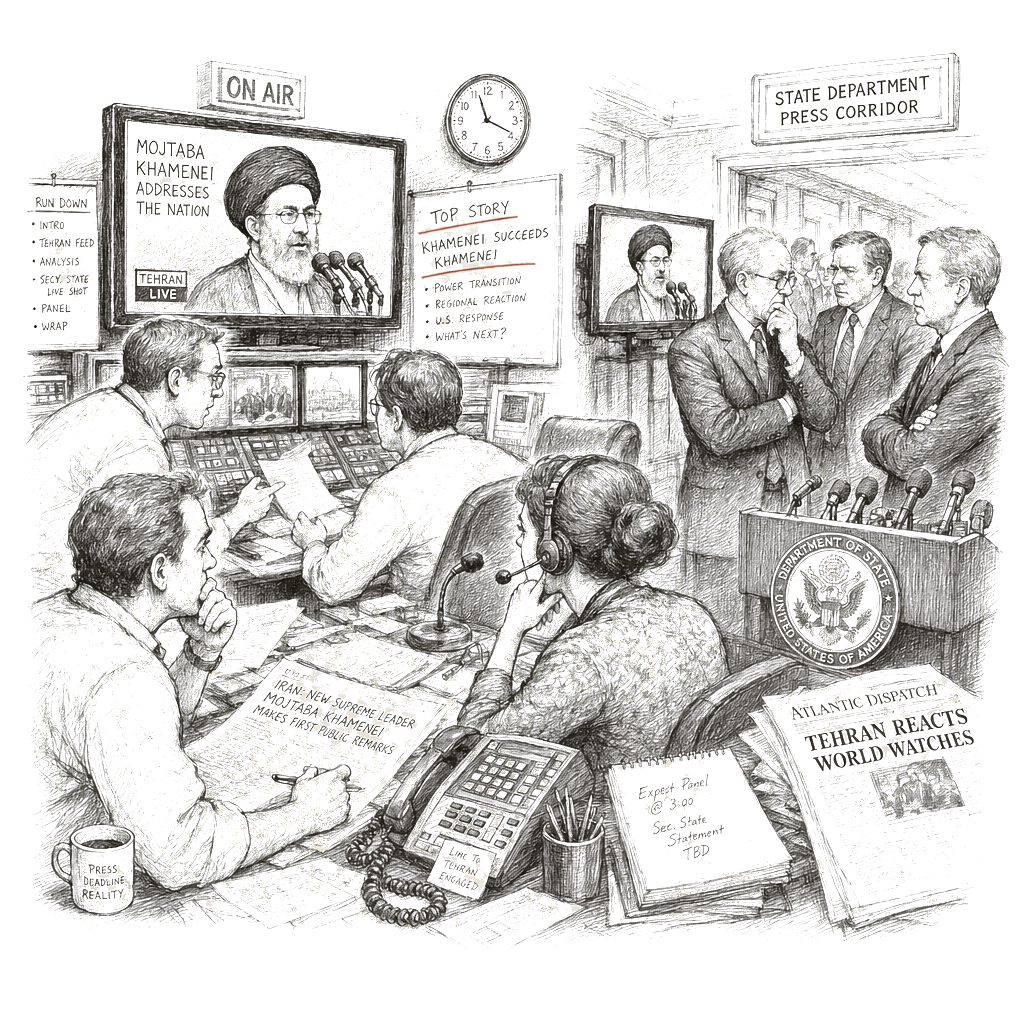
The Trump administration denounced CNN on Thursday, March 12, 2026, for airing portions of a public statement by Iran’s new supreme leader, Mojtaba Khamenei, marking the second time in three days the White House targeted the network over its coverage of the Iranian regime’s response to American attacks. The dispute centers on CNN’s decision to broadcast selected text from Khamenei’s remarks, a move the network defended as possessing obvious news value for a global audience anticipating the conflict’s trajectory. The administration’s sustained pressure highlights a broader analytical reality: the friction between the White House and CNN is no longer confined to a simple disagreement over newsgathering choices, but rather exposes compounding structural vulnerabilities rooted in CNN’s pending corporate ownership transition, the asymmetric treatment of adversary communications across digital platforms, and the heightened sensitivity of the network’s editorial-independence margin.
The dispute and its surface
The Trump administration denounced CNN on Thursday, March 12, 2026, for airing portions of a public statement by Iran’s new supreme leader, Mojtaba Khamenei, who succeeded his father following an Israeli airstrike. The Associated Press report by David Bauder characterized the criticism as the second time in three days the administration targeted the network for reporting on how Iran was responding to American attacks. The earlier exchange occurred on March 10, when White House communications director Steven Cheung criticized an interview CNN anchor Erin Burnett conducted with Hossein Mousavian, a former Iranian nuclear negotiator, during which Mousavian stated there was not much interest in talks with the United States. Cheung subsequently wrote on X that CNN regurgitates quotes and unverified information from “Iranian terrorists” and called the network “the murderous Iranian Regime’s version of Pravda.”
On March 12, the White House posted on social media that CNN broadcast “four straight minutes of uninterrupted” Iranian state television, characterizing the outlet as part of a “psychotic and murderous regime” that “prided itself on brutally slaughtering Americans for 47 years.” The dispute unfolded as CNN aired selected text rather than the statement in full. Following the speech, CNN correspondent Nick Paton Walsh debriefed anchor Kate Bolduan, focusing on the leader’s absence on camera. Walsh stated, “We were waiting to see the face of the man to have proof of his health and survival,” adding, “and they’ve not met that moment.” He noted the material was “a handwritten message, it seems,” that “mostly reiterates things we kind of already knew.”
CNN responded to the White House attack by stating it aired portions of Khamenei’s statement for their news value and argued the remarks were not exclusive, citing that CNN, Sky News, and Al Jazeera also showed portions of the statement live. “The world is watching with anticipation which direction this war will take,” CNN stated, adding that “Purported remarks from Iran’s new supreme leader are a critical component in helping audiences understand where this conflict is heading and were aired for their obvious news value.”
Media and journalism experts evaluated the White House challenge. Jane Ferguson, a veteran international correspondent and founder of the journalism platform Noosphere, told the AP the remarks were “absolutely newsworthy and legitimate” for CNN to air, arguing it is not for government leaders to “pick apart” what CNN reports. Douglas Brinkley of Rice University stated it was unfair for CNN to be singled out, while cautioning that journalists must be careful. “You have to be leery of being used as a propaganda tool by the Iranian regime,” Brinkley said, adding that knowing what the enemy is saying and looking for signs of “a peace offering or a nuance” is important. The AP framed the dispute by observing that CNN has been a favored target of President Donald Trump dating back to his first term, and noted that Paramount Global’s agreement to purchase CNN’s parent company, Warner Bros. Discovery, raises questions about CNN’s editorial independence.
The curvature of political pressure
For CNN, the dispute functions as a visibility event. The network’s quoted defense positions the outlet as indispensable to a global audience navigating an active conflict. CNN’s exposure to political criticism is compound in shape, layered onto the AP report’s observation regarding the administration’s historical targeting of the network. The White House’s “four straight minutes” claim serves as a concrete anchor for the criticism; however, CNN’s counter-anchor—that other major international networks also broadcast the material live—distributes the political heat, though it does not eliminate it.
The curvature of the White House communications posture runs in two directions. The position is compound on general public credibility, as each successive public attack generates exposure to the critique attributed to Ferguson and Brinkley, and that exposure compounds if the factual predicate of the criticism is shown to be incomplete. Conversely, the same White House position generates immediate political oxygen with the administration’s domestic base, where skepticism toward established cable media is already structural, and the durability of that oxygen does not depend on the factual predicate holding. The two curvatures coexist; the durability of the pressure pattern is read by combining them rather than by collapsing to a single reading.
Hidden exposures in ownership and platform layers
The AP report places the dispute in the context of Paramount Global’s agreement to purchase CNN’s parent company, Warner Bros. Discovery, characterizing the deal as raising questions about CNN’s editorial independence. The capacity to absorb the next incident is being structurally redrawn during the dispute itself. The review period typical for a transaction of this scale operates as a distinct pre-closing fragility vector. Editorial decisions taken during pendency can shape the working constraints that crystallize into the post-closing environment, and the AP’s characterization of the deal as raising questions reflects the active uncertainty about what those constraints will be. The substrate confirms the transaction is pending but provides no specific regulatory conditions, antitrust review status, closing timeline, or editorial-independence covenants; the pre-closing review-period fragility vector is anchored to the substrate’s general characterization, but the exact shape of the pre-closing sensitivity remains undifferentiated within the available reporting.
Beyond the ownership layer, the platform layer introduces emergent fragilities regarding digital governance. The AP report notes that several Iranian leaders and institutions maintain verified accounts on X, which is owned by Trump ally Elon Musk. CNBC reported that Khamenei has one of those verified X accounts, and an X account using Khamenei’s portrait posted the text of his remarks in Farsi and in an English translation. The AP also reported that even though Khamenei’s father is dead, an account with his portrait was active on Thursday and was mainly reposting messages from his son, including one that referenced the “revenge we have in mind” and the obligation to respond to the killing of members of the nation. X is officially blocked in Iran, though the AP reported users often bypass restrictions via a virtual private network.
The administration’s public pressure is directed at a traditional broadcaster’s use of the material, while the same material circulates on a platform owned by a political ally, with the verified-account infrastructure intact. Under Nassim Nicholas Taleb’s fragility framework, the network’s dependency on adversary-controlled information inputs constitutes a load fragility, with visual confirmation absent as the specific evidence. The information environment introduces what Taleb’s framework terms emergent fragilities; the system’s reliance on a platform owned by a political ally to host Iranian state communications during an active kinetic conflict represents a hidden concavity in the digital information infrastructure. The network’s structural position becomes concave, as it absorbs the political and reputational stress of the broadcast while its corporate ownership transition introduces latent conditions that may limit its operational flexibility to absorb future informational shocks.
The subtraction of inconsistency
The most direct subtraction available in this dynamic is the inconsistency in the administration’s pressure pattern. The fragility on the administration’s side increases as the gap between its criticism of CNN and the parallel circulation of the same material on a platform owned by a political ally widens, because the gap is what makes the critique of unfair singling out legible. The AP report’s observation that the dispute came as CNN aired selected text rather than the statement in full sits in tension with the White House’s “four straight minutes” claim. Furthermore, Walsh’s contemporaneous description of the material as a handwritten message is the network’s own characterization of the content as lower-value than the White House’s framing implies. The gap between the White House’s broadcast-duration claim and the network’s description of the material’s format is the leading edge of the credibility-side exposure. The corresponding addition of robustness, should one be made, requires a uniform standard applied across the broadcast and platform layers, since the substrate shows the same statement is moving through both, rendering the editorial question inseparable from the platform question.
Consequences, sequel, and the next three days
If the cadence of administration attacks extends beyond the current baseline, the next fracture point is most likely at the editorial-choice interface rather than at the broadcast-duration interface. The trigger shape for this stress point is a future choice to air, or decline to air, a Khamenei statement that contains either an escalation signal or a diplomatic opening. The AP report cites coverage of plans described as aimed at choking off the world’s oil supply and a statement that pledged to keep up attacks on other Arab countries in the region as escalation content. Brinkley frames the relevant diplomatic signal as a peace offering or a nuance.
The load pathway follows a specific trajectory: White House pressure feeds into editorial deliberation, which produces a broadcast decision, triggering a public response that escalates further pressure. Leading indicators that the structure is approaching a stress point include an increase in the cadence of administration attacks, a shift in target from cable outlets to broadcast networks or wire services, and the closing of the Paramount–WBD transaction, which would convert a transitional structural exposure into a settled one. The specific component most likely to yield first is not the newsgathering apparatus, which remains intact, but the editorial-independence margin in newsroom decisions about adversary material. This margin is the smallest, most discretionary element of the system and therefore the one with the highest marginal sensitivity to outside pressure.
Structural boundaries and uncertainties
The newsworthiness of adversary statements is a settled journalistic principle that is now being actively contested in the public sphere. The contest is bipartisan in the sense that the principle is being tested by political pressure rather than by an internal journalistic debate. The editorial-independence question has migrated upstream of the newsroom into the ownership layer, where the Paramount–WBD deal sits, and the timing of that migration is the load-bearing structural fact. The platform layer, featuring verified adversary accounts on X and the asymmetry in how the same material is treated across mediums, has become the under-examined third rail of the dispute; any analysis that treats the CNN–White House exchange as a closed system will miss the surface where the durability of the current pressure pattern is actually being tested.
A cross-outlet comparison of how Sky News, Al Jazeera, and the AP wire handled the same Khamenei material, alongside a closer read of the Paramount–Warner Bros. Discovery transaction terms, would test whether the AP report’s framing holds outside the U.S. cable frame.
Analytical techniques used in this piece
This analysis applies the methods below. Each links to a short, plain-English explainer you can read and reuse.
- Fragility / Antifragility Audit
- Asks whether a system gains or loses from volatility, shocks, and disorder (Taleb).
- Pre-Mortem (Fragility)
- Imagines a system has already broken and traces the structural fragilities that let it.
- Quick Orientation
- A fast lay-of-the-land read of an unfamiliar domain.
- Anchoring
- An initial number quietly drags every subsequent estimate toward it.
- Brinkmanship
- Manufacturing shared risk at the edge of catastrophe to force the other side to blink.
- Mutually Assured Destruction
- Deterrence by guaranteeing that any attack is suicidal for the attacker.
- Stanley on Propaganda
- How anti-democratic propaganda cloaks itself in the language of democratic ideals.