Summary
- The Trump administration contests journalistic broadcasting of Iranian leadership statements by redefining adversary communication as state propaganda rather than public information.
- White House officials redirect the conceptual category of newsworthiness toward national security compromise to enjoin domestic narrative control during an active conflict.
- CNN operationalizes contextualized coverage through translated excerpts and correspondent analysis to maintain editorial gatekeeping functions against executive boundary-shifting.
- The Iranian regime leverages the broadcast environment to project leadership continuity during a transition period marked by the new supreme leader’s physical absence.
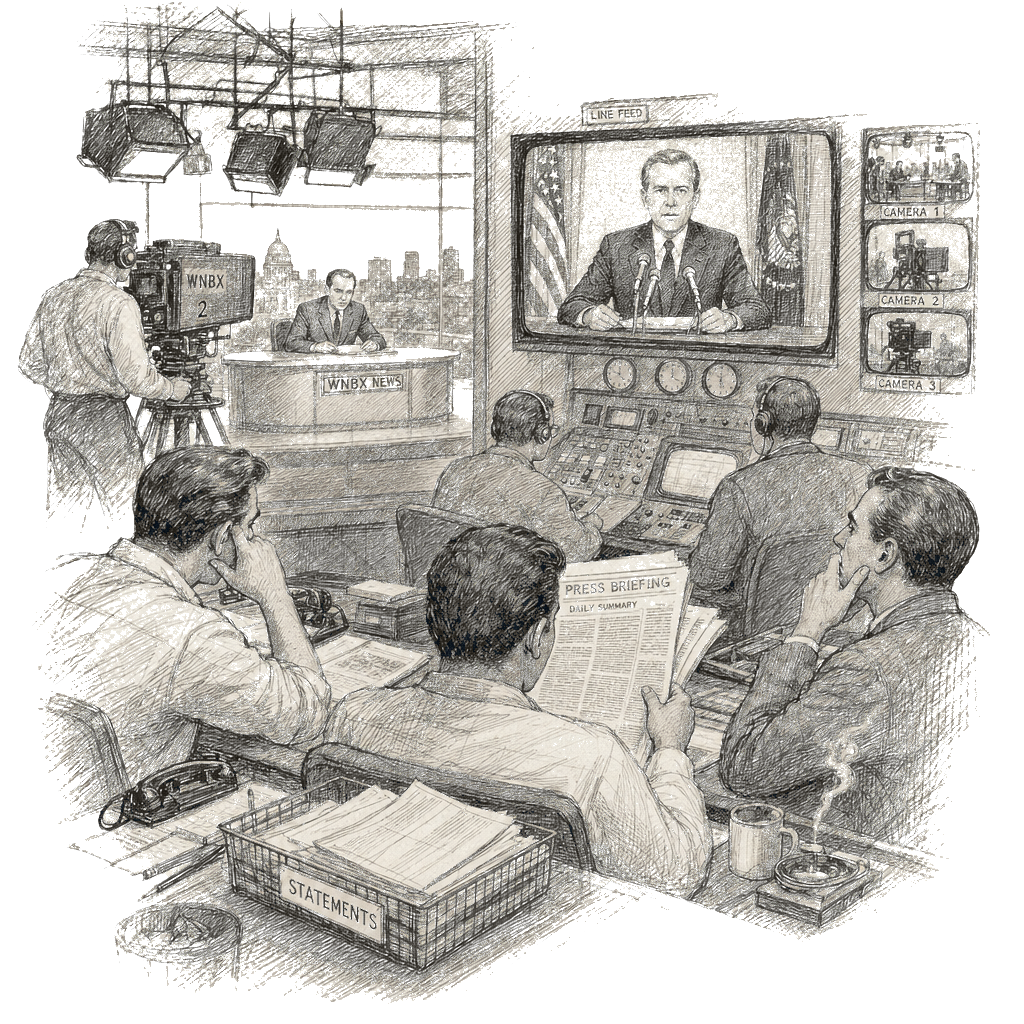
The Associated Press reported on March 12, 2026, that the Trump administration intensified its criticism of CNN for broadcasting segments of Iranian Supreme Leader Mojtaba Khamenei’s first public remarks, an event that documents a structural contest over the definition of legitimate journalism during wartime. While the White House framed the network’s coverage as a conduit for enemy propaganda, CNN and peer international outlets defended the broadcast as a standard exercise of editorial gatekeeping. The dispute documents a broader dynamic in which the executive branch leverages active conflict to recategorize adversary statements from newsworthy intelligence into national security compromises, transforming routine press coverage into a focal point for institutional friction over narrative control.
How the broadcast is being framed
The concept being contested is “newsworthiness,” which the administration reframes through the conceptual category of “enemy communication.” Administration communications relocate the practice of broadcasting adversary statements from standard journalistic inquiry to the category of national security compromise, deploying the Soviet Pravda reference as the implicit alternative norm. White House communications director Steven Cheung accused CNN of how it handles adversary communication, writing on X on March 10 that the network “regurgitates quotes and unverified information from Iranian terrorists” and has “become the murderous Iranian Regime’s version of Pravda,” the Associated Press reported. A subsequent social media post on March 12 condemned CNN for airing segments of Khamenei’s remarks, declaring that “fake news CNN just aired four straight minutes of uninterrupted Iranian state TV, run by the same psychotic and murderous regime that prided itself on brutally slaughtering Americans for 47 years,” according to the report. The Associated Press account does not specify which broadcast the social media post addressed, leaving open whether the redescription applies to the Khamenei excerpt, the earlier Mousavian interview, or another segment.
CNN defended the broadcast through standard journalistic norms. The network stated that the purported remarks were “a critical component in helping audiences understand where this conflict is heading and were aired for their obvious news value,” the Associated Press reported.
The administration’s redefinition does not distinguish contextualized coverage from raw conduit. The Associated Press specified CNN’s on-air structure: “a news anchor reading a translated excerpt of Khamenei’s remarks in Farsi, without airing the full address,” followed by correspondent Nick Paton Walsh’s analytical segment with anchor Kate Bolduan. The ameliorative purpose a revised concept of wartime reporting would need to serve is the preservation of this gatekeeping distinction under wartime pressure, when the distinction is most easily elided.
Historian Douglas Brinkley of Rice University formulated this contextualized-coverage architecture, noting in the report, “You have to be leery of being used as a propaganda tool by the Iranian regime. On the other hand, knowing what the enemy is saying and looking for a sign of a peace offering or a nuance is important… It’s a difficult balance.” CNN’s on-air structure, on the Associated Press’s account, operationalized the balance Brinkley described. Veteran international correspondent Jane Ferguson named the boundary-claim dynamic in the report, stating: “It’s not the job of government leaders to pick apart what CNN is reporting. We’ve always faced this, when reporters interview leaders or other figures hostile to American interests. This has been a bit of low-hanging fruit for a while.”
Who benefits from the dispute
The documented interests of the involved parties separate shared-integrative claims from genuinely opposed institutional objectives.
The executive branch’s documented public posture toward CNN has been characterized in the reporting as combative. The Associated Press identified “a persistent pattern in President Trump’s combative relationship with the media, particularly CNN, which he has frequently labeled ‘fake news.’” The substantive procedural interests the reporting documents include domestic narrative discipline during active conflict and sustained institutional friction with CNN that predates the current term. The reporting also notes the White House seeking to exploit concerns raised by the pending Paramount Global acquisition of Warner Bros. Discovery, which raises “additional questions about CNN’s future editorial independence.” Whether the pattern extends to a broader institutional consolidation of authority over the information ecosystem remains unestablished in the available reporting.
CNN’s documented public defense framed its conduct around editorial norms and peer practice rather than market positioning. The network emphasized the “obvious news value” of the purported remarks and noted that peer organizations including Sky News and Al Jazeera also aired portions of Khamenei’s statement live. The Associated Press and The New York Times also disseminated alerts on the remarks. The Times featured the speech as “an early indication of how the new supreme leader would approach the war, as well as how he would lead the country.” The interests documented include maintaining editorial independence under corporate-transition uncertainty and competitive positioning against peer international outlets.
The Iranian regime’s underlying interest, served by the broadcast’s existence regardless of its tone, appears to be continuity projection at a moment of leadership transition. The Associated Press reports that the new Supreme Leader did not appear in person, reportedly owing to an injury from an airstrike. Correspondent Walsh observed on air, “We were waiting to see the face of the man to have proof of his health and survival,” and noted, “they’ve not met that moment. Instead, a handwritten message, it seems.”
What the dispute predicts about persistence
The genuinely opposed interest is distributive. The executive’s wartime narrative discipline and CNN’s editorial independence cannot both be maximized simultaneously. The reporting does not resolve which interest predominates, but it supplies a diagnostic regarding the substance of the aired material. Walsh observed that the broadcast’s content “mostly reiterates things we kind of already knew.” If the substantive news value of the aired material was modest, as Walsh’s on-air assessment suggests, then the dispute’s intensity becomes a signal about the documented recurrent recategorization of CNN coverage as enemy collaboration. In this dynamic, the concept of “newsworthiness” serves as the moveable boundary. Ferguson’s characterization of the administration’s tactics as targeting “low-hanging fruit” points to the same diagnostic.
The dispute’s persistence rests on a structure the reporting documents. Three connected domains function as a learning architecture: the wartime-information domain, in which the Pravda reference indexes the Soviet model of state-controlled media as the implicit alternative norm; the press-freedom domain, in which the journalist’s gatekeeping function is treated as protected activity and the government’s role is positioned as commenter rather than regulator; and the recurrent government-press-friction domain that the Associated Press explicitly identifies. Removing the centrality of independent gatekeeping from any one domain dissolves the others. A dispute framed only as wartime information policy is also a press-freedom claim, and a dispute framed only as press freedom is also a recurring-pattern claim about how a particular administration categorizes adversary coverage.
The Associated Press’s own framing captures this dynamic, concluding that the incident reflects “a broader struggle over narrative control in wartime.” The reporting characterizes the wartime act of defining journalism as a contest over the boundaries of legitimate public communication, with one genuinely opposed axis concealed by surface agreement on the value of monitoring adversary statements.
Analytical techniques used in this piece
This analysis applies the methods below. Each links to a short, plain-English explainer you can read and reuse.
- Conceptual Engineering
- Asks not just what a concept means but what it should mean, and re-engineers it.
- Domain Induction
- Builds a working mental model of a domain from the ground up.
- Interest Mapping
- Separates parties’ stated positions from their underlying interests (Fisher & Ury).
- Anchoring
- An initial number quietly drags every subsequent estimate toward it.
- Brinkmanship
- Manufacturing shared risk at the edge of catastrophe to force the other side to blink.
- Stanley on Propaganda
- How anti-democratic propaganda cloaks itself in the language of democratic ideals.