Summary
- The current Gaza arrangement fails the definitional functions of a ceasefire, operating instead as a phased containment regime where near-daily fire and leadership decapitations continue under a stalled diplomatic track.
- Structural concave exposures to daily fire, leadership decapitation, West Bank flashpoints, and negotiation stalling compound to degrade the framework without triggering proportional responses.
- The conceptual structure lacks the integrity to absorb concurrent interface shocks, producing multiple divergent failure paths whose sequencing remains analytically uncertain.
- Diagnostic correction requires subtracting the term ceasefire from the descriptive vocabulary and treating military decapitation operations as inseparable from the negotiation track.
Under international legal frameworks and conflict-resolution scholarship, a ceasefire denotes a mutual and verifiable suspension of organized hostilities between identifiable parties. The current arrangement in Gaza fails two specific functions of this concept: it does not describe a mutual suspension, as near-daily fire and stalled disarmament tracks continue, nor does it describe a stable condition, as the overseeing diplomat describes the negotiation track as stalled. The term retains a diplomatic function by identifying a non-full-scale war status for external actors, but has lost its descriptive function, requiring a revised vocabulary that distinguishes political status from operational condition.
Framing and the ceasefire construct
The arrangement is described in current reporting as a fragile ceasefire by the unnamed top diplomat overseeing the truce, by Israel’s military, and by Hamas spokespeople, all within a single news cycle. Ceasefire denotes, in international law and conflict-resolution practice, a mutual and verifiable suspension of organized hostilities between identifiable parties.
The current arrangement fails two specific functions of the concept: first, it does not describe a mutual suspension—near-daily Israeli fire in Gaza, a stalled disarmament track, and no verifiable reciprocal steps continue; second, it does not describe a stable condition—the apparatus that would administer it, the negotiation track, has been described by the overseeing diplomat as stalled. The function the term retains is diplomatic: it identifies a status—the war is not currently in an open, full-scale phase—that allows external actors, including mediators, donor states, and United Nations agencies, to allocate resources and posture politically. The function the term has lost is descriptive: a concept that cannot describe the on-the-ground condition it is supposed to name has become a coordination device rather than a measurement.
A revised vocabulary would need to distinguish political status, such as talks ongoing and formal war footing suspended, from operational condition, where organized fire continues, leadership decapitations continue, and settler attacks continue. The operational reality aligns more closely with a phased containment regime or an active truce with targeted exception protocols than with a ceasefire. The current deployment of the term sets expectations of a cessation of major combat operations while masking ongoing targeted strikes.
Event attribution and recorded fatalities
The ceasefire arrangement took effect in October. Per Gaza’s Health Ministry—which the reporting describes as part of a Hamas-run government but staffed by medical professionals, with tallies viewed as generally reliable by international observers—more than 850 Palestinians have been killed in the territory since the arrangement took effect. This figure reflects the ministry’s tally at the time of reporting and is sensitive to the exact date. Per the same ministry, more than 72,700 people have been killed in the wider war; multiple independent sources corroborate the 70,000 to 75,000 range consistent with the ministry’s counts at publication.
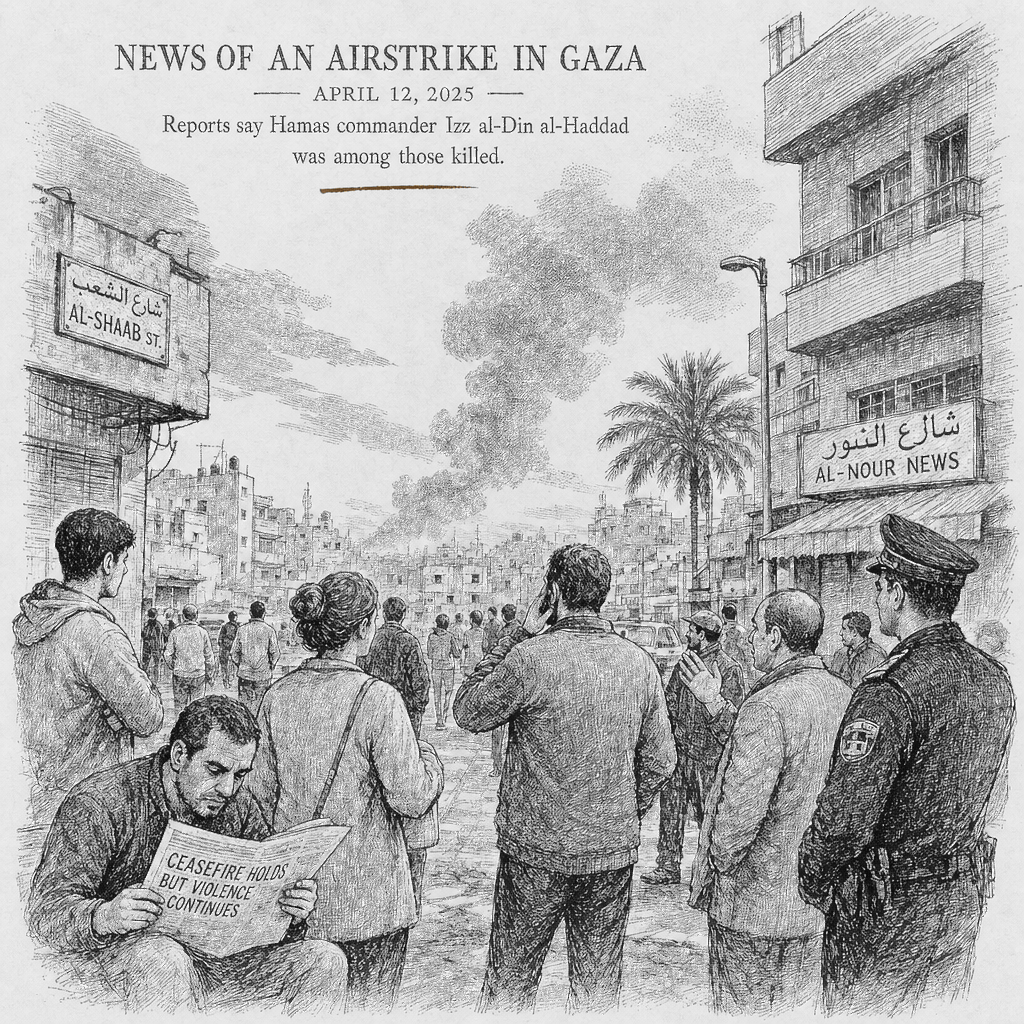
Israel’s military confirmed that Izz al-Din al-Haddad was killed Friday in an Israeli airstrike. Israel described the operation as a significant operation and labeled al-Haddad a senior Hamas military commander and one of the last surviving architects of the October 7, 2023 attacks. Those initial attacks killed around 1,200 people and resulted in more than 250 hostages being taken.
Hamas spokesperson Hazem Qassem confirmed al-Haddad’s killing via social media. Al-Haddad’s family confirmed the death to The Associated Press, which reported that six other people, including his wife and daughter, were killed in the strike, and that his two sons had been killed earlier in the war. Mourners carried his body at a Saturday Gaza City funeral wrapped in Hamas and Palestinian flags.
Israel’s military stated that al-Haddad assumed the role of Hamas commander after Mohammed Sinwar was killed. The reporting noted that al-Haddad joined Hamas when it was established in the 1980s, was a member of the Qassam Brigades’ Majd section tasked with targeting collaborators with Israel, and belonged to the Hamas Military Council, described as the highest group of commanders involved in the attacks that triggered the war. The Israeli military also alleged that al-Haddad surrounded himself with Israeli hostages during the war as a shield against an attack. Israel’s military chief of staff stated that Israel would continue pursuing its enemies to hold them accountable.
Beyond Gaza, three distinct incidents occurred in a 72-hour window in the occupied West Bank. Hassan Fayyad, 34, was shot in the Jenin refugee camp. The Palestinian Red Crescent reported he was fatally shot in a thigh; Israel’s military stated troops fired warning shots at a person trying to infiltrate the camp and shot him when he did not comply, adding that he was provided medical treatment as he was transferred to a hospital. On Thursday, Israeli troops shot and killed a 15-year-old boy in Eastern Lubban, near Nablus, according to the Palestinian Health Ministry. Israel’s military stated it identified three people hurling rocks toward Israeli vehicles and endangering lives, and that troops fired at them, killing one. Separately, Palestinian religious authorities reported that settlers set fire to a mosque and vehicles in the village of Jibiya, northwest of Ramallah. Security camera footage showed people pouring flammable material on the mosque and at least two vehicles. Sabir Shalash, head of Jibiya’s municipal council, noted that Hebrew spray-painted slogans were found on the mosque’s walls.
The Ministry of Awqaf and Religious Affairs characterized the Jibiya attack as a cowardly terrorist act and criticized international inaction over mounting Jewish settler attacks against Muslim and Christian sites in the occupied Palestinian territories. Israel’s military and police stated they deployed to the area, did not locate any suspects while investigating, and strongly condemn attacks on religious institutions. The top diplomat overseeing the truce stated that the talks have stalled over the deadlock on disarming Hamas, and that both sides have traded accusations of ceasefire violations.
Structural exposure and systemic stressors
The arrangement, taken as a system, is exposed to several distinct stressors with different frequency-and-magnitude profiles. The daily-fire pattern presents a primary exposure. Israeli fire in Gaza has been near-daily since the ceasefire took effect. The frequency is high; each individual incident may be small in military-system terms, but the cumulative toll, per the Health Ministry, is more than 850 dead. This represents a structurally concave exposure where small frequent costs accumulate against a structure—the diplomatic ceasefire—that does not register the accumulation. Each individual incident can be administratively absorbed or denied, but the cumulative load degrades the structure.
The leadership-decapitation stressor is evident in the killing of al-Haddad, a member of the Military Council, described as a significant operation. The diplomatic function of the arrangement is concave to leadership-decapitation operations. The immediate effect is signaling and confirmation by Hamas via Hazem Qassem and the funeral, while the medium-term effect is succession through the Military Council. The structure does not register this cycle as a degradation event. A hidden concavity exists in the decapitation profile. Each decapitation event eliminates a known, legible command node but risks replacing it with a decentralized, fragmented, or more radical structure less susceptible to traditional deterrence. The arrangement absorbs small stresses through continued targeted strikes, but the accumulated stress of repeated command disruptions produces a disproportionate, non-linear degradation of enforceability.
The West Bank flashpoint stressor is demonstrated by the three distinct incidents in a 72-hour window. The structure is concave to these flashpoints in a tail-risk sense. Each incident is small and can be administratively isolated, but the tail event—a religious-site attack producing a major escalatory response, or a troop-shooting incident producing popular mobilization—is the load condition the structure is least able to absorb. Dependency fragility exists at the Gaza-West Bank interface. Violence in the West Bank generates emergent stress that propagates back into the Gaza ceasefire dynamic, providing Hamas or affiliated factions with operational pretext to retaliate. The ceasefire’s stability depends on the assumption that West Bank friction can be contained.
The negotiation-track stressor reveals that the track is stalled over disarmament. The arrangement is concave to continued stalling in a way that compounds with the other stressors. Each day the track is stalled, the on-the-ground incidents continue to accumulate, the structure’s remaining diplomatic function erodes, and the incentives for either party to return to the table decline. Load fragility characterizes the entire framework. The arrangement is subjected to the load of ongoing combat operations—including the killing of al-Haddad and the deaths of Hassan Fayyad and a 15-year-old in the West Bank—while simultaneously being expected to function as a cessation of hostilities. The conceptual structure is not designed to bear both loads without fracturing.
State fragility is absolute. The 72,700-plus deaths and accumulated destruction have crossed thresholds that make a return to the pre-October 2023 status quo structurally impossible. The ceasefire is a temporary pause applied to a fundamentally altered territory, not a mechanism for restoring a previous state. The structure, taken as a whole, classifies as fragile. No element identified in the available reporting gains from volatility; each is concave to stress.
Strategic beneficiaries of the disorder
Diplomatic intermediaries maintain continuous engagement frameworks throughout the stalemate, producing a structural relevance-preservation effect. Israel’s military maintains a documented operational tempo of targeted strikes and containment without initiating a full-scale ground re-invasion, yielding intelligence collection and political positioning effects. Hamas factions use the lack of definitive resolution to sustain public messaging and reconstitute infrastructure under the cover of the truce, producing recruitment-narrative and asymmetric-leverage effects. These observable dynamics create structural incentives that complicate the push for a definitive peace. Whether these actors actively seek this disorder remains an analytical inference rather than documented intent; no element identified in the available reporting is unambiguously documented as gaining from volatility, but the structure creates incentives that may benefit certain actors.
Failure paths and structural sequel
The structure has not failed in a single dramatic sense; it has been failing in a distributed sense since the arrangement began. The yield pattern follows a specific sequence: a specific load condition exceeds a specific component, the component yields, and the failure migrates. The load-migration sequence is a chain rather than a single event.
Path A involves the negotiation track yielding under the load of the daily-fire pattern. The track is held together by the assumption that parties can return to a table and that the disarmament question is the operative disagreement. As long as fire is near-daily and the toll is in the hundreds, the diplomatic language loses purchase on both internal constituencies. On the Israeli side, daily fire is framed as retaliation and interdiction; on the Hamas side, daily fire and decapitation operations are framed as violations. The track has no vocabulary that allows it to operate against a condition the structure’s own label says does not exist.
Path B involves the West Bank flashpoint channel yielding. The Jibiya incident pattern—religious-site fire-setting, no suspects located, official condemnation with no operational follow-through—is the leading-indicator pattern. The structure can absorb one such incident; it cannot absorb a sequence in which religious-site attacks, troop-shooting incidents, and settler violence appear in the same reporting cycle as Gaza-side fire. The load condition is concurrent flashpoint events, forcing the diplomatic track to either treat them as connected and lose the isolated-incident framing, or treat them as separate and lose the ceasefire-is-holding framing.
Path C involves the leadership-decapitation cycle yielding. If hostage-shielding is a feature of the command layer, then decapitation operations cannot reach the layer’s highest remaining members without producing either hostage casualties—a condition for which the Israeli side has documented political exposure—or operational pauses, a condition the stalled diplomatic track cannot afford. The load condition is a hostage-casualty event connected to a decapitation operation; the structure has no described protocol for this event.
Path D involves Israeli political rupture. If a high-casualty incident in Gaza or a retaliatory strike from the West Bank produces domestic political shock in Israel, the government may abandon the containment framework in favor of a renewed large-scale ground offensive, shattering the ceasefire from the Israeli side.
Path E involves stalled disarmament producing internal collapse. If the deadlock stretches without humanitarian or political relief, internal Palestinian pressure or a shift in regional diplomatic alignments could force Hamas to abandon the truce entirely, collapsing the arrangement from within.
Ordering divergence exists between analytical streams regarding these paths. Documented reporting supports multiple failure sequences depending on which stressor is weighted as primary. Weighting the daily-fire pattern yields Path A as the leading indicator; weighting the West Bank flashpoint channel yields Path B; weighting political variables yields Path D or E. The divergence is recorded as a tension rather than resolved, and the ordering across all five paths is genuinely uncertain. A structural note ties the failure paths together. The ceasefire concept relies on a unified command to enforce it on the Hamas side. The continued fragmentation of that command, accelerated by killings like al-Haddad’s, means the system lacks the structural integrity to absorb the inevitable interface shocks.
Diagnostic corrections through subtraction
The fragility is not primarily a problem of insufficient additions such as more monitors, more terms, or more engagement, but of a misnamed condition. The first diagnostic correction subtracts the word ceasefire from the descriptive vocabulary of the arrangement and replaces it with a term that distinguishes political status from operational condition. The revised vocabulary would not change the on-the-ground condition but would stop the diplomatic track from operating against a label the available reporting contradicts, and would force the structural question of what is being administered and toward what end to be answered in terms the on-the-ground reporting can support.
The second diagnostic correction subtracts the assumption that leadership-decapitation operations are a separable track from the negotiation track. The reporting shows them in the same news cycle, in the same structure, producing the same effect of signaling and cycle-reset. Operating them as separable tracks is what allows the diplomatic track to describe the arrangement as a ceasefire while the military track produces the conditions the diplomatic track says do not exist.
Diagnostic summary
At least one hidden concave exposure, the daily-fire pattern, is already accumulating. The load conditions most likely to exceed the structure’s components are the conditions already present in the reporting. The available reporting does not allow a confident prediction of timing. It does allow the specific diagnosis of a fragile structure with concave exposure on every identified stressor, conceptual drift in the term used to describe it, an antifragility layer on top that stabilizes the disorder it is supposed to be resolving, and four-to-five distinct pre-mortem yield paths whose ordering is genuinely uncertain.
Analytical techniques used in this piece
This analysis applies the methods below. Each links to a short, plain-English explainer you can read and reuse.
- Conceptual Engineering
- Asks not just what a concept means but what it should mean, and re-engineers it.
- Fragility / Antifragility Audit
- Asks whether a system gains or loses from volatility, shocks, and disorder (Taleb).
- Pre-Mortem (Fragility)
- Imagines a system has already broken and traces the structural fragilities that let it.
- Antifragility (Taleb)
- Whether shocks break a system, leave it unharmed, or actually make it stronger.