Summary
- Pyongyang’s twin June 14 Foreign Ministry statements, declaring denuclearization “finally and irreversibly concluded” and inaugurating a previously unpublicized “Department 10” as a dedicated inter-Korean messaging channel, compound the tension between the allied coalition’s denuclearization objective and a nuclear trajectory that has advanced during the period the coordinating framework has been operative.
- North Korea’s 2022 nuclear weapons policy law, adopted by the Supreme People’s Assembly, codified the right to first use and removed conditions under which denuclearization had previously been conceivable, establishing the “irreversible” language as a constitutional assertion rather than a negotiating posture.
- If Department 10 matures into a durable, compartmentalized entity with separate command authority, the bifurcation of signaling — one channel managing universal deterrence, another delivering targeted pressure against Seoul — introduces a variable that complicates crisis communication beyond baseline hostile rhetoric.
- The allied coalition faces a decision that the June statements have made more difficult to defer: whether denuclearization functions as a policy goal requiring a credible path to realization, or as an alliance-management principle whose value lies in maintaining consensus rather than correspondence to achievable outcomes.
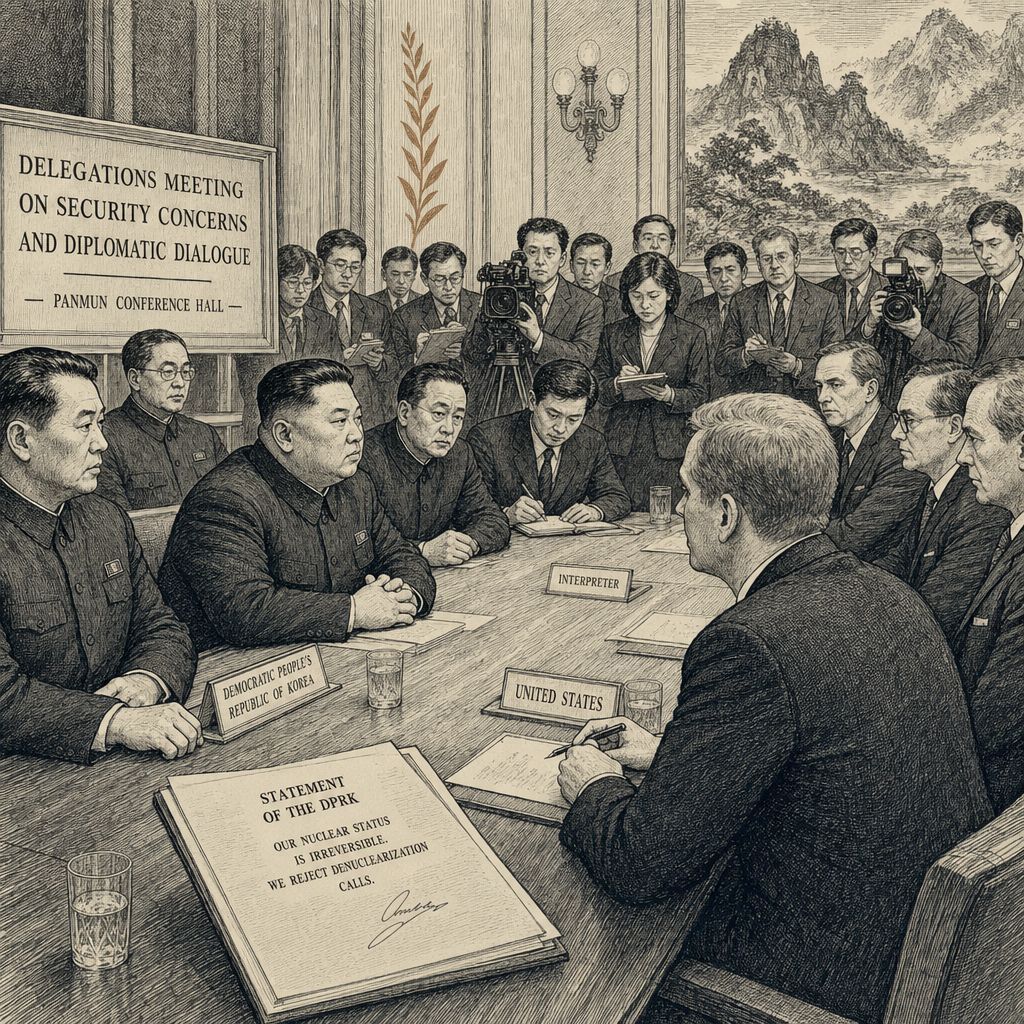
Pyongyang published two Foreign Ministry statements on June 14, reported by North Korean state media and translated by UPI, responding to the sixth meeting of the South Korea–U.S. Nuclear Consultative Group in Seoul on June 11, trilateral consultations with Japan, and a South Korea–European Union summit. The standard spokesperson declared denuclearization “an issue that has been finally and irreversibly concluded,” rejecting the framework the allied partners reaffirmed days earlier. A second statement, issued under the previously unpublicized designation of “Department 10” of the Foreign Ministry, directed targeted language at South Korean President Lee Jae Myung — referring to him as “the South Korean ruler” and accusing him of “throwing off the mask of peace” — and labeled South Korea the “foremost hostile state” and “a dagger” of the United States. The quoted language appears verbatim from the UPI wire; independent verification against the underlying Korean-language KCNA transcript was not available for this analysis.
The Constitutional Assertion
Pyongyang’s “finally and irreversibly” language does not describe a bargaining position; it describes a constitutional status. North Korea’s 2022 nuclear weapons policy law, adopted by the Supreme People’s Assembly in September 2022 per KCNA reporting, codified the right to first use and removed conditions under which denuclearization had previously been conceivable. The June statements reassert that legal framework. The allied position rests on the premise that denuclearization remains achievable; the Nuclear Consultative Group, launched under the 2023 Washington Declaration, was designed to operationalize that premise by strengthening extended deterrence while keeping denuclearization as the declared end state. North Korea’s nuclear capability has advanced in both operational capacity and legal codification during the period these coordination mechanisms have been operative. The analytical question is not whether Pyongyang means what it says — its legal and operational trajectory has been consistent since at least the 2017 nuclear and missile testing cycle — but what decision the allied coalition now faces regarding a goal the counterpart has formally declared non-negotiable.
The standard spokesperson’s statement also referenced “military and technical countermeasures” using “all available capabilities,” signaling possible additional weapons development or military activity. Pyongyang cited arms transactions among the United States, Japan, and South Korea and joint exercises based on scenarios involving nuclear weapons as justification for strengthening its self-defense capabilities. The EU, at its summit with South Korea, stated: “The DPRK will never be accepted as a nuclear-weapon State under the NPT or have any other special status in that regard.” The EU called on Pyongyang to comply with its international obligations.
The Institutional Shift
The decision to issue one statement under “Department 10” rather than the established ministry spokesperson carries signaling value regardless of the division’s permanence. North Korea’s foreign policy apparatus has historically been segmented by target audience. The creation of a dedicated department for South Korea-related messaging, if confirmed by subsequent statements, suggests Pyongyang is institutionalizing the inter-Korean relationship as a distinct policy domain separate from its broader diplomatic posture. The critical question for allied analysts is whether Department 10 operates under a separate command authority, which would introduce an unpredictable variable into future crisis management.
Ryu Hyun-woo, a former acting North Korean ambassador to Kuwait who defected to South Korea, assessed that Department 10 may be operating from a separate physical location due to limited space at the Foreign Ministry’s main building and that Kim Yo Jong, Kim Jong Un’s sister, would likely continue to issue statements on inter-Korean matters when authorized, even if the new department assumes a greater public role. This assessment is recorded with an unresolved sourcing caveat: web verification has not located an independent intermediary source attributing these specific Department 10 operational assessments to Ryu, and one analytical stream removed the attribution on sourcing discipline grounds while the other retained it with the minority-view qualification. Ryu’s assessment, if accurate, suggests Department 10 may not displace the existing informal channel but layer atop it — raising the question of whether the institutional change is better understood as bureaucratic layering rather than structural decoupling. If it does operate as a distinct compartmentalized entity with a dedicated inter-Korean focus, the bifurcation of signaling — one channel managing universal deterrence, another delivering targeted pressure against South Korea — would alter the risk calculus beyond baseline hostile rhetoric. Whether the compartmentalization proves useful for de-escalation or serves as a conduit for more precisely calibrated pressure depends on decisions not yet made on either side.
The Seoul Tension
Seoul’s position contains an internal tension: President Lee campaigned on engagement and inter-Korean dialogue but has continued to endorse the allied denuclearization framework, which North Korea characterizes as a hostile act. Department 10’s statement accused Lee’s government of contradicting its stated policy of peaceful coexistence by continuing to support North Korea’s denuclearization. South Korea’s presidential office assessed that the statements “largely restated Seoul’s established position” and pledged continued efforts to reduce tensions. That assessment may reflect access to non-public intelligence on Department 10’s actual status or routine minimization; open sources cannot verify which interpretation applies. The creation of a new public-facing designation warrants allied analytical attention regardless.
Policy Decision Architecture
The current policy architecture — NCG coordination, trilateral consultations, EU engagement, extended deterrence, sanctions — has produced coordination mechanisms and defense integration but has not altered Pyongyang’s nuclear trajectory. The allied coalition faces three broad postures, none without significant cost.
An acceptance-based engagement — accepting North Korea’s nuclear status as a basis for engagement — would unlock diplomatic space encompassing arms control, security guarantees, and normalization, but would fracture allied consensus, raise proliferation concerns, weaken the NPT framework, and face domestic political opposition in both South Korea and the United States.
A continuity approach maintains the denuclearization commitment alongside existing pressure mechanisms. Its analytical challenge is that the gap between declared objective and demonstrated trajectory has widened during the period the mechanisms have been operative, which raises questions about the framework’s instrumental credibility even if its alliance-management function remains intact.
A defer-and-monitor approach would maintain coordination while reducing the rhetorical commitment to denuclearization as a near-term negotiating objective, focusing on threat management, confidence-building measures, and crisis communication — preserving alliance cohesion while adjusting expectations. For the NCG, extended deterrence must now map against a threat environment where the bureaucratic origin of a statement is as analytically significant as its content.
The Analytical Core
The “irreversible” nuclear status declaration establishes the floor of North Korea’s posture. The emergence of Department 10, if it matures into a durable channel, could shift the ceiling for operational hostility. Pyongyang’s narrative architecture — now buttressed by Department 10’s targeted messaging — appears designed to outlast treaty-based objections, shifting the burden of de-escalation onto Seoul while insulating its broader diplomatic corps from the fallout of targeted hostility. The allied coalition faces a denuclearization objective formally rejected by its target and one that has not prevented the target’s nuclear capability from advancing. If denuclearization is a policy goal, it requires a credible path to realization that the current framework has not produced. If it is an alliance-management principle, its value lies in maintaining consensus rather than in correspondence to achievable outcomes. The June statements have made the choice between those two readings more difficult to defer.
Remaining Uncertainties
Whether Department 10’s emergence constitutes genuine institutional restructuring or a temporary propaganda choice remains unresolved. It would require domain-expert assessment of North Korean Foreign Ministry organizational history and the significance of novel departmental labels in state media to determine.
Seoul’s assessment that the statements restated its established position may reflect intelligence advantage or routine minimization; open sources cannot verify which.
Stakeholder coverage maps all actors identifiable from the source article but cannot confirm completeness without Korea-specialist review. China and Russia are absent from the public exchange but are materially affected structural stakeholders in the nuclear posture, the NPT framework, and the allied deterrence architecture the June statements engage. Their omission from the immediate public record does not indicate irrelevance; it indicates that the bilateral and trilateral channels through which Beijing and Moscow engage these issues operate outside the scope of what the source material documents.
The Ryu Hyun-woo assessment regarding Department 10’s operational characteristics remains unverified through available open-source tools. The unresolved sourcing gap is flagged in the Institutional Shift section above and the assessment is retained with that qualification rather than presented as established fact.
Analytical techniques used in this piece
This analysis applies the methods below. Each links to a short, plain-English explainer you can read and reuse.
- Decision Clarity
- Articulates the real stakes, stakeholders, and interests behind a decision facing a third party.
- Mutually Assured Destruction
- Deterrence by guaranteeing that any attack is suicidal for the attacker.