Summary
- The Supreme Court’s pending rulings on birthright citizenship, TPS termination, and Federal Reserve removal authority constitute a structural test of whether the executive branch can reshape constitutional interpretation, immigration protections, and institutional independence through unilateral action absent legislative settlement.
- Congressional inaction on immigration reform and institutional design has left statutory and constitutional ambiguities that executive orders exploit, placing the judiciary in the role of drawing boundaries the legislature has not drawn.
- The three cases raise distinct legal questions — constitutional text, statutory authority, and separation-of-powers structure — making a unified judicial statement on executive authority unlikely and a split outcome across the cases analytically plausible.
- Public coverage of the disputes has been sourced asymmetrically, with the constitutional-commitment frame represented by a single expert voice and no counter-voices from the textualist or institutional-independence perspectives, leaving public understanding tilted toward one dimension of the cases.
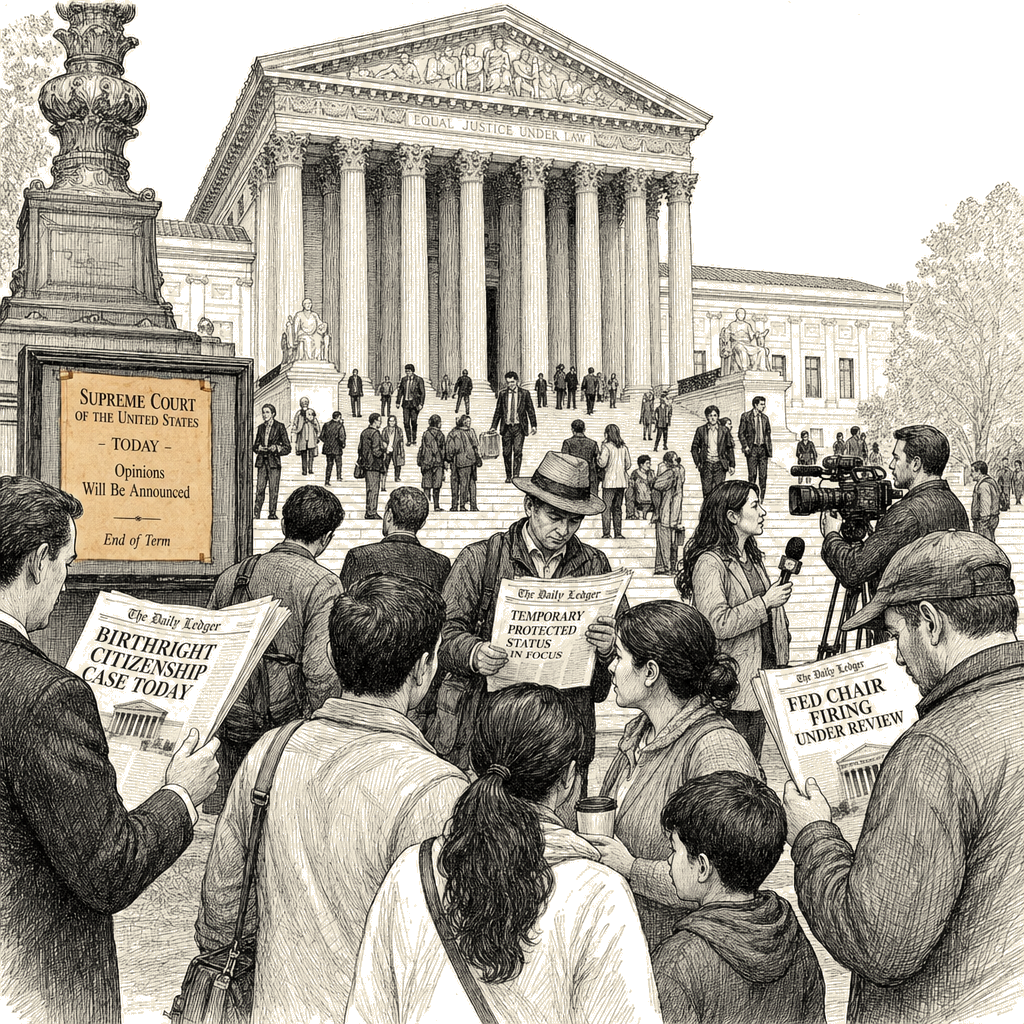
The Supreme Court is expected to release opinions on at least three politically consequential cases before the current term ends: President Donald Trump’s executive order ending birthright citizenship for children of undocumented immigrants and temporary residents; the administration’s attempt to terminate Temporary Protected Status designations for Haiti and Syria; and a dispute over the president’s authority to remove a member of the Federal Reserve Board of Governors. The rulings will arrive at the intersection of constitutional interpretation, immigration statutory authority, and structural separation-of-powers questions, and may determine whether the executive’s capacity to act unilaterally across these domains faces enforceable judicial limits or remains open for future administrations to test.
The constitutional question: birthright citizenship
The 14th Amendment’s Citizenship Clause provides that “all persons born … in the United States, and subject to the jurisdiction thereof, are citizens.” The administration’s executive order reads “subject to the jurisdiction thereof” as an independent textual limit that excludes children of parents who lack permanent legal status or hold only temporary authorization, on the theory that such parents are not fully “subject to the jurisdiction” in the relevant constitutional sense.
The administration’s strongest argument distinguishes United States v. Wong Kim Ark (1898), which held that a child born on U.S. soil to non-citizen parents domiciled in the United States was a citizen. The distinction rests on the claim that Wong Kim Ark addressed parents lawfully domiciled and thus fully subject to U.S. law, and that children of undocumented or temporarily authorized parents are not similarly situated. A textualist reading of the Citizenship Clause could support the administration’s position; the argument is not foreclosed by textual analysis alone. Subsequent interpretation, however, has understood Wong Kim Ark’s principle to extend broadly to nearly all persons born on U.S. soil, subject only to narrow, historically recognized exceptions such as children of foreign diplomats.
Adam Strom, executive director and co-founder of Reimagining Migration, described birthright citizenship as “one of America’s most consequential commitments — the idea that where you are born, not where your parents came from, determines your belonging to this nation” and said “for the millions of immigrant-origin children in our schools, this isn’t an abstraction. It’s the ground they stand on” (quoted in The74, via The Guardian, June 18, 2026). Strom’s framing captures the constitutional-commitment dimension of the dispute. The textualist dimension — whether the clause’s language supports a narrower reading than the one that has prevailed for over a century — is not represented by a comparable expert voice in the source material.
During oral arguments, “several justices cast doubt on the administration’s legal theory.” The diagnostic value of this signal is limited for two reasons: oral-argument skepticism is a notoriously unreliable predictor of outcomes, as justices frequently challenge the position they later vote to uphold; and the reported questioning centered on the textual and historical sufficiency of the government’s case rather than on threshold doctrines that would insulate the order from review. The observation that a textualist reading could support the administration’s position means the argument-questioning signal does not foreclose a ruling in the administration’s favor.
Two competing scenarios structure the birthright citizenship question. Under the first, the Court accepts the textualist reading and upholds the order, validating a pathway for future administrations to reinterpret constitutional provisions by executive action. Under the second, the Court reaffirms the established interpretation that virtually everyone born on U.S. soil is a citizen at birth, resolving the immediate case but leaving the underlying incentive to test executive authority intact absent legislative action.
TPS termination and statutory authority
The TPS case asks whether the statutory framework permits the administration to terminate designations at will or whether such terminations are subject to a substantively reviewable standard under the Administrative Procedure Act. TPS allows nationals from designated countries experiencing armed conflict, environmental disaster, or other extraordinary conditions to live and work in the U.S. legally. Haitian and Syrian immigrants covered by TPS would lose their protected status if the administration prevails. The specific statutory language governing termination authority is not reproduced in the source material, and no comparable public argument signal exists for this case, leaving the outcome genuinely open.
The TPS dispute illustrates the same root pattern as the birthright citizenship case — executive testing of institutional boundaries through litigation — operating on a different constitutional and statutory backdrop. Where the birthright citizenship case turns on constitutional text, the TPS case turns on statutory authority and the boundary between executive discretion and congressional intent. Congressional inaction on comprehensive immigration reform has left the TPS termination authority ambiguous in statute, creating the gap the administration’s position exploits.
Federal Reserve removal and institutional independence
The Federal Reserve case concerns whether the president may remove a Board of Governors member at will, implicating the separation-of-powers framework that has historically insulated the central bank from direct political control. The dispute connects to a broader line of structural constitutional questions about the scope of presidential removal power over independent agencies. Congress designed the Federal Reserve’s governance structure without specifying the consequences of an attempted removal, a gap that now faces judicial resolution.
A ruling expanding Federal Reserve removal authority could alter the de facto independence of the central bank, with consequences for monetary policy and financial stability. The case operates in a distinct doctrinal domain from the two immigration disputes — structural separation-of-powers principles rather than constitutional text or statutory interpretation — which makes it the case most likely to diverge from the other two in outcome.
Structural cause: executive action filling legislative gaps
A persistent mismatch between immigration policymaking by executive action and legislative gridlock that has prevented Congress from enacting comprehensive reform underlies the two immigration cases before the Court. When legislative avenues remain blocked, administrations of both parties have increasingly turned to executive orders, rulemaking, and enforcement memoranda to reshape policy. The Federal Reserve case exhibits the same structural dynamic in a different domain: Congress has designed institutional governance without specifying the boundary conditions the executive is now testing.
Presidents pursue unilateral measures to satisfy constituencies and reshape policy rapidly, knowing that legal challenges will work through the courts over a period of years. The Court’s willingness to grant certiorari on these three cases in a single term, and its decision to address the merits rather than decline review, reflects institutional choices about which questions the judiciary must resolve — the Court is not merely a passive recipient of cases.
The alternative causal chain points to congressional inaction and legislative under-specification rather than executive ambition alone. Congress has not legislated on birthright citizenship’s scope, has left TPS termination authority ambiguous in statute, and has designed the Federal Reserve’s governance structure without specifying the consequences of an attempted removal. Under this chain, the executive fills gaps that Congress has left open.
Scenario space across the three cases
Five scenarios span the possible outcomes.
S1 — the Court rules against the administration on all three cases, establishing or reinforcing limits on executive authority in constitutional interpretation, immigration policy, and agency independence. S2 — the Court rules narrowly on procedural or standing grounds in one or more cases, avoiding constitutional merits, preserving the status quo operationally but deferring substantive questions to future litigation. S3 — the Court rules for the administration on one or more cases, expanding the recognized scope of executive authority. If the birthright citizenship order is upheld specifically, it validates a pathway for future administrations to reinterpret constitutional provisions by executive action. S4 — the Court splits across cases, distinguishing between domains rather than issuing a unified statement on executive authority. The three cases raise distinct legal questions — constitutional text, statutory authority, structural separation-of-powers principles — making a split analytically plausible. S5 — rulings turn on narrow, case-specific grounds that neither expand nor constrain executive authority in any meaningful systemic sense; the term’s significance has been overstated by calendar convergence.
No comparable public argument signal exists for the TPS or Federal Reserve cases. The TPS outcome may turn on the specific statutory language. The Federal Reserve outcome may turn on removal-power precedent referenced only obliquely in the source material. The scenario space remains genuinely open across all three disputes.
Frame asymmetry in public presentation
Four identifiable frames structure the public presentation of the rulings: constitutional commitment and national belonging, represented by Strom’s framing; textualist and originalist dimensions of the Citizenship Clause’s “subject to the jurisdiction” language; statutory authority and executive discretion versus congressional intent on TPS; and institutional independence and Federal Reserve removal power.
The dominant public presentation treats the cases as discrete immigration disputes grouped by pending status. Strom is the only named expert quoted in the source material. The article does not include voices supporting the administration’s legal position, voices from the Federal Reserve independence perspective, or voices from the textualist tradition. This sourcing asymmetry leaves counter-frames underrepresented in the coverage the public has access to.
What the rulings will determine
Whether the rulings, taken together, establish a meaningful constraint on the executive’s capacity to act unilaterally across these domains, or whether they leave sufficient ambiguity for future administrations to continue testing the same boundaries, is the question the pending opinions will answer. Strom’s characterization captures one dimension — the constitutional-commitment dimension — of what is at stake for affected populations. The institutional dimension — whether the Court draws enforceable lines around executive authority in immigration, central bank independence, and constitutional interpretation simultaneously — is the dimension that determines whether the structural dynamic of executive action filling legislative gaps meets a judicial limit or persists as an open pathway.
Analytical techniques used in this piece
This analysis applies the methods below. Each links to a short, plain-English explainer you can read and reuse.
- Argument Audit
- A full structural audit of an argument’s premises, inferences, and load-bearing assumptions.
- Differential Diagnosis
- Lists the candidate explanations for a symptom and rules them out one by one.
- Root-Cause Analysis
- Traces a symptom back along its causal chain to the conditions that actually generated it.