Summary
- The Trump administration’s selective-outcome victory frame and former President Barack Obama’s cumulative cost-benefit assessment impose contradictory accountability benchmarks on the US-Iran ceasefire negotiations, constraining each party’s flexibility in structurally distinct ways.
- Obama’s analytical baseline assumes JCPOA-era continuity; the administration’s baseline assumes the post-withdrawal environment in which Iran had already expanded its nuclear capacity — neither is factually incorrect, but each implies a different set of obligations for the memorandum of understanding signed this week.
- The administration’s narrative contains what the rationalist community, following Scott Alexander, terms a motte-and-bailey: verified destruction of Iranian conventional military capacity — the defensible claim — sheltering the broader assertion that the war has prevented Iranian nuclear development, a claim the ceasefire does not obviously secure.
- Iran’s negotiating position, articulated through chief negotiator Mohammad Bagher Ghalibaf’s “red lines” and retaliation language, draws strength from 15 weeks of demonstrated conventional resistance and from the domestic political dimension each American frame creates.
How the competing frames operate
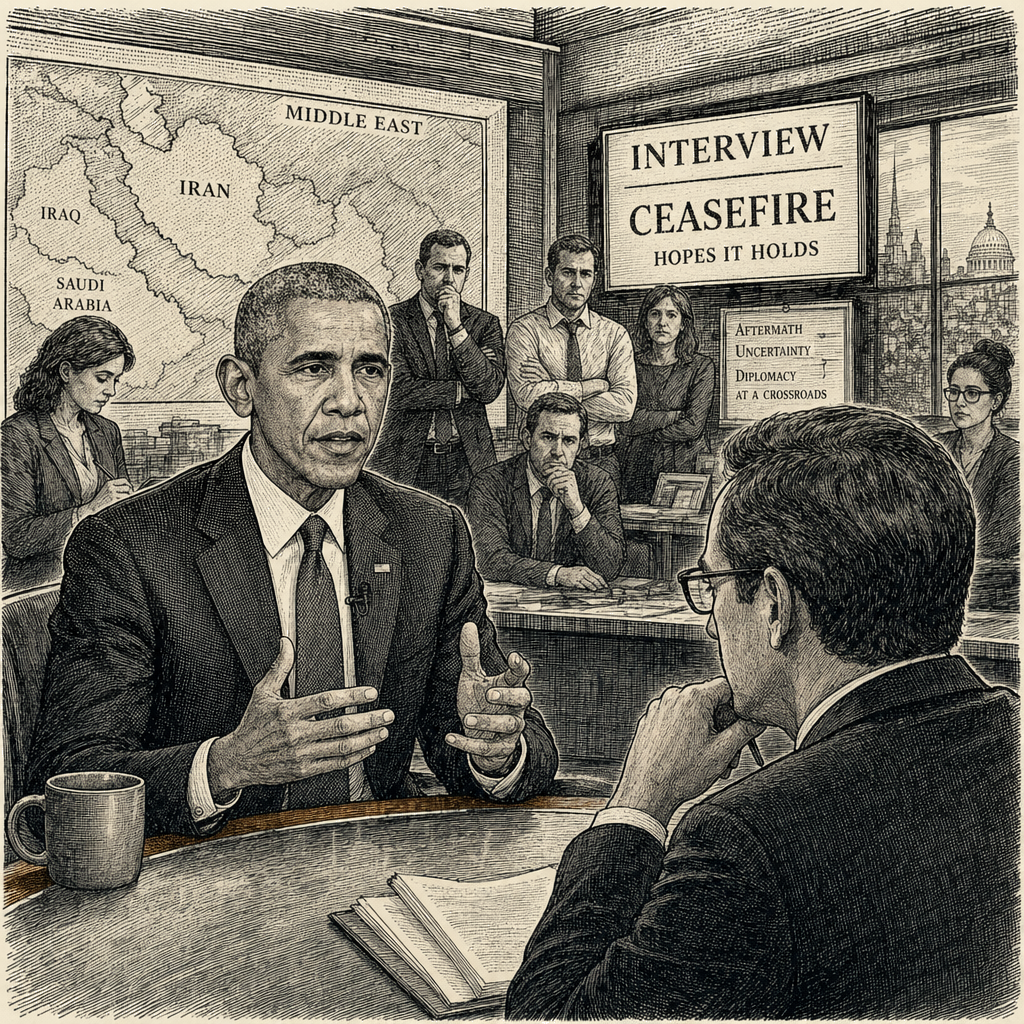
Former President Obama, in an interview with NBC News aired Friday, assessed the 15-week conflict against a cumulative cost ledger. “We’ve now fought a war, spent billions and billions of dollars, you know, put enormous strain on our military. A lot of people have died. And it feels like we’re back where we were before we started the war, except maybe a little bit worse off,” Obama said, according to a transcript published by The Guardian. Vice President JD Vance, speaking at the White House on Thursday, selected outcome-category metrics — falling gas prices and the destruction of Iran’s military capacity — as evidence the peace plan is “already bearing fruit for America.”
The two frames are structurally different accounting methods applied to the same set of outcomes. Obama’s frame weighs inputs — expenditure, military strain, casualties — against strategic gains and produces a net negative. The administration’s frame isolates select outputs from the cost side and presents them as vindication. Neither is factually incorrect on its own terms; the difference lies in what each frame counts and which baseline each adopts.
Obama’s baseline is the JCPOA-era status quo ante — the environment in which, as he stated, “Under the JCPOA, Iran had agreed not to develop nuclear weapons.” He attributed the subsequent deterioration to President Donald Trump’s withdrawal: the president “pulled out of it, which caused then Iran to develop more nuclear capacity.” This baseline implicitly assumes the agreement would have held indefinitely absent US withdrawal — an assumption that is itself contestable, given the sunset clauses and regional dynamics that were already straining the deal before 2018. The administration’s baseline is the post-JCPOA environment, in which Iran had already expanded its enrichment capacity, making the war a response to a degraded status quo rather than a disruption of a stable one.
The motte-and-bailey in the administration’s narrative
The administration’s narrative contains a coherence tension. It cannot simultaneously claim the war was necessary to prevent a nuclear-armed Iran and that the ceasefire — with Iran still possessing what Obama describes as expanded nuclear capacity — represents victory. The argument structure fits what the rationalist community, following Scott Alexander, terms a motte-and-bailey: a defensible, verifiable claim — the destruction of Iranian conventional military capacity, which the administration’s recorded objectives do include — sheltering a broader, less defensible one — the claim that the war has prevented Iranian nuclear development, which the ceasefire does not obviously secure.
All Graham Allison’s Model II organizational-behavior analysis (Essence of Decision, 1971) observes that rational-actor accounts of government decisions frequently mask competing bureaucratic and procedural logics. Here, the competing frames produce not merely different retrospective assessments but different accountability standards for the MOU ahead. The victory narrative constrains the administration’s negotiating flexibility: concessions that satisfy Iran’s criteria may conflict with the domestic success story, while Obama’s counterfactual standard creates a competing benchmark the administration would prefer not to be measured against.
The competing frames also serve prospective positioning. Each frame, if accepted publicly, implies a different set of obligations and expectations for the negotiations. The administration’s frame implies that leverage is preserved and results are already in hand; Obama’s frame implies that the baseline cost of the conflict already exceeds the gains, raising the threshold of what the MOU must deliver to justify the expenditure.
Underlying interests and leverage
The US position, as articulated by Vance, is that the deal is “already bearing fruit” and that leverage is retained: “if the Iranians don’t comply, we still have every single tool and point of leverage that we have today.” The underlying interests include economic stability — the falling gas prices Vance cited — military de-escalation, and a verifiable constraint on Iranian nuclear development. The last is an inference drawn from the administration’s stated war rationale rather than from any explicit link to the MOU’s terms, which have not been made public.
Iran’s position, as articulated by Ghalibaf through Iran’s official IRNA news agency, demands that negotiations respect what he called “red lines” — reportedly conditions involving a ceasefire in Lebanon — accompanied by a demonstrated-retaliation threat: “If the enemy becomes excessive [in its demands], we have proven that we are ready to retaliate and will not hesitate to deliver a stinging response.” The underlying interest is recognition as a negotiating party whose security concerns extend beyond the nuclear file to regional proxies and commitments — a linkage the US has not publicly agreed to make. Iran’s posture is conditional cooperation, not capitulation.
The JCPOA itself remains the most salient historical evaluative criterion and served as a prior commitment device: a verifiable, monitored, multilateral framework that constrained Iranian enrichment in exchange for sanctions relief. The 2018 withdrawal demonstrated that US commitment to the arrangement was reversible — a signal that likely affected Iran’s willingness to invest in compliance with successor arrangements. Iran’s threat credibility is bolstered by 15 weeks of demonstrated conventional resistance and by a repeat-play posture: having absorbed the loss of conventional military capacity and continued to negotiate, Iran signals that US leverage may not extend to the nuclear domain Obama described as expanded. Ghalibaf’s language is consistent with a party that reads the time horizon — and the domestic political dimension — as working in its favor.
The interaction displays features of a finite-horizon commitment game. James D. Fearon’s rationalist framework identifies commitment problems — situations where mutually acceptable bargains exist but cannot be credibly enforced because one party’s bargaining position is shifting — as a central mechanism preventing settlement. Iran’s nuclear development trajectory may create a capability threshold beyond which the strategic calculus shifts fundamentally, generating the conditions under which backward induction shapes both parties’ postures: Iran delays and develops capability as leverage; the US seeks to extract maximum concessions before the horizon closes.
Fallback positions are asymmetric. The US fallback is return to conflict — further strain on an already-strained military, further spending beyond the “billions and billions of dollars” Obama cited, further loss of life. Iran’s fallback is continued resistance from a position of reduced conventional capacity but retained — and, per Obama’s claim, expanded — nuclear capacity.
The negotiating horizon
The ceasefire can hold only if both parties believe continued conflict would be costlier than the current settlement — a condition Obama’s “worse off” claim implicitly asserts has not been met for the United States, and Ghalibaf’s retaliation-acceptance language implicitly asserts has not been met for Iran.
The MOU’s verification standard remains opaque. Its text has not been made public, so it cannot be assessed against the JCPOA’s verification architecture or any novel standard. Without binding enforcement and verification mechanisms, the underlying commitment problem remains unresolved, and the cycle of escalation and ceasefire risks repeating at higher cost.
The administration’s retention of “every single tool and point of leverage” is a future threat whose credibility depends on willingness to re-escalate after a ceasefire already declared victorious. Vance’s assertion that the president “believes in this deal, he is going to see it to completion” is a commitment signal attempting to counter the credibility deficit created by the prior JCPOA withdrawal; its success depends on institutional factors — congressional support, verification capacity, Iran’s assessment of staying power — beyond presidential intent. The White House confirmed that Vance delayed a planned trip to Switzerland to lead new nuclear-focused talks with Tehran, signaling intent to pursue direct nuclear diplomacy alongside the ceasefire framework.
Both parties signal resolve and condition cooperation on the other’s concession. Vance’s coercive-retention language and Ghalibaf’s retaliation language operate symmetrically. Chris Voss’s critique of principled negotiation — that high-stakes adversarial negotiations require tactical empathy and calibrated questions rather than the cooperative default Roger Fisher and William Ury prescribe — describes this interaction more accurately than the integrative frame.
Domestic accountability and strategic sustainability
Obama, speaking at the dedication of the Barack Obama Presidential Center in Chicago, positioned the Iran policy debate within a broader argument about democratic accountability. He urged Americans to “play a part in assuring that our elected officials are accountable” during what he described as a period of “disruption, polarization” in which “our democracy, our civic habits and virtues, our shared understanding of how we treat each other has started to crumble.”
The analytical significance lies in the intersection: the ceasefire’s political sustainability domestically and its strategic sustainability with Iran are linked through the accountability frame the public adopts. If the administration’s selective-outcome frame holds, the political costs of resumed conflict rise less steeply, preserving the coercive leverage Vance described. If the counterfactual-baseline frame dominates, each subsequent escalation carries the compounded cost of prior expenditure without corresponding gains — constraining the administration’s future options regardless of nominal leverage. Ghalibaf’s language suggests Tehran reads this domestic dimension: a US administration facing accountability pressure has less latitude for renewed escalation, which shifts Iran’s negotiating position.
The competing claims about the war’s outcome cannot be adjudicated without an answer to a question neither party has addressed: what, precisely, has been constrained.
Analytical techniques used in this piece
This analysis applies the methods below. Each links to a short, plain-English explainer you can read and reuse.
- Argument Audit
- A full structural audit of an argument’s premises, inferences, and load-bearing assumptions.
- Principled Negotiation
- Works a negotiation from interests, options, and objective criteria rather than positions.
- Strategic Interaction (Game Theory)
- Models a situation as a game — players, moves, payoffs, and likely equilibria.
- Mutually Assured Destruction
- Deterrence by guaranteeing that any attack is suicidal for the attacker.