Summary
- The Trump administration’s failure to seek congressional authorization for the Iran war creates a structural legislative bind that threatens to delay or reshape the Pentagon’s $80 billion supplemental funding request, as the Senate lacks the 60 votes needed to advance the package under standard procedures.
- The Pentagon’s cost estimate for the Iran war escalated from $29 billion in mid-May to an $80 billion composite covering multiple operations within roughly one month, following a historical pattern in which initial U.S. military cost estimates substantially understate eventual appropriations.
- Sen. Chris Murphy, a Senate Appropriations Committee member, stated there are not 60 Senate votes for the supplemental, grounding Democratic opposition in constitutional-process objections — a posture documented as more durable than policy-based opposition against changing battlefield conditions.
- The administration’s bundling of nondefense priorities such as farm and disaster relief into the supplemental represents an attempt to build a broader voting coalition, though the strategy risks fracturing Republican fiscal conservatives who oppose using budget reconciliation for wartime spending.
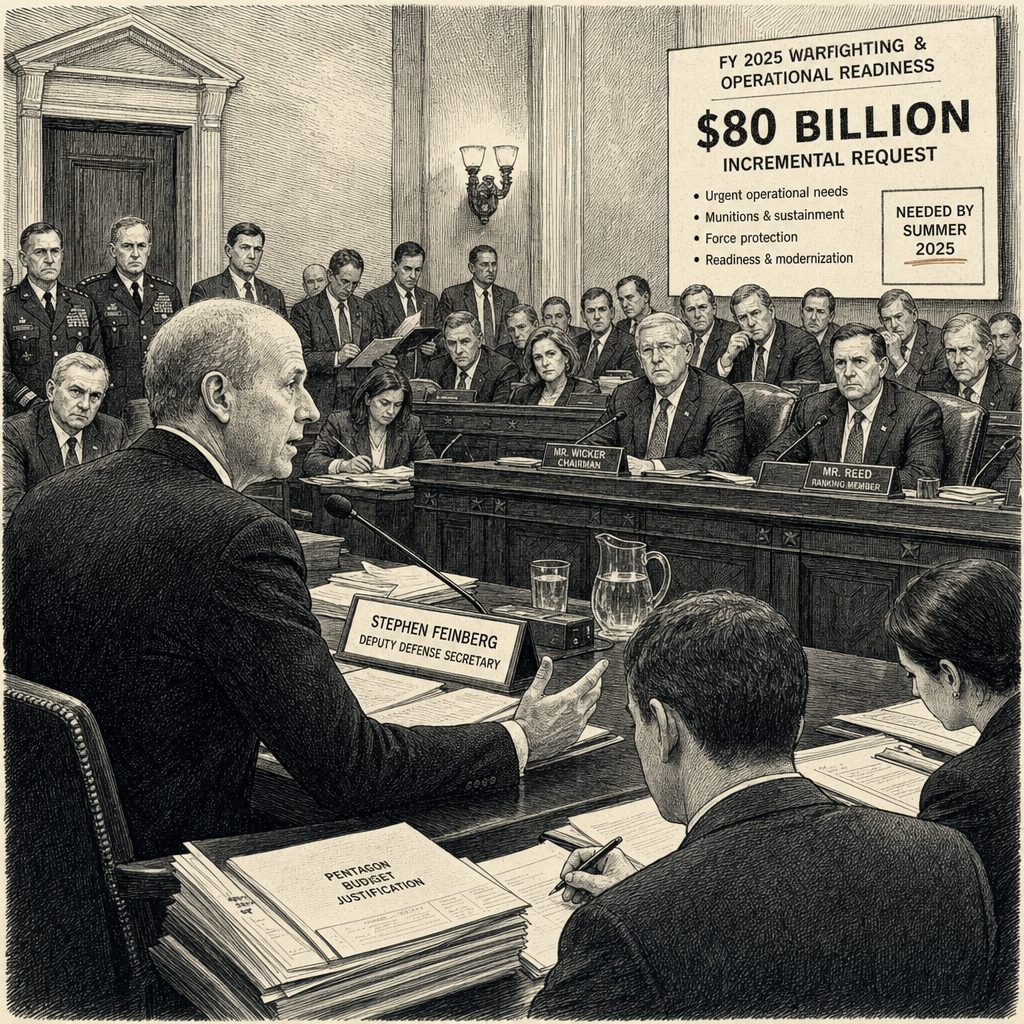
Deputy Defense Secretary Stephen Feinberg told lawmakers in phone calls this week that the Pentagon needs $80 billion to cover costs from the Iran war and other operations, according to people familiar with the discussions. The figure represents the Pentagon’s first comprehensive price tag for the conflict that began Feb. 28. Pentagon leaders warned the military could run out of operating funds this summer without a new wartime spending bill, forcing cuts to training exercises and other priorities. The request has not yet received approval from the White House’s Office of Management and Budget, meaning it has not formally reached Congress — yet its disclosure to lawmakers through direct Pentagon outreach signals either genuine operational urgency or a deliberate effort to build legislative support before the formal process begins. Both explanations may be operative simultaneously, and the available reporting does not provide sufficient basis to discriminate between them.
Cost escalation and the historical pattern
The $80 billion figure is a composite encompassing Iran war costs, operations along the U.S. southern border, the military action in Venezuela, and counter-narcotics strikes in the Caribbean and eastern Pacific. The Pentagon estimated the Iran war’s cost at $29 billion in mid-May; roughly one month later, officials stated the earlier figure was “likely higher” before arriving at the $80 billion composite for all operations. If the Iran war cost has risen to a range of $30–35 billion, the remaining roughly $45–50 billion plausibly covers those other commitments. The speed and magnitude of this revision raise questions about the quality of cost modeling available at the time the conflict was initiated.
The pattern is well-documented across prior U.S. military operations. The Bush administration estimated in 2003 that the Iraq war would cost $50–$60 billion; cumulative appropriations ultimately exceeded $800 billion, according to the Senate Joint Economic Committee. Whether the Pentagon’s initial underestimation reflects genuine operational uncertainty or institutional optimism in initial budgeting is not determinable from available information, but the directional consistency across reference classes is clear. The Congressional Budget Office and Congressional Research Service have documented that post-conflict obligations for Iraq and Afghanistan ran into the trillions over decades, raising questions about whether the $80 billion request will prove adequate as a one-time ask. The Iran war’s trajectory is not fixed; escalation could force a far larger supplemental later in the year.
Without a detailed breakdown of how the $80 billion divides among Iran operations, border deployments, the Venezuela action, and Caribbean strikes, opponents will have grounds to characterize the request as a general defense top-up exploiting the urgency of an unauthorized war — an attack line that would complicate Republican unity.
The authorization-funding bind
The Trump administration never sought congressional authorization for the Iran war, which began Feb. 28. This distinguishes the conflict from the 1991 Gulf War and the post-9/11 authorizations for Afghanistan and Iraq, each of which received a prior authorization vote. Sen. Chris Murphy (D., Conn.), a member of the Senate Appropriations Committee, stated: “There are not 60 votes in the Senate for a supplemental. I think that’s a pretty true statement that’s not going to change anytime soon.” His position on the Appropriations Committee gives him direct access to the whip count.
Because most legislation requires 60 votes to advance in the Senate, Republican leadership would need Democratic support to pass the supplemental under standard procedures. The alternative — budget reconciliation, which requires only a simple majority — has been publicly opposed by senior Republican appropriators. This produces a three-way bind: the Pentagon warns it will exhaust operating funds this summer; the administration has not sought a use-of-force authorization; and the procedural tools available to the majority party are either insufficient in votes (standard passage) or opposed by members of the majority’s own caucus (reconciliation).
Given the administration’s demonstrated lack of interest in seeking authorization, the path of disaggregation into a smaller, strictly defense supplemental passed on a party-line reconciliation vote appears the more likely route, though it depends on whether Republican appropriators reverse their stated opposition. Pairing the request with an authorization vote would require the White House to concede the legal ground Democrats demand — a step it has so far avoided.
Process durability and Democratic positioning
Murphy characterized the war as “wildly unpopular” and asserted that the administration “made no effort to keep Congress in the loop.” This frames the Democratic position as grounded in process objections — the absence of authorization — rather than solely in policy disagreement about the conflict itself. Process-based objections tend to be more durable than policy-based ones: senators who oppose a war on policy grounds may be moved by changing conditions, while those who object on constitutional-process grounds are unlikely to fund operations they regard as unauthorized regardless of battlefield developments. This distinction matters for the funding timeline. If Murphy’s characterization of the whip count holds, no shift in the war’s military trajectory will move the vote count absent an authorization step the administration has shown no willingness to take.
Strategic bundling and coalition architecture
The full supplemental will include nondefense priorities such as farm and disaster relief. This bundling strategy expands the coalition of members with affirmative reasons to vote for the package beyond those who support the war — agricultural-state senators and members representing disaster-affected districts become potential yes-votes. Whether bundling can generate sufficient support to overcome the 60-vote threshold remains uncertain, but the inclusion signals that the administration recognizes the authorization deficit as a binding constraint and is attempting to compensate through coalition architecture rather than through a use-of-force vote.
The bundling also introduces a countervailing risk. Senior Republican appropriators who oppose reconciliation may resist a package they view as expanding spending through nondefense sweeteners, potentially fracturing the majority’s own fiscal conservatives.
Operating urgency and its dual valence
Pentagon leaders warned the military could “run out of operating funds this summer,” forcing cuts to training exercises and other priorities, according to people familiar with the discussions. The summer deadline adds urgency, but deadlines have been stretched historically; the larger variable is whether the White House decides a fight over war authority is worth the cost of a funding failure. The urgency also functions as an admission that the executive branch allowed the services to burn through appropriations without a clear funding strategy — a charge that will surface in hearings.
Sen. John Barrasso (R., Wyo.), one of the senators who met with Defense Secretary Pete Hegseth on Tuesday, said they spoke about the necessity to ensure the military has the resources it needs. “There’s been a draw down, as you know, of weaponry. We need to make sure that that’s refilled,” Barrasso said. His comment signals at least some willingness within the Republican conference to support replenishment spending, though it does not resolve the procedural question of how the supplemental advances.
The chain and its compression
The relationship structure follows a chain: the Pentagon generates the operational requirement, OMB gates the formal request, the White House determines whether to seek authorization alongside funding, and Congress holds the procedural leverage to condition either on the other. Each node can delay or redirect the outcome; no single actor controls the full pathway. The Office of Management and Budget holds a gatekeeper dependency — the request cannot go to Congress without White House approval, introducing an internal executive-branch negotiation that could delay or reshape the package.
Feinberg’s phone calls to lawmakers transmit the Pentagon’s estimate, giving the number institutional weight. Hegseth’s meetings with senior Republican senators test the conference’s appetite. The Pentagon’s direct outreach represents an attempt to compress the chain by building congressional support in parallel with, rather than sequentially after, the OMB review process. The request’s timing — arriving before formal OMB review — is itself notable. Supplemental requests that reach Congress without OMB sign-off are unusual and suggest either that the operational funding pressure is genuine and time-sensitive, or that the administration views early congressional engagement as strategically necessary even before the formal request is finalized.
What the $80 billion actually represents
The available evidence does not establish whether the $80 billion figure represents the Pentagon’s operational assessment of actual need, an opening position calibrated for negotiation, or a figure designed to impress upon lawmakers the scale of the commitment the executive branch has undertaken without their authorization. Comparison with classified ship-movement and munition-consumption data could indicate whether the request tracks actual operational burn rates, while contemporaneous Pentagon–OMB correspondence might reveal the negotiating dynamics behind the figure’s finalization. The three interpretations carry different implications for the funding timeline and for the broader question of executive-legislative war powers, and the reporting does not provide sufficient basis to discriminate among them.
Analytical techniques used in this piece
This analysis applies the methods below. Each links to a short, plain-English explainer you can read and reuse.
- Bayesian Hypothesis Network
- Updates the probabilities of competing hypotheses as evidence accumulates.
- Red-Team Assessment
- Models a capable adversary probing a plan for the seams they would exploit.
- Relationship Mapping
- Extracts the network of ties among people, institutions, and entities.
- Bayesian Reasoning
- Starting from base rates and updating beliefs proportionally as evidence arrives.