Summary
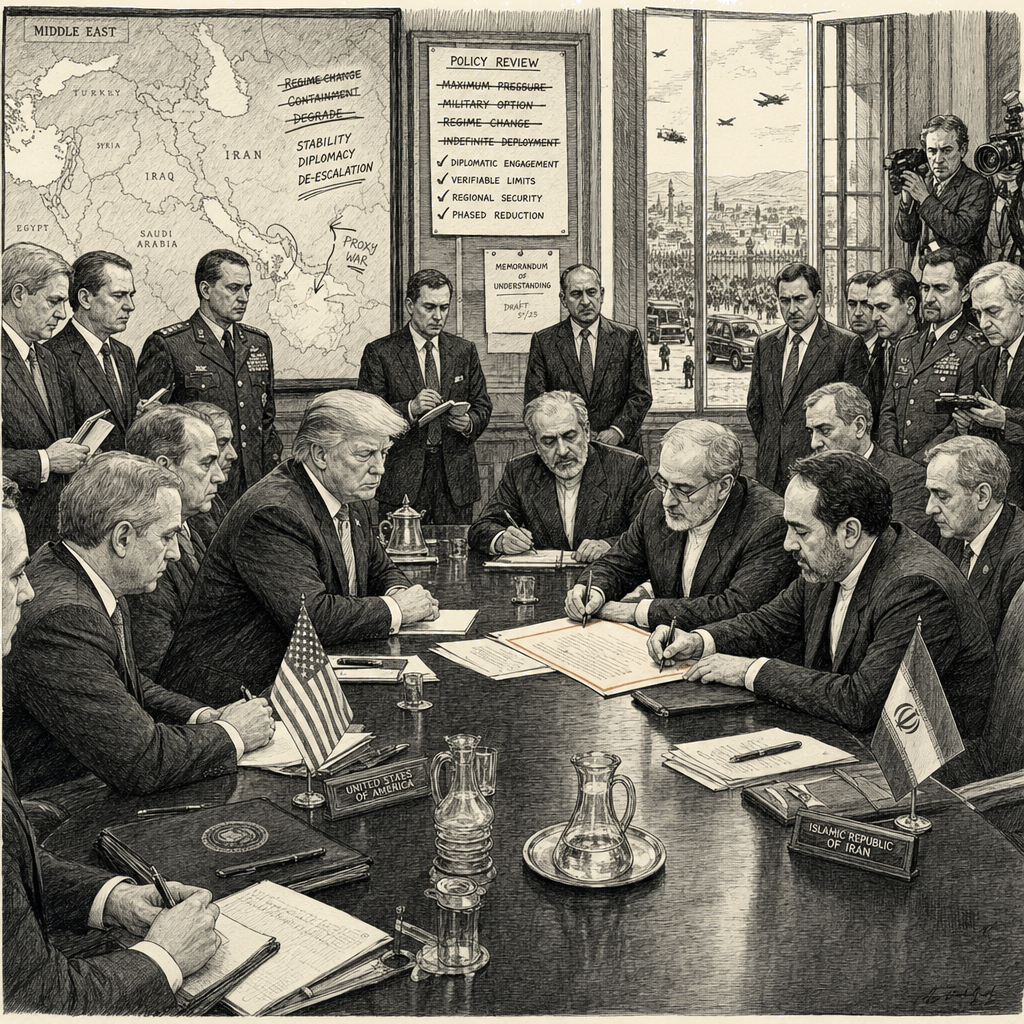
- President Trump abandoned most of the maximalist war objectives declared on Feb. 28 — including regime overthrow, missile and navy destruction, and proxy elimination — and signed a memorandum of understanding with Iran that preserves Tehran’s missile force, permits oil exports, and narrows the U.S. position to nuclear non-proliferation.
- Iran’s closure of the Strait of Hormuz imposed global economic costs — rising gas prices, accelerating inflation, and depleted oil reserves — that shifted the best-alternative-to-negotiated-agreement calculation for both parties, making continued conflict costlier than phased accommodation.
- Mojtaba Khamenei’s succession and the Islamic Revolutionary Guard Corps’ expanded influence consolidated Iranian regime authority after the Feb. 28 strike, producing the opposite of the regime-change trajectory the initial military campaign was designed to catalyze.
- The MOU ties sanctions relief to negotiation progress rather than providing upfront benefits, preserving U.S. sequencing control while deferring the hardest questions — missiles and proxies — to parallel tracks that lack defined frameworks, timelines, or participant mandates.
President Trump’s declared objectives for the U.S. military campaign against Iran have narrowed substantially over four months of conflict, from demands for unconditional surrender and the destruction of Iran’s military capabilities to a memorandum of understanding that permits Iran to sell oil, retains its missile force, and centers the bilateral relationship on nuclear non-proliferation. The shift reveals the single demand — preventing an Iranian nuclear weapon — around which all other concessions were arranged, as well as the economic and strategic costs that made the maximalist position untenable.
What was demanded and what was settled
On Feb. 28, the day an Israeli airstrike killed Supreme Leader Ali Khamenei and other senior officials, Trump posted a video on Truth Social listing expansive goals: the destruction of Iran’s missiles and the factories that produce them, the elimination of Iran’s navy and air force, the weakening of regional proxies including Hezbollah to the point they could never again threaten the region, and the assurance that Iran could not develop a nuclear bomb. In the video, Trump characterized the Iranian regime as “a vicious group of very hard, terrible people,” called for Iran’s “unconditional surrender,” and urged Iranian demonstrators who had taken to the streets in January to “wrest control of the government’s institutions,” promising unspecified U.S. assistance.
By the time the MOU was signed, every demand except nuclear non-proliferation had been dropped, deferred, or reframed. Trump described Iran’s current leaders as “more pragmatic” and no longer spoke of helping regime opponents. Iran is now permitted to sell oil before nuclear negotiations begin; the U.S. will waive sanctions on those exports and on related shipping and insurance services. Trump stated that Iran is “entitled to have a missile force like other states in the region” and that Iran’s missiles would not be covered under a U.S.-Iran deal, deferring the issue to a parallel set of talks involving Iran and Arab Gulf states. The demand to eliminate proxies such as Hezbollah was downgraded from operational objective to a topic for future discussion. The demand to destroy Iran’s navy and air force was dropped entirely.
What happened on the ground
Iran’s response to the Feb. 28 strike materially altered the best-alternative-to-negotiated-agreement calculation for both parties. Iran closed the Strait of Hormuz — a chokepoint for approximately 20% of the world’s oil supply — and launched missiles and drones at U.S. forces and allies across the Middle East. The Wall Street Journal reported that the closure drove up global gas prices and inflation and depleted U.S. oil reserves. For the United States, the international economic damage of a closed strait shifted the calculus from a military campaign aimed at degrading Iran’s capabilities toward a reality in which the economic costs of continued conflict outweighed achievable military gains.
The negotiation was not conducted in the cooperative mode that Fisher and Ury’s principled-negotiation framework assumes. Iran’s closure of the strait and missile and drone attacks on U.S. forces represent coercive leverage rather than interest-based bargaining. The maximalist initial demands may have functioned as what Tversky and Kahneman’s research on anchoring effects would predict: an extreme initial position designed to shift the counterparty’s reference point, with subsequent narrowing creating the appearance of movement while retaining the core objective. Christopher Voss, whose critique of the Fisher-Ury framework holds that high-stakes adversarial negotiation requires tactical tools beyond principled negotiation’s cooperative-default toolkit, describes the tactical release of extreme positions as a mechanism for preserving the appearance of strength while retaining the essential demand. Whether the narrowing represented a deliberate tactical sequence or an adjustment to the demonstrated costs of the initial posture cannot be determined from available reporting.
Iran demonstrated a mixed posture throughout: coercive when leverage was available, cooperative when phased accommodation was offered. The MOU’s structure — providing Iran economic benefits before nuclear concessions — is consistent with what Voss describes as tactical empathy: understanding the counterparty’s need to show gains to their own constituents as a mechanism to unlock negotiations that positional bargaining cannot.
Who benefits from the arrangement
The United States secured the reopening of the Strait of Hormuz and a pathway to nuclear negotiations. Iran secured oil export revenue, sanctions waivers on shipping and insurance, and the prospect of at least $300 billion from regional partners for economic development. Both sides retained what each valued most: the U.S. kept nuclear non-proliferation as the non-negotiable demand; Iran kept its missile force and proxy network. Trump stated none of the funds would come from the United States, and American officials have said sanctions relief will be tied to progress on a nuclear accord.
The phased sanctions-relief structure preserves U.S. sequencing control and distinguishes the arrangement from the 2015 Obama-era deal, under which the U.S. released $1.7 billion at the agreement’s start to settle a pre-revolution arms dispute — a structure Trump explicitly criticized. Under the current MOU, economic benefits for Iran are tied to the progress of nuclear negotiations rather than provided upfront.
Iran’s substantive-economic interests are served by the MOU’s provisions: sanctions waivers on oil, shipping, and insurance; potential release of frozen funds for humanitarian purposes through a plan the U.S. is discussing with Qatar; and the regional-partner commitment for economic development. Iran’s identity interests are partially addressed as well. Trump’s statement that Iran is “entitled to have a missile force like other states in the region” invokes equal treatment — a framing consistent with what Fisher and Ury identify as a principle difficult for a counterparty to reject without rejecting the principle itself.
The $300 billion commitment from regional partners, however, lacks operational specificity in available reporting. The disbursement mechanism, timeline, and conditions are not specified. If regional partners attach conditions, delay disbursement, or hedge against changed political circumstances, the economic incentive designed to hold Iran at the negotiating table may weaken. Frozen funds to be discussed with Qatar for humanitarian purposes similarly lack operational detail, though their scale is likely insufficient to anchor the broader economic relationship. Neither party has enforceable MOU commitments; the MOU is a memorandum of understanding, not a binding accord, and its value at this stage rests on the reputational and economic costs both sides would incur by walking away rather than on a legal architecture that constrains defection.
The succession and its consequences
The Feb. 28 Israeli airstrike that killed Supreme Leader Ali Khamenei, combined with Trump’s video urging demonstrators to “wrest control of the government’s institutions,” was designed to catalyze internal collapse. Instead, Khamenei’s son Mojtaba succeeded his father as supreme leader, Masoud Pezeshkian remained president, and the Journal noted that the Islamic Revolutionary Guard Corps — the security force established after the 1979 revolution — holds greater influence than ever. The succession produced regime consolidation, the opposite of the intended direction. The shift from unconditional surrender to phased negotiation carries domestic political cost for the U.S. administration, and the rhetorical reframing examined below is structured to manage that cost by positioning concessions as strategic rather than compelled. The IRGC’s elevated influence may constrain Iran’s negotiating flexibility; the MOU does not address this structural factor.
The reframing
The lexical trajectory from Feb. 28 to the MOU period constitutes what George Lakoff’s cognitive-linguistic analysis would describe as a shift from a WAR metaphor frame — in which the conceptual structure of total military conflict organizes the language — to a NEGOTIATION metaphor frame. In February, the Iranian regime was “a vicious group of very hard, terrible people” against whom the United States would destroy, sink, and eliminate military capabilities. By the MOU period, Iran’s leaders had become “more pragmatic,” and the operative verbs shifted to discuss, negotiate, and talk. Under the WAR frame, negotiation reads as capitulation; under the NEGOTIATION frame, it reads as statesmanship. The terms “vicious” and “pragmatic” characterize the same actors in incompatible ways; the later term displaces the earlier without explicit acknowledgment of the contradiction. What critical discourse analysts describe as lexicalization choices — the selection of particular words over available alternatives to define a situation — performed the reframing work.
In the MOU’s operational language, sanctions will be waived, funds may be made available, and relief will be tied to progress. The passive construction removes the agentive center: decisions are presented as procedural outcomes rather than deliberate choices by identifiable officials. Under Jason Stanley’s diagnostic framework, the initial framing functioned as supporting content for a posture of dominance; the subsequent reframing undermines that content without declaring the undermining. The Feb. 28 positions have not been retracted, only superseded by a different operative framework. What was presupposed but not asserted — that regime change was the goal — was quietly dropped rather than explicitly reversed. Stanley’s analysis identifies this as a characteristic mechanism: what is presupposed but not asserted can be shifted without the social cost of a visible reversal.
The administration’s framing positions concessions as strategic rather than compelled. Describing Iran’s leaders as “more pragmatic” and tying sanctions relief to negotiation progress rather than providing it upfront serves to reconcile the initial maximalism with the current position: the architecture allows the claim that no upfront surrender of leverage occurred, even as the scope of demands has narrowed substantially. There is a gap between the professed goal of protecting the American people from “imminent threats” and the function the initial Feb. 28 rhetoric served in establishing a maximalist bargaining position. The initial demand for unconditional surrender invoked no external standard and was rooted in military dominance. The current missile framing invokes equal treatment — a distinct criterion. Whether the gap represents strategic flexibility, pragmatic adjustment to demonstrated economic realities, or the cumulative effect of an expensive military posture cannot be resolved from the public record.
What remains unresolved
Nuclear negotiations have not yet begun. The missile deferral contains an unresolved tension: the missile force Iran is now described as “entitled to have” was the same capability Secretary of State Marco Rubio argued, at the conflict’s outset, would — unless destroyed — give Tehran such a large conventional arsenal that it could deter international action against its nuclear efforts. The parallel missile talks involving Arab Gulf states have no stated framework, timeline, or objective criteria for measuring success. The MOU does not clarify the sequencing between the nuclear track and the proposed parallel missile talks, introducing an additional set of actors whose interests, leverage, and negotiating mandates are not yet defined. Qatar’s involvement as a channel for humanitarian funds adds another actor whose role in the process architecture is undeclared. The MOU does not specify what happens to the U.S. military posture during negotiations.
Hezbollah remains a potent militia and has continued to clash with Israel, according to the Journal. The move from elimination to discussion leaves open the risk that the proxy force remains a destabilizing factor irrespective of any nuclear accord. Should nuclear talks stall or collapse, MOU provisions are in principle reversible, raising the question of whether the current stability is a durable settlement or a temporary pause sustained only by the absence of a better alternative for both parties.
Both parties demonstrated costly alternatives and arrived at a framework that defers the hardest questions. The initial U.S. position — a sustained military campaign aimed at regime change and full disarmament — proved costlier than projected once the Strait of Hormuz was closed and economic costs materialized. Iran’s position — continued isolation and economic pressure under a new supreme leader but with the strait as leverage — proved sufficient to extract early sanctions relief and retain core conventional capabilities. The MOU reflects the point at which the costs to both sides became high enough to make limited agreement preferable to continued conflict, with missiles and proxies deferred to a process that remains undefined.
Analytical techniques used in this piece
This analysis applies the methods below. Each links to a short, plain-English explainer you can read and reuse.
- Principled Negotiation
- Works a negotiation from interests, options, and objective criteria rather than positions.
- Process Mapping
- Lays out a process end to end — steps, hand-offs, and bottlenecks.
- Propaganda Audit
- Reads a message for propaganda technique — loaded framing, manufactured consensus, and demonization.
- Mutually Assured Destruction
- Deterrence by guaranteeing that any attack is suicidal for the attacker.