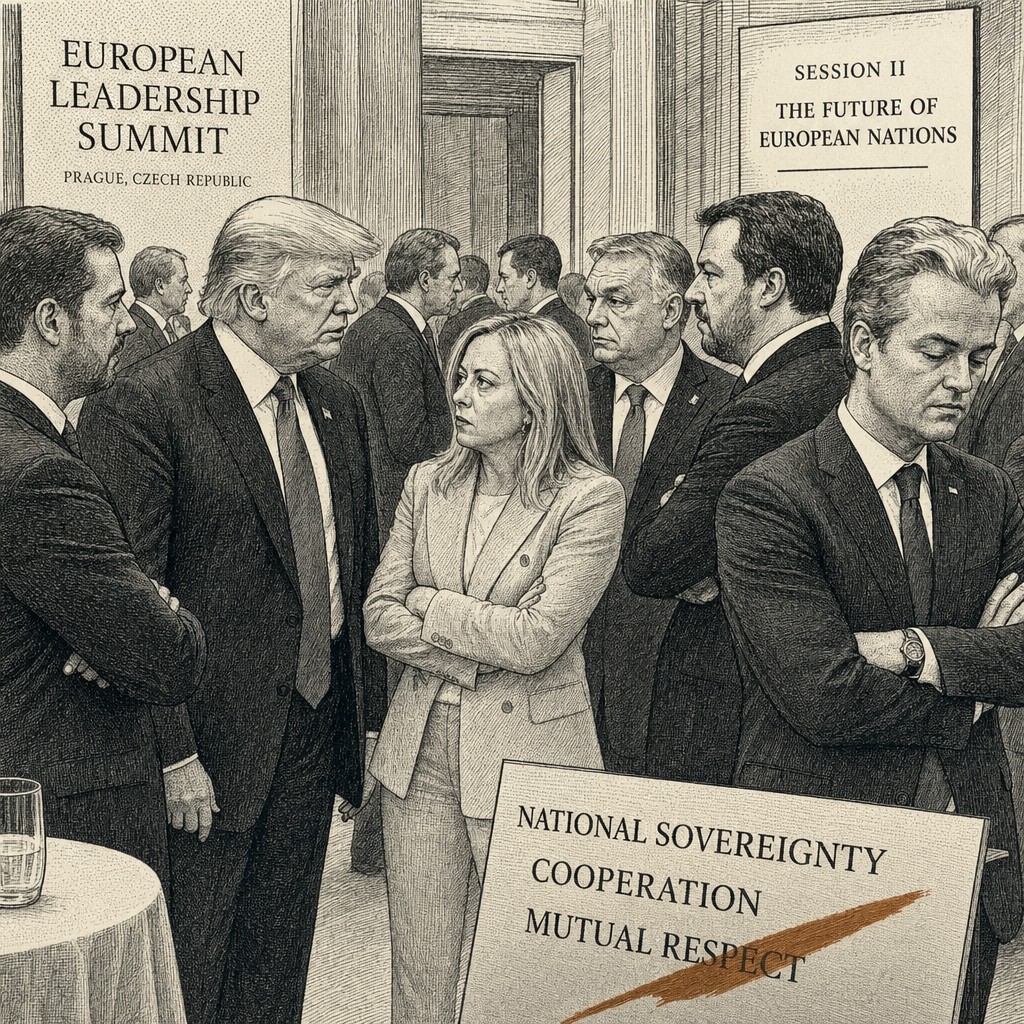
Summary
- A public quarrel between Trump and Giorgia Meloni — touched off by his claim she “begged” him for a photo — is the visible surface of a deeper structural break: across Europe’s nationalist right, proximity to Trump has shifted from an electoral asset to a liability.
- The mechanism running underneath the personal feud is interest-divergence: parties built on “national interests first” cannot indefinitely subordinate those interests to a U.S. president, and the Iran war forced that contradiction into the open.
- The defection is broad, not isolated — Le Pen, Farage, Orban’s bloc, and the AfD have each cooled, and one British survey found 37% of voters citing Farage’s support for Trump as their top reason to reject Reform UK.
- The break is described as durable rather than tactical: even sources sympathetic to alliance restoration suggest the relationship “can never be the same as it was.”
In early 2025, Europe’s nationalist politicians sold themselves as the continent’s bridge to Washington; eighteen months later they are walking away from a president they now regard as electoral poison. The Meloni–Trump spat is the proximate flashpoint, but the source frames it as a symptom of a structural collision: nationalist parties define themselves by placing their own country’s interest first, and the Iran war — which disrupted energy markets and hurt Europe’s economy — made loyalty to Trump directly costly to those national interests. What looks like a personality clash is the point at which a standing contradiction became unsustainable.
The Mechanism: Why “National Interest First” Eventually Repels Trump
The central causal claim of the piece is not that European nationalists dislike Trump personally, but that their own political logic was always going to turn them against him under stress. Lorenzo Castellani, a political analyst at LUISS Guido Carli University in Rome, states the mechanism directly: “For these parties, it was always going to be difficult to defend the interests of the U.S. over the interests of their own nation states.” A movement whose organizing premise is the primacy of the nation cannot credibly subordinate that nation to a foreign leader without dissolving its own brand.
This makes the rupture less a contingent falling-out than a latent fault line that needed only a trigger. The Iran war supplied it. By disrupting global energy markets and damaging Europe’s economic prospects, the war converted alliance with Trump from a cheap symbolic affiliation into a concrete cost — borne, in Italy’s case, by an economy that “depends heavily on gas imports.” The same nationalist framing that once made Trump attractive (sovereignty, border control, opposition to “woke ideology”) becomes the framing that forces a break the moment American and European interests visibly part.
The Distributional Ledger: Who Paid for Proximity
A recurring thread is that closeness to Trump produced costs without offsetting returns. Meloni invested “perhaps more political capital than any other” European leader in the relationship — she was the only European leader at Trump’s 2025 inauguration, stood by him through tariff threats and his stated designs on Greenland, and was rewarded with the label “great leader.” The source’s accounting of what she received in exchange is blunt: “Italy’s products have been subject to tariffs and its economy has suffered fallout from the Iran war.” Her own summary closes the ledger — “being your friend certainly has not helped.”
The pattern repeats across the bloc. Orban, “another one of his top allies,” lost his re-election bid “by a wide margin” despite a late-campaign visit from Vice President JD Vance — direct U.S. intervention that “appeared to do little to buoy” him. The British survey result inverts the original 2025 proposition entirely: where nationalists once pitched Trump-proximity as their unique selling point, 37% of voters now name Farage’s support for Trump as their single biggest reason to reject Reform UK. Affiliation that was supposed to import American momentum instead exports American unpopularity.
Each Leader’s Walkaway Option
The defections are legible as a set of actors discovering that their best alternative to a costly alliance is simply to distance themselves at low cost. The exit is cheap precisely because these leaders never depended on Trump for legitimacy at home; their constituencies are domestic, and Trump’s standing with those constituencies has gone “underwater even among the nationalist right.”
The walkaways are calibrated rather than uniform. Farage, who has had “a fairly close relationship” with Trump, has merely “played down any links” while questioning his Iran judgment — a hedge, not a rupture, preserving optionality. Meloni went further only when forced: she “initially avoided criticizing Trump directly” and changed course only after he attacked Pope Leo XIV, at which point “pressure from Italy’s overwhelmingly Catholic population” made defending Trump costlier than breaking with him. The AfD, once “the Trump administration’s closest partner in Germany,” moved earliest and most rhetorically, with official Tino Chrupalla declaring in March: “Donald Trump started as a president of peace. In the end, Donald Trump will end as a president of war.” In each case the leader retains a viable position without Trump; none retains a viable position defending him.
The Steelman: Is This Just Theater?
It is worth pressing the contrary reading. Meloni was filmed at the G-7 saying she and Trump “never stopped being friends,” and the two were seen “speaking together on a sofa” — which could suggest the feud is performative, a managed spat that both sides expect to outlast. On this account the public messages are domestic theater and the working relationship survives underneath.
The source supplies the evidence that defeats this reading. The sofa scene is immediately undercut: “the public spat that ensued told a very different story.” After Meloni’s video reply, Trump did not de-escalate but “doubled down” in a social-media post, mocking that she wanted to be friends “in order to get her ‘numbers up.’ No thanks!!!” Meloni answered by advising him to focus on his own approval ratings. A choreographed reconciliation does not include the more popular party publicly refusing the olive branch. The “friends” footage is better read as the last moment of the old posture before the structural costs overrode it — not evidence the posture endures.
Second-Order Stakes: From a Feud to the Atlantic Alliance
The piece’s most consequential move is to scale the quarrel up to the security architecture. The same interest-divergence visible in the Meloni spat appears in the operational refusal beneath it: Trump aired frustration that Italy would not let the U.S. military use an air base in Sicily for Iran strikes, calling it a “great logistical inconvenience,” while Italy’s government noted such operations “require advance parliamentary approval.” A personal grievance and a sovereignty constraint are, here, the same event seen at two altitudes.
E.J. Dionne of the Brookings Institution extends the consequence forward and frames it as hard to reverse: Trump has signaled that “in the long run, they are not going to be able to rely on the U.S. in the way they did,” and while “some of the relationship will be reconstructed” under a future pro-alliance administration, “I don’t think the alliance can ever be the same as it was.” Combined with Trump’s having “publicly raised the possibility of pulling out of” NATO, the analysis points to a path-dependent shift: once European partners price in American unreliability, that expectation persists past any single presidency. The exit from trust has no clean re-entry.
Additional Considerations
The source establishes correlation more firmly than magnitude. Orban’s loss “by a wide margin,” the AfD’s reversal, and Le Pen’s distancing are presented as evidence of a Trump liability, but the article does not isolate how much of each outcome traces to Trump versus domestic factors — it offers one quantified data point (the 37% Reform figure) and otherwise relies on directional claims from named analysts. The forward judgment that the alliance “can never be the same” is a single expert’s forecast, not a demonstrated fact. And the piece is built substantially on attributed analysis from Castellani and Dionne rather than independent measurement, so its strongest claim — that the rupture is structural and durable rather than a passing feud — rests on interpretation the source argues well but does not prove.
Analytical techniques used in this piece
This analysis applies the methods below. Each links to a short, plain-English explainer you can read and reuse.
- Causal DAG
- Maps cause and effect as an explicit directed graph, exposing confounders and mediators (Pearl).
- Red-Team Advocate
- Argues the adversary’s case in full to expose what a plan underrates.
- Relationship Mapping
- Extracts the network of ties among people, institutions, and entities.
- BATNA
- Your best alternative to a negotiated deal — the walk-away that sets your leverage (Fisher & Ury).