Summary
- Interim President Delcy Rodríguez manages a disaster response constrained by depleted infrastructure, economic, and institutional stocks following the June 25 twin earthquakes in Venezuela.
- The Wall Street Journal documents a 59-year recurrence of structural damage in east Caracas, indicating deferred maintenance amplified the seismic impact beyond geological magnitude.
- Process tracing of the available evidence supports prior economic devastation and infrastructural neglect as the dominant factors driving the disaster’s severity.
- Centralized disaster authority under the transitional government concentrates reconstruction control while structurally marginalizing civil society and opposition groups.
The 7.2- and 7.5-magnitude earthquakes that struck Venezuela on Wednesday, with the U.S. Geological Survey locating the epicenter of both near Yamure, roughly 200 miles west of Caracas, register in the Wall Street Journal’s reporting as a perturbation to a system whose stocks of capacity were already low. Venezuela entered the seismic event with depleted infrastructure, economic capacity, and institutional continuity, producing the asymmetric outcome and compound-crisis dynamic documented by Ryan Dubé in the June 25, 2026 article “Earthquakes Clobber Venezuelan Capital.”
The structural reading and failure of refuge
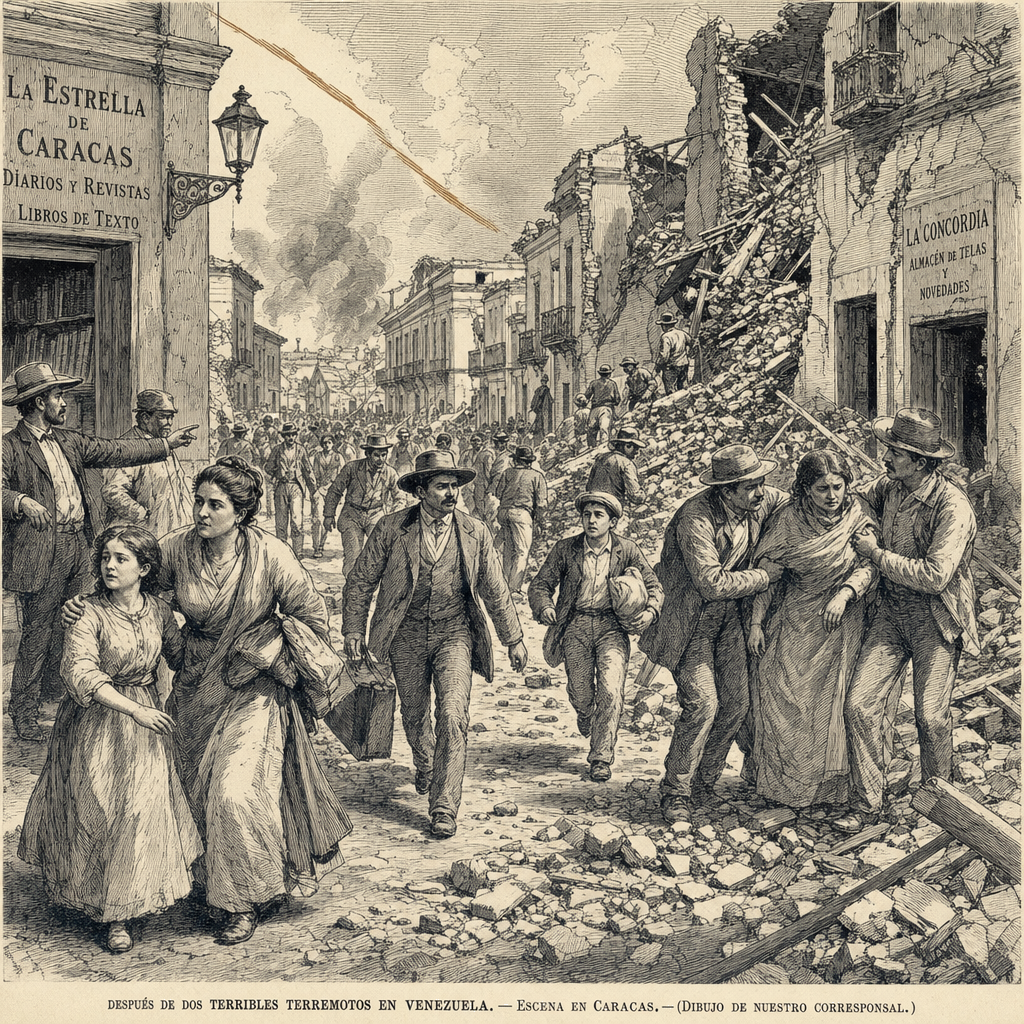
The 59-year east Caracas recurrence is the structural observation the available reporting makes available. The Wall Street Journal reports that the heaviest damage occurred in east Caracas, in districts the paper identifies as “the same seismically active areas that were devastated in a 1967 earthquake.” Christopher Alexander’s pattern language, as developed in his 1977 catalog, identifies the relationship between context, problem, and solution at the building and urban scale. The east Caracas recurrence is consistent with patterns in which the load-distribution and refuge functions of buildings — what Jay Appleton’s prospect-refuge framework names the qualities that make a built structure habitable — have not been brought up to the standard of the known hazard. The reporting does not specify the building codes, retrofitting history, or inspection regime; the available reporting supports saying only that whatever the regime produced, the result 59 years later is reported damage in the same districts. The 1967 earthquake is part of the place’s memory; the 2026 event extends that memory by another 59 years.
The available reporting documents the failure of refuge at multiple scales. Francelin Machuca, 53, told the Wall Street Journal she stayed under a door frame rather than flee: “I was asleep, and it was terrible as the bed began to move,” Machuca said. “But I was afraid to start running, so I stayed under the door frame.” Gaston Bachelard’s topoanalysis, in “The Poetics of Space,” treats the door frame as a threshold — the architectural condensation of inside and outside, of remaining and going-out. Machuca’s choice to remain under the threshold is the most intimate image the available reporting offers of refuge at the moment of refuge’s failure. Barbara De Jesus wrote on X that she saw “the walls of my building crumbling down.” Wilmer Azuaje posted video of the airport terminal’s roof collapse, with large cracks in the walls and bricks covering the check-in and baggage areas; “It’s shaking,” Azuaje said as dust and debris fell around passengers. “Look at this! Everything is totally destroyed.” Jose Cordero, 39, speaking from Puerto La Cruz east of Caracas on the Caribbean coast, told the paper he felt the quakes for more than a minute: “I felt like I was at sea and the waves were shaking me.”
Christian Norberg-Schulz’s reading of genius loci — the “spirit of place” — attends to the qualitative-total character of a setting rather than its features in isolation. On the available evidence, the genius loci of east Caracas and the affected districts has been disturbed. Kevin Lynch’s framework for urban legibility — paths, edges, districts, landmarks — names the elements through which inhabitants form what Lynch termed the imageability of a place; the destruction of district boundaries in east Caracas replaces familiar paths and edges with unrecognizable rubble, degrading the city’s imageability. Rachel and Stephen Kaplan’s attention-restoration theory assesses settings by four properties: being-away, extent, compatibility, and soft fascination. The available reporting does not support a strong reading on compatibility — the match between setting and purpose — because the setting is, on the reporting, failing its purpose; on the other three, the streets with rubble, the dust and debris Azuaje recorded, and the population huddled outside that Telesur photographed together constitute the document of a setting whose restorative properties are now inverted into stress. The degraded physical environment captured in these accounts — the failing buildings, the disturbed genius loci, the inverted restorative properties — is, in turn, the material surface on which the political and economic conditions of the system register. The same 59-year window that documents the recurrence of damage documents the depletion of the stocks that would have prevented it.
Process tracing the causal hypotheses
To test which causal hypothesis best accounts for the system’s condition at the moment of the shock, process tracing, in the methodological tradition developed by George and Bennett, distinguishes among three plausible accounts the available reporting supports: H1, that the geological magnitude and wave propagation of the twin earthquakes directly caused the structural failures, with the prior system’s condition secondary; H2, that the prior system’s depleted condition — years of economic devastation and infrastructural neglect producing a degraded building stock uniquely vulnerable to seismic activity — is the dominant factor in the disaster’s impact, with the seismic event the trigger; and H3, the residual.
The two analytical streams diverge on the framing of H3, and the divergence is a real tension rather than a paraphrase difference. One stream frames H3 as governance discontinuity — whether the transition from Maduro to Rodríguez produces a rupture in the response apparatus that constrains response independent of the prior condition. The other stream frames H3 as geological specificity — whether the geological vulnerability of east Caracas (site amplification, directivity, soil conditions) amplified the local damage independent of the building stock. Both framings are defensible from the available evidence and are not reducible to the other on the reporting alone.
The hoop test for H2 is whether the most heavily damaged areas correspond to areas of long-deferred maintenance. The Wall Street Journal’s identification of east Caracas, and the 1967/2026 recurrence, passes the hoop: the article explicitly identifies the affected districts as ones previously devastated. The recurrence itself also functions as a straw-in-the-wind observable for H2: the same districts that suffered damage 59 years ago are the districts suffering damage now, which is the temporal pattern H2 predicts in the absence of effective intervening maintenance. The corresponding hoop test for H1 — epicentral proximity and ground-motion intensity consistent with the cited magnitudes — cannot be fully verified from the available reporting, which does not include a published USGS shakemap. The collapse of the airport terminal roof captured in Azuaje’s video provides additional straw-in-the-wind evidence supporting H2, as widespread non-structural and structural failure in a major transit hub typically correlates with deferred maintenance. The smoking-gun test for H2 would be specific evidence of deferred retrofitting or known-unaddressed vulnerabilities; the article does not supply that level of detail. The doubly-decisive test that would isolate H2 would require pre-existing structural audit records or engineering reports detailing the seismic retrofitting status of the collapsed buildings; that evidence is absent from the available reporting, leaving the relative weight of H1 and H2 contingent on further engineering investigations. On the governance-discontinuity framing of H3, the article’s “preserved predecessor’s authoritarian system” attribution is decisive against H3 in its strong form — full rupture in the response apparatus between the Maduro and Rodríguez periods — but a hoop-passing indicator for H3 in its weak form, in which response is constrained by authoritarian continuity rather than ruptured by transition.
The available reporting supports H2 in the strong form and, on the governance-discontinuity framing, H3 in the weak form.
Systems dynamics and reinforcing feedback loops
From a systems-dynamics perspective, the vulnerability of Caracas is the product of reinforcing feedback loops that have compounded over years. The collapse of the oil industry and subsequent economic devastation created a vicious cycle: poverty and capital flight drove an estimated seven to nine million Venezuelans to flee abroad — the source article’s “nearly nine million” figure is defensible only with the inclusion of unregistered populations in host-country counts; UNHCR/R4V registered populations document approximately 7.9 million — depleting the human and financial capital required to maintain complex urban infrastructure. This pattern aligns with the “Eroding Goals” archetype in systems thinking, formally identified in Peter Senge’s “The Fifth Discipline” (1990), Appendix 2, in which the standard for infrastructure maintenance and building code enforcement gradually degrades as short-term survival takes precedence over long-term resilience. The structural coupling of degraded infrastructure and high seismic risk creates conditions analogous to Charles Perrow’s Normal Accident Theory, in which the complexity of urban systems and the tight coupling of failing components make cascading failures — the simultaneous collapse of residential districts, commercial areas, and transit hubs — inevitable when a trigger event occurs.
The available reporting identifies at least two reinforcing loops and one balancing loop. R1: economic collapse reduces the maintenance flow, which degrades the infrastructure stock, which raises the vulnerability of the system to shocks, which deepens the economic loss when shocks occur. R2: preservation of the predecessor’s authoritarian governance system, as the WSJ reports, limits accountability mechanisms for infrastructure standards, permitting unaddressed known hazards to persist, which raises disaster losses, which deepens the political incentive to centralize response rather than to distribute preparedness. The balancing loop is the disaster response flow that Interior Minister Diosdado Cabello described — cutting natural-gas service, urging evacuation, gathering information, telling citizens there are “several problematic areas” and “some very alarming situations.” The response flow is itself constrained by the depleted infrastructure stock (cutting gas service presupposes a network that can be cut) and by the depleted governance stock (the response runs through state television and the interior ministry’s communications). The delay on the response loop is short; the delay on the maintenance loop is long, and the 59-year east Caracas recurrence is the headline number on that delay. The systems boundary encompasses the domestic socio-technical and economic loops within Venezuela. Temporally, the immediate response loop, characterized by centralized state deployment, dominates the system’s short-term behavior; medium- and long-term behavior will be dictated by the reinforcing loops of capital flight and infrastructural decay unless interrupted by structural policy shifts.
Who benefits from centralized disaster authority
The political transition is the explicit frame in which the WSJ situates the disaster response. As the Wall Street Journal reports, interim President Delcy Rodríguez “took power in January after the U.S. military ousted former leftist strongman Nicolás Maduro” and has “preserved predecessor’s authoritarian system while becoming a close partner of the Trump administration.” The article also reports that “years of economic devastation have driven nearly nine million Venezuelans to flee abroad as poverty skyrocketed and the oil industry collapsed.” Rodríguez’s transitional government inherits the economic and institutional constraints of the preceding administration; the available reporting supports the reading that the stocks of infrastructure, economy, and governance continuity were depleted over a period longer than the six months of her interim presidency.
The centralized disaster authority exercised by Rodríguez’s transitional government permits rapid deployment of state resources to manage the physical aftermath, while simultaneously concentrating control over reconstruction planning — a configuration that structurally marginalizes civil society and opposition groups from the rebuilding process. Opposition leader María Corina Machado, who the article reports fled Venezuela last year, wrote on X: “My prayers are with every Venezuelan home in these hours of anguish. May strength, serenity, and solidarity prevail among us in the face of this difficult moment.” Interior Minister Cabello, managing the immediate state response, told state television: “There are several problematic areas here” and “We have some very alarming situations,” as authorities urged citizens to leave their homes and temporarily cut natural-gas service.
What happens next in the reinforcement cycles
The consequences-and-sequel hinge on whether the centralized institutional response can interrupt the reinforcing loops of infrastructural and economic decay, or whether the disaster will instead accelerate the structural constraints that define the capital’s current vulnerability. The specific institutional levers through which such interruption is analytically identified are: building-code enforcement, reconstruction financing, and civil-society inclusion in the rebuilding process. The dominant timescale is therefore the long one. The 7.2 and 7.5 magnitudes are the perturbation; the structural condition determines the impact. The 1967/2026 east Caracas recurrence is the available reporting’s clearest expression of that timescale.
How this is being framed in the source reporting
The frame-audit notes how the WSJ report itself structures the available evidence. The report leads with the USGS magnitudes, the epicenter, and the damage in Caracas; it centers named witnesses whose accounts of refuge failure constitute the human register; it situates the disaster response in a political transition characterized by preserved authoritarianism and a close Trump-administration partnership; and it closes with an opposition leader’s solidarity statement, providing a counter-register to the state response without resolving the underlying structural question.
Analytical techniques used in this piece
This analysis applies the methods below. Each links to a short, plain-English explainer you can read and reuse.
- Genius Loci — Sense of Place
- Reads the character and felt quality of a place.
- Process Tracing
- Reconstructs the step-by-step causal pathway of a specific historical event.
- Systems Dynamics (Structural)
- Maps a system’s structure — stocks, flows, and the architecture that shapes its behavior.