Summary
- SEIU-United Healthcare Workers West advances its one-time 5% wealth tax initiative to the November ballot, triggering a structural realignment of California Democratic coalition dynamics as party leadership opposes the measure despite overwhelming rank-and-file voter support.
- Governor Gavin Newsom and Democratic nominee Xavier Becerra lead institutional opposition to the initiative, citing investment deterrence risks, while rejecting a legislative compromise offering a smaller 2% tax.
- Billionaire-funded counter-initiatives, including measures backed by Google co-founder Sergey Brin, qualify for the ballot to undercut the wealth tax, establishing a high-spending electoral environment projected to exceed the $226 million Proposition 22 record.
- The electoral configuration presents a documented divergence from historical precedents, with major healthcare and education institutions aligning with establishment leadership against a measure whose revenue allocates ninety percent to healthcare and the remainder to education and food assistance.
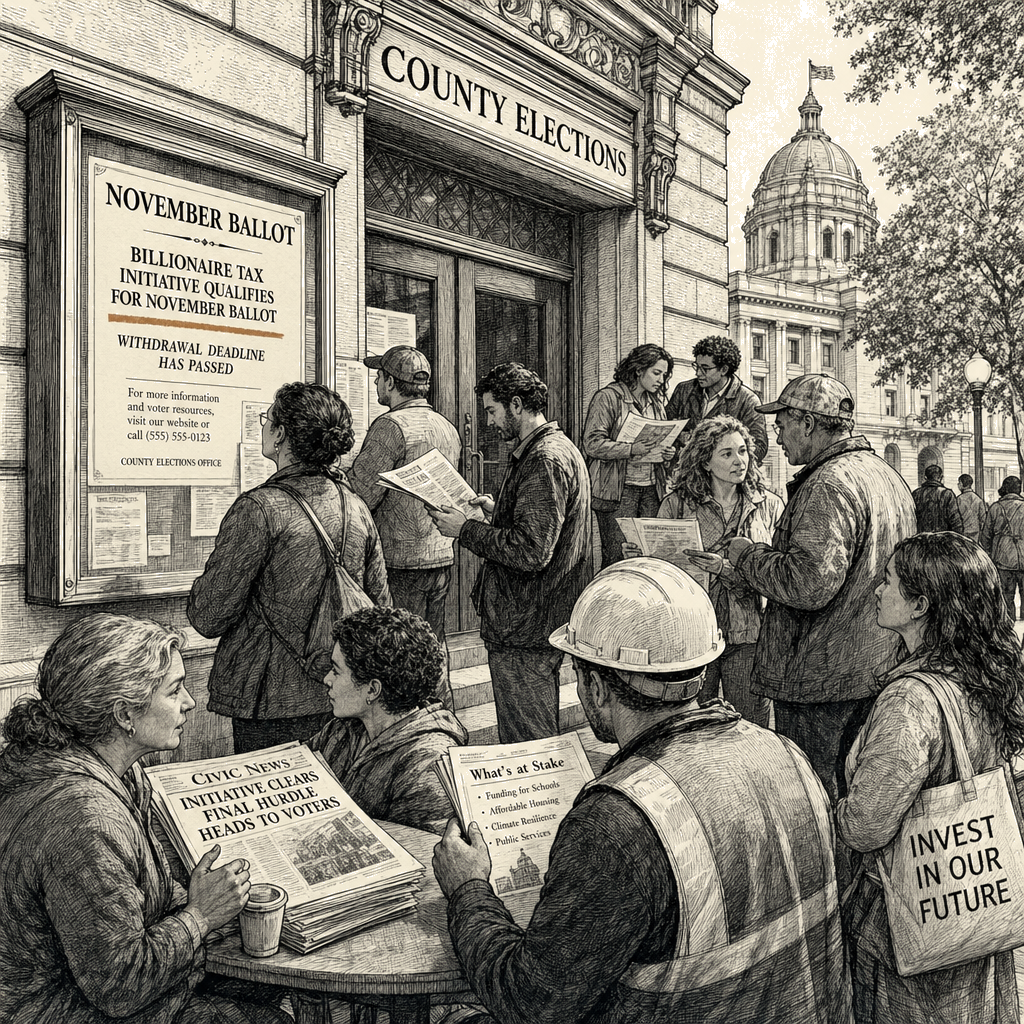
The November California ballot will feature a one-time 5% wealth tax on residents with net assets exceeding $1 billion, proposed by SEIU-United Healthcare Workers West to raise $100 billion for healthcare, education, and food assistance, following the union’s decision to let the withdrawal deadline pass. This development initiates a high-stakes electoral contest defined by an unprecedented intraparty alignment, as documented by Public Policy Institute of California survey director Mark Baldassare, wherein establishment Democratic leadership and major institutional providers actively oppose a measure commanding 76% support among likely Democratic voters. The resulting ballot configuration pairs the union’s initiative with billionaire-backed counter-measures, setting the stage for what strategists project will be the state’s most expensive ballot fight and a potential bellwether for national Democratic coalition dynamics.
Architecture of the Electoral Contest
The architecture of the November contest centers on institutional Democratic leadership as the primary hub of opposition. Governor Gavin Newsom, widely reported as expected to run for president in 2028, and Democratic nominee Xavier Becerra publicly oppose the measure. Newsom’s stated rationale, documented in article reporting, centers on investment deterrence and the weakening of California’s high-income-earner fiscal base. The administration rejected a public union offer to drop the measure in exchange for a smaller, 2% legislative tax through a spokeswoman.
The pro-coalition spoke network is anchored by SEIU-United Healthcare Workers West, with President Dave Regan confirming the initiative’s progression to the Journal by stating, “We’re going to the ballot” and “We’ve now crossed the deadline.” This coalition extends to Teamsters California, hospitality unions, public-sector employee unions, left-leaning activist groups, and Senator Bernie Sanders, who campaigned in Los Angeles for the tax in February.
The counter-coalition spoke network features a committee funded by billionaires, including Google co-founder Sergey Brin, backing a pair of Republican-backed ballot initiatives that the Journal reported are designed to undercut the wealth tax.
A critical cross-link feature of this dynamic is the documented divergence of major institutional providers. The California Medical Association, Planned Parenthood Affiliates of California, and the California Teachers Association have aligned with Newsom and Becerra in opposition in recent weeks. This places major healthcare and education providers in opposition to a measure whose revenue allocation dedicates nine-tenths to healthcare and the remainder to education and food assistance.
This elite-versus-rank-and-file divergence prompted UCLA political science professor Martin Gilens to characterize the mechanism as donor-dependency, stating, “These elected officials depend on wealthy campaign contributors. That also contributes to the reluctance of our elected Democrats to support this tax.” The connection remains subject to a falsifiability hook: the empirical claim would be weakened if public campaign finance disclosures show no overlapping donor bases between the establishment opposition committees and the billionaire counter-initiative committee. Documented conduct shows Newsom and his allies called billionaire donors directly in the post-primary period to seek compromise, representing sourced conduct rather than attributed motive.
The intraparty conflict mirrors a correlational-structural parallel in New York, where three congressional progressives backed by New York City Mayor Zohran Mamdani won Democratic primaries during the week of publication, defeating two incumbents.
Anticipated Consequences and Sequential Dynamics
In the immediate weeks following the deadline expiration, the campaign structure is locked. The first measurable signals are campaign-finance disclosures from both sides and early divergence from historical Proposition 22 spending ratios at the 30-day mark. Democratic strategist Jeremy Oberstein projected the fight could surpass the $226 million record set six years ago by the Proposition 22 gig-worker labor-protections contest, a figure corroborated by Ballotpedia records placing the combined-sides total at approximately $224.5 million. Oberstein’s strategic characterization to the Journal, “It’s gonna be real messy,” frames the anticipated operational environment.
Over the short-to-medium horizon extending through the November midterms, the intraparty signaling cascade becomes operative. The Baldassare attribution establishes the divergence as outside ordinary recall by an attributed authority. The New York-California parallel presents as correlational-structural, with a weakening condition occurring if the California measure fails to draw sustained national media attention or if the New York progressive victories fail to produce follow-on primary challenges. Oberstein’s proposition, attributed to the Journal, that the California contest carries national weight is captured in his statement: “As California goes, so goes the nation.”
In the medium term, contingent on passage, the state faces a structural shift in its revenue model. The projected revenue scale stands at $100 billion over five years from the one-time 5% levy on net assets of $1 billion or more as of January 1, 2026, contingent on the threshold being met at year-end 2026. Newsom’s stated warning notes the levy could deter investment and weaken the state’s high-income-earner-dependent fiscal base. An unintended consequence surface emerges: a policy designed to backstop Medicaid and social services against federal reductions could, if it triggers capital flight or depressed investment, shrink the very tax base required to sustain those services. Implementation would require navigating legal and administrative mechanics, including the valuation of illiquid assets, prevention of jurisdictional arbitrage, and navigation of constitutional challenges regarding interstate tax jurisdiction.
In the long term, the contest presents two opposing trajectories for the California Democratic coalition. A successful tax could establish a precedent for wealth-based revenue models in other high-cost states, altering the national fiscal baseline. A defeat could solidify the institutional bloc’s control over the party’s fiscal agenda, marginalizing the progressive labor wing.
Probabilistic Forecasting and Electoral Trajectories
Forecasting the measure’s passage requires evaluating two reference classes. The first is California ballot measures reaching November with majority support among likely voters in pre-election polling. Drawing on general historical knowledge of California ballot-measure passage rates rather than vault-corroborated specifics, the base rate for ballot propositions reaching November with majority likely-voter support at this stage is estimated at roughly two-thirds to three-quarters of the time. The second reference class is the California mega-initiative environment, characterized by massive spending and high volatility.
Inside-view drivers operating below the base rate include the Baldassare-attested unprecedented nature of Democratic-establishment opposition, the presence of billionaire-funded counter-initiatives that could split or confuse voters, and Democratic strategist concerns about Republican-donor galvanization. Inside-view drivers operating above the base rate include the 76% Democratic-support floor and the structural commitment of healthcare, education, and food-assistance funding targets, which create durable constituency beneficiaries.
Applying adjustment math starting from a 65–75% base-rate range, the unprecedented party-leadership opposition and billionaire counter-measures warrant a downward adjustment of 10–20 percentage points, while the strong Democratic rank-and-file support warrants a smaller upward stabilization. Given residual base-rate uncertainty, the resulting probability range is roughly 45–65% that the measure passes in November, a wider range than a default point estimate to reflect the unusual configuration.
Alternative trajectories extend beyond binary passage or failure. These include passage followed by judicial invalidation, passage accompanied by capital flight that depresses revenue below the $100 billion projection, or the prior passage of counter-initiatives that dilute the wealth tax’s political and fiscal appeal before November.
Leading Indicators and Falsifiability Anchors
The trajectory of the contest and the validity of its underlying analytical claims will be tested by seven leading indicators. First, early fundraising disclosures in July will reveal whether the counter-coalition outpaces SEIU-UHW. Second, campaign-finance disclosures from both sides within weeks of the deadline passing will quantify the financial commitment. Third, divergence from historical Proposition 22 spending ratios at the 30-day mark will indicate the scale of the electoral environment.
Fourth, subsequent PPIC likely-voter polling relative to the May 76% and 54% baseline will measure shifting electorate sentiment. Fifth, the framing of the November federal ballot will act as a contextual variable, where a highly polarized top-of-ticket race could either suppress moderate turnout, aiding the tax, or maximize Republican turnout, harming it. Sixth, state legislature behavior between the deadline and November will be critical, as any compromise or alternative revenue proposal could deflate the initiative’s momentum.
Seventh, the donor-base overlap between establishment opposition committees and the billionaire counter-initiative committee serves as the load-bearing falsifiability test for the Gilens-attributed donor-dependency mechanism.
Wealth-Concentration Backdrop
The $1 billion threshold captures a specific demographic context relevant to the initiative’s political economy. Top-1% households hold a disproportionate share of U.S. household wealth. Analyses of the 2022 Survey of Consumer Finances place the figure in roughly the upper-twenties to mid-thirties percent range, meaning a $1 billion-and-above threshold captures a concentrated but small population whose opposition resources are substantial relative to their number. The 30–35% figure is presented as derived from analyses of the Survey of Consumer Finances rather than as a confirmed specific datapoint, preserving the directional magnitude while hedging the precise percentage.
Analytical techniques used in this piece
This analysis applies the methods below. Each links to a short, plain-English explainer you can read and reuse.
- Consequences & Sequels
- Plays a decision forward to its first- and second-order consequences.
- Probabilistic Forecasting
- Puts calibrated probabilities on what happens next.
- Relationship Mapping
- Extracts the network of ties among people, institutions, and entities.
- Brinkmanship
- Manufacturing shared risk at the edge of catastrophe to force the other side to blink.