Summary
- Democratic party factions operate from incommensurable electoral metrics following progressive primary victories in New York and subsequent insurgent campaigns in multiple states.
- Centrist organizations measure electoral progress through general-election competitiveness in swing districts and cite data showing recent left-wing victories occurred in heavily Democratic areas.
- Progressive organizers measure electoral progress through grassroots mobilization and affordability platforms in safe districts and treat primary base cohesion as a prerequisite for broader majority-building.
- Centrist and progressive leaders contest the definition of electoral evidence itself rather than merely debating policy direction within the party.
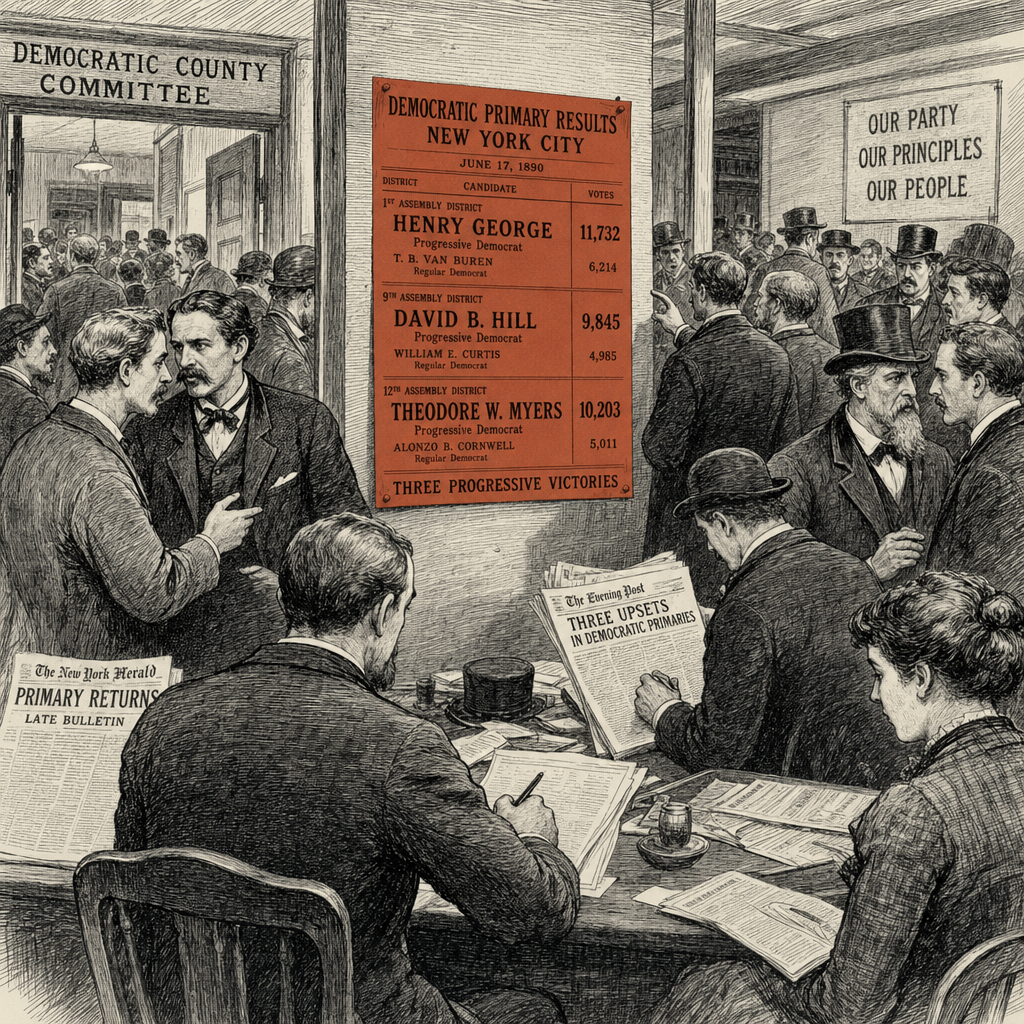
On June 23, three left-wing candidates won Democratic primaries in New York, toppling two incumbents including the chair of the Congressional Hispanic Caucus and escalating the party’s internal struggle over its direction. The victories, backed by New York City Mayor Zohran Mamdani and featuring two Democratic Socialists of America members, sit within a documented pattern of progressive wins across recent municipal and House contests. While the surface dispute centers on the party’s ideological direction following President Donald Trump’s 2024 victory, the underlying structural conflict operates as a contest over the metric by which electoral direction is judged, with centrist and progressive factions measuring success against incommensurable standards of competitive viability and base mobilization.
The New York Primary Results and the Progressive Network
On June 23, three left-wing candidates won Democratic primaries in New York, toppling two incumbents including the chair of the Congressional Hispanic Caucus, according to The Wall Street Journal. All three winners were backed by New York City Mayor Zohran Mamdani, and two of the three were members of the Democratic Socialists of America. DSA-backed candidates also won New York State Legislature races in the same cycle. The candidates’ platforms, as reported by the Journal, called for higher taxes on the wealthy, expanded government services, breaking with U.S. support for Israel, and abolishing Immigration and Customs Enforcement.
The New York results sit within a documented pattern of progressive wins reported in the article. Democratic socialists won the mayor’s offices in New York City and Seattle in 2025 and captured the Democratic mayoral primary in Washington, D.C., earlier in June 2026. In two recent House primaries in California and Maine, progressive candidates defeated centrists backed by the party’s main House campaign arm. In Maine, Graham Platner, a political newcomer backed by independent Sen. Bernie Sanders of Vermont, won the Senate nomination.
The progressive campaign network operates through a decentralized endorsement and organizational sponsorship structure. Mamdani serves as the geographic and organizational anchor for the New York primary, having backed all three winners. The DSA sponsored two of the three New York winners and several state-legislature winners. Sen. Bernie Sanders provided endorsements for Platner in the Maine Senate race and Abdul El-Sayed in the Michigan Senate race. Faiz Shakir, a senior adviser to Sanders, articulated the unifying element of these campaigns, stating that the unifying element for populist-left candidates winning in recent years is that they are grassroots-funded and run on platforms addressing affordability, not just opposition to Trump. Rep. Ro Khanna of California, who is considering a 2028 presidential campaign, framed the New York elections as proof that progressives really have the energy in the party. Progressive strategists noted that the intraparty fight has been building since Sanders’s 2016 presidential run. Reinforcing this stance, Grace Mausser, co-chair of the DSA chapter in New York City, told the Journal, “We are here, we have won elections fair and square, and there’s not much they can do about it.”
Centrist Network and Institutional Establishment Responses
Centrist Democrats reacted with alarm to the New York results, organizing policy advocacy, campaign spending, and coalition statements to counter the progressive momentum. Ten House Democrats signed a “common sense” pledge committing to “fiscal discipline and capitalism over socialism.” Rep. Tom Suozzi of New York and Rep. Josh Gottheimer of New Jersey were among the signatories. Suozzi stated, “The left, the DSA, and the right, the MAGA movement, they’re both very well organized, and those of us that oppose those policies are talking to each other at cocktail parties and wringing our hands. But we got to get organized.” Gottheimer characterized the progressive movement as using Tea Party tactics and trying to divide up the country and pray to socialist ideals.
The centrist network relies on policy groups, super PACs, and institutional campaign arms. Third Way, a centrist Democratic policy group, produced the district-margin analysis cited in the Journal. WelcomePAC, a group supporting centrist Democrats, also mobilized in opposition; co-founder Liam Kerr described the current primary battles as proxy battles in a way for what happens in the 2028 primary. The House campaign arm backed centrist candidates in the recent California and Maine House primaries, though those candidates lost to progressive challengers.
Institutional-establishment actors attempted to consolidate opposition to progressive challengers in the Senate. Senate Minority Leader Chuck Schumer preferred Rep. Haley Stevens in the Michigan Senate primary. Sen. Gary Peters of Michigan, who is not seeking re-election, told associates the party should coalesce around one challenger to El-Sayed and suggested State Sen. Mallory McMorrow consider dropping out, according to people familiar with the discussions. This dynamic illustrates a documented asymmetric mechanism: the progressive side operates through a decentralized endorsement network, while the institutional establishment attempts to act as a consolidation bottleneck. The progressive network produces candidates; the centrist network funds defensive campaigns and counter-mobilization.
Incommensurable Metrics of Electoral Progress
The dispute reads on its surface as a contest over ideological direction, but the underlying data indicates it operates structurally as a contest over the metric by which direction is judged. The two camps operate from incommensurable measures of what constitutes electoral progress, each internally coherent on its own terms but answering different questions about the same calendar.
The metric articulated by Third Way measures Democratic success through performance in competitive districts. Per Third Way’s data, the three New York districts won by left-wing candidates are on average 36 points more Democratic than the country as a whole. By contrast, the Republican-held seats that Democrats need to flip to win a House majority are only about 8 points more Republican on average. Under this metric, the question the primaries answer is whether Democratic primary voters are selecting candidates who can win the seats that determine control of the House. This view treats the base-mobilization approach as a category error, arguing that energy in a primary is not, by itself, a measure of majority-building capacity. The Third Way view reads the present as a competitive-election phase.
The metric articulated by Shakir and Mausser measures the durability of a working-class majority built on affordability platforms and grassroots funding. Under this metric, primary wins in safe districts are evidence of base cohesion and ideological clarity, treated as prerequisites for competing in harder terrain. The Shakir-Mausser view treats the Third Way analytical approach as a distraction from the question of whether the party’s commitments are legible to working-class voters. This view reads the present as a build-out phase. Each side is reporting truthfully on what it measures, but the two measurements do not converge.
A structural reading of the Tea Party comparison clarifies this incommensurability. Gottheimer’s comparison of progressive primary tactics to the organizational playbook of the 2010 conservative insurgency is a coherence claim subject to examination against the data. The Third Way district-margin data resolves the comparison’s ambiguity: the comparison operates at the level of safe-seat primary mobilization structure rather than general-election impact. This reveals a documented structural isomorphism across the ideological spectrum: the left-wing primary mechanism of grassroots challengers unseating entrenched incumbents takes the same form as the conservative insurgency, albeit with divergent policy objectives.
External Framing and Partisan Context
The intraparty dispute is further framed by external partisan actors and strategic analysts. President Donald Trump posted on social media that the Communists are finally making their move and that the game is on, urging followers to enjoy watching. This post places the intraparty Democratic dispute within a national partisan frame and operates as a documented shift from the candidates’ stated platform of democratic socialism to a maximal-accusation frame.
Strategic analysts map the current municipal and state-level insurgencies onto the timeline of national realignment. Kerr’s framing treats local primaries as leading indicators of the party’s future ideological center of gravity. The left’s victories present a challenge for a party still recovering from President Donald Trump’s 2024 victory, as the internal struggle complicates the broader electoral strategy.
Upcoming Tests and Structural Consequences
Upcoming primaries in Colorado, Los Angeles, and Michigan will test whether the progressive momentum continues, with Democratic socialist candidates challenging incumbents in each state. In Colorado, allies of longtime Rep. Diana DeGette are pouring hundreds of thousands of dollars into ads to help her defeat Melat Kiros, a 29-year-old Democratic socialist, in next week’s primary. In Los Angeles, Mayor Karen Bass reshuffled her campaign team in her re-election bid against Nithya Raman, a Democratic socialist city council member.
Michigan’s Senate primary presents the biggest test of progressive momentum. Abdul El-Sayed, a Sanders-endorsed candidate running for Senate, has a lead in recent public polling over Rep. Haley Stevens. State Sen. Mallory McMorrow has been trailing in third place.
A critical category the reporting does not contain is progressive performance in the specific category Third Way’s metric identifies: districts that are competitive at the general-election level. That is the category on which the two metrics would meet on shared ground, and the article’s own data indicates it is decisive for the House majority. Until progressive candidates demonstrate viability in those specific competitive districts, the two factions will continue to measure success against incommensurable standards, deepening the internal structural conflict over the party’s electoral direction.
Analytical techniques used in this piece
This analysis applies the methods below. Each links to a short, plain-English explainer you can read and reuse.
- Coherence Audit
- Tests whether an argument hangs together — spotting contradictions, gaps, and circular reasoning.
- Relationship Mapping
- Extracts the network of ties among people, institutions, and entities.
- Worldview Cartography
- Maps the clashing worldviews underlying a dispute.
- Creative Destruction
- Innovation that grows the economy by dismantling the incumbents it displaces (Schumpeter).