Summary
- The United States and Iran accept a preliminary ceasefire that shifts the conflict from a regime-change objective to an unstable deterrence equilibrium, leaving the underlying strategic calculations opaque.
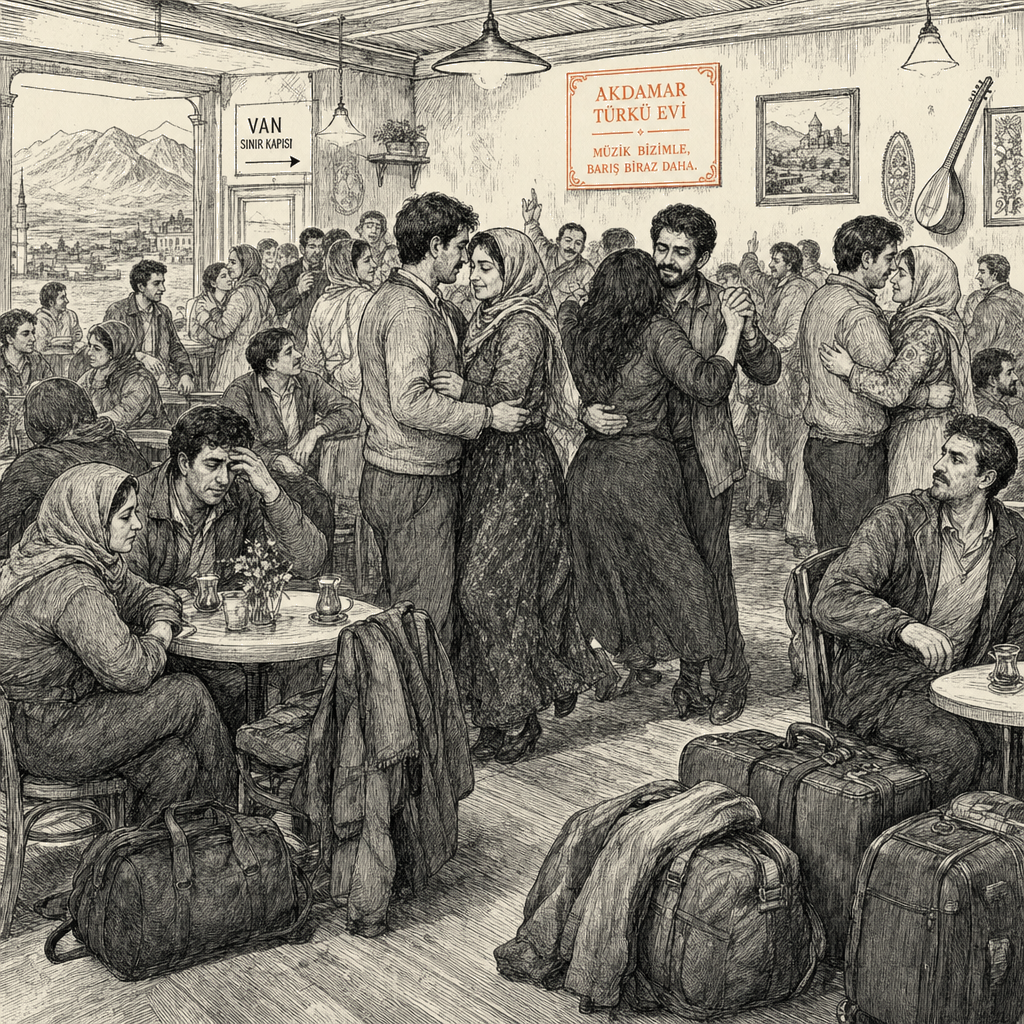
- Iranian civilians crossing into Turkey exhibit war exhaustion and seek decompression while the Islamic revolutionary regime consolidates state control through heightened domestic coercive presence.
- The truce agreement omits structural verification mechanisms and fails to address the Israeli track, creating a highly sensitive interface at the Strait of Hormuz where localized kinetic events immediately propagate into broader escalation.
- The U.S. and Iranian leadership retain their respective strike and closure capacities, rendering the ceasefire dependent on mutual exhaustion rather than a durable domestic constituency for peace within Iran.
The preliminary ceasefire between the United States and Iran, signed last week to wind down the war that began with February 28 airstrikes, shifts the interaction from an initial regime-change objective to a tense deterrence equilibrium. While the truce provides Iranian civilians an opportunity to exhale and decompress in border towns like Van, Turkey, the agreement omits structural verification mechanisms and fails to address the underlying strategic calculations of either side. The immediate post-war landscape reveals a highly sensitive interface where the United States and Iran retain their respective strike and closure capacities, leaving the arrangement dependent on mutual exhaustion rather than a durable domestic constituency for peace within Iran.
Who benefits from the truce terms
The truce settled the war on terms giving each side what it minimally needed: the United States an off-ramp from a conflict it could not finish, and Iran a recognition of its survival. The deal did not deliver the war’s principal stated objective, as Iranian opponents are bitterly disappointed that the war did not topple the regime, which was one of the aims U.S. President Donald Trump and Israeli Prime Minister Benjamin Netanyahu initially put forward. A clean U.S. win would have produced visible terms addressing regime change; a clean Iranian win would not have produced the Friday strikes the U.S. launched after Iran fired on a commercial vessel in the Strait of Hormuz. Iran retains the Strait of Hormuz instrument and the program infrastructure that produced the original casus belli, while the United States retains the capacity to strike. The preliminary deal represents a shift from the coalition’s initial objective of regime change to a tense, unstable deterrence equilibrium. The published record of the deal’s preliminary status, its initiation by airstrikes with regime change as a stated aim, the Wall Street Journal’s framing of hard-liners having held out under thousands of airstrikes and forced Washington to make difficult compromises, and the Friday strikes are difficult to reconcile with a reading of managed de-escalation in which both sides have agreed to lock in mutual exhaustion.
What happens next under structural fragility
Three load paths are most likely to yield under the deal’s structure. The first is the Strait of Hormuz corridor; Iran has already used it as a coercive instrument, and it produced the Friday incident within days of the deal’s signing. The second is the Israeli track, because Netanyahu’s stated aim of toppling the regime is not addressed by the deal and is therefore a motive outside the truce’s published terms. The third is the Iranian domestic track, where the regime has survived by repressing its own population, which carries elevated incentives to externalize the threat if internal pressures compound. The interaction is characterized by a highly sensitive interface at the Strait of Hormuz, where the Friday strike following a single maritime incident demonstrates a lack of buffers or circuit-breakers in the operational environment; a localized kinetic event immediately propagates into broader escalation. A managed de-escalation would require a verification architecture, a credible answer to the Israeli track, and a regime-side constituency capable of restraining the Hormuz instrument, none of which is visible in the published record. The Friday strikes serve as evidence for an alternative reading: a truce between two parties that have not agreed on what they were fighting about, and which therefore contains the conditions for the next round. Load fragility is also evident in the U.S. and Israeli domestic political arenas, as the preliminary deal requires domestic political cover that may not withstand future provocations, potentially prompting a return to the bombing campaign if the coalition’s domestic tolerance for the compromise is tested.
How the post-war environment is being framed domestically
The prevailing domestic environment in Iran reflects a synthesis of societal fracture and heightened coercive presence, where the populace exhibits war exhaustion and seeks decompression while the state simultaneously tightens its domestic grip. According to the Wall Street Journal, supporters of the Islamic revolutionary regime are triumphant after Iran’s hard-line leaders held out under thousands of airstrikes, shut the strategic Strait of Hormuz, and forced Washington to make difficult compromises to secure last week’s deal. The Journal frames the regime as having forced these compromises. Polarized societal fracture is evident as the conflict accelerated anti-regime sentiment, but the cessation of bombing removed the catalyst for active uprising, resulting in passive disillusionment and outward migration. The Journal reports that opponents are bitterly disappointed the war did not achieve the regime-change objectives initially outlined by U.S. and Israeli leadership. The regime is consolidating state control via heightened coercive presence, using the external conflict to justify permanent internal security measures. Travelers report that Revolutionary Guard troops and Basij enforcers are now more visible on the streets than before the conflict, following the regime’s January crackdown on protesters in which Iranian government forces shot dead thousands of their own citizens to crush antigovernment protests. The population’s primary mechanism of response has shifted from active internal confrontation to external exit, articulating a sense of exhausted disillusionment. An observable structural tension exists between the Iranian populace’s outward migration and the state’s hyper-visible security apparatus, revealing a vulnerability at the intersection of border permeability and domestic control.
The civilian experience at the border
The traveler accounts at the Kapıköy crossing and the Van decompression economy demonstrate that the war’s outcome has not produced a stable domestic constituency for peace, which is the constituency any durable settlement would require. Resul Khurbani, a 51-year-old mechanic from Tabriz who volunteered to join Iran’s reserve forces during the war, stated, “Iran won the war. Iran put America’s nose in the dirt,” adding, “We are very happy that we didn’t let Americans set foot in Iran.” Conversely, a manager of a Tehran shoe store expressed disappointment, stating, “Trump promised to help the Iranian people, but he didn’t keep his word,” and asking, “What is the point of starting a war and then stopping suddenly?” A man who returned to Iran during the war to care for his mother, whose arm was broken and back and leg injured when a bomb struck his building one floor up, said he did not blame the U.S. or Israel, stating, “Not like this, not war, but something should have happened. They were killing people.” At the Van train station, a 27-year-old medical lab technician from Tehran awaiting a train back to the capital said, “I don’t know who won the war, but the people lost.” A 30-year-old social media manager from Tehran, standing outside the crossing awaiting a car to Van, stated, “We just came from a war, so we’re going to have some fun.” A pathologist from Tabriz traveling to the Mediterranean resort town of Antalya for a vacation said, “We hope the war is over,” and noted, “We don’t know what tomorrow will bring.” Hüseyin Aşan, the 32-year-old manager of Queen Festa, the largest nightclub in Turkey serving Iranian tourists, reported that the club hosted about 350 partyers before the war, saw a 70% drop in business during the conflict, and is now recovering. Aşan stated, “Morale is a bit better now,” and observed, “In Iran there’s no dancing in restaurants. There’s something inside of them screaming out to dance.” The Turkish border economy depends entirely on the uninterrupted flow of these tourists and traders; a resumption of hostilities would instantly collapse this localized economic dependency. The post-conflict landscape is defined not by the strategic calculations of state actors, but by the civilian experience of the intervening months.
Analytical techniques used in this piece
This analysis applies the methods below. Each links to a short, plain-English explainer you can read and reuse.
- Differential Diagnosis
- Lists the candidate explanations for a symptom and rules them out one by one.
- Pre-Mortem (Fragility)
- Imagines a system has already broken and traces the structural fragilities that let it.
- Strategic Interaction (Game Theory)
- Models a situation as a game — players, moves, payoffs, and likely equilibria.
- Antifragility (Taleb)
- Whether shocks break a system, leave it unharmed, or actually make it stronger.