Summary
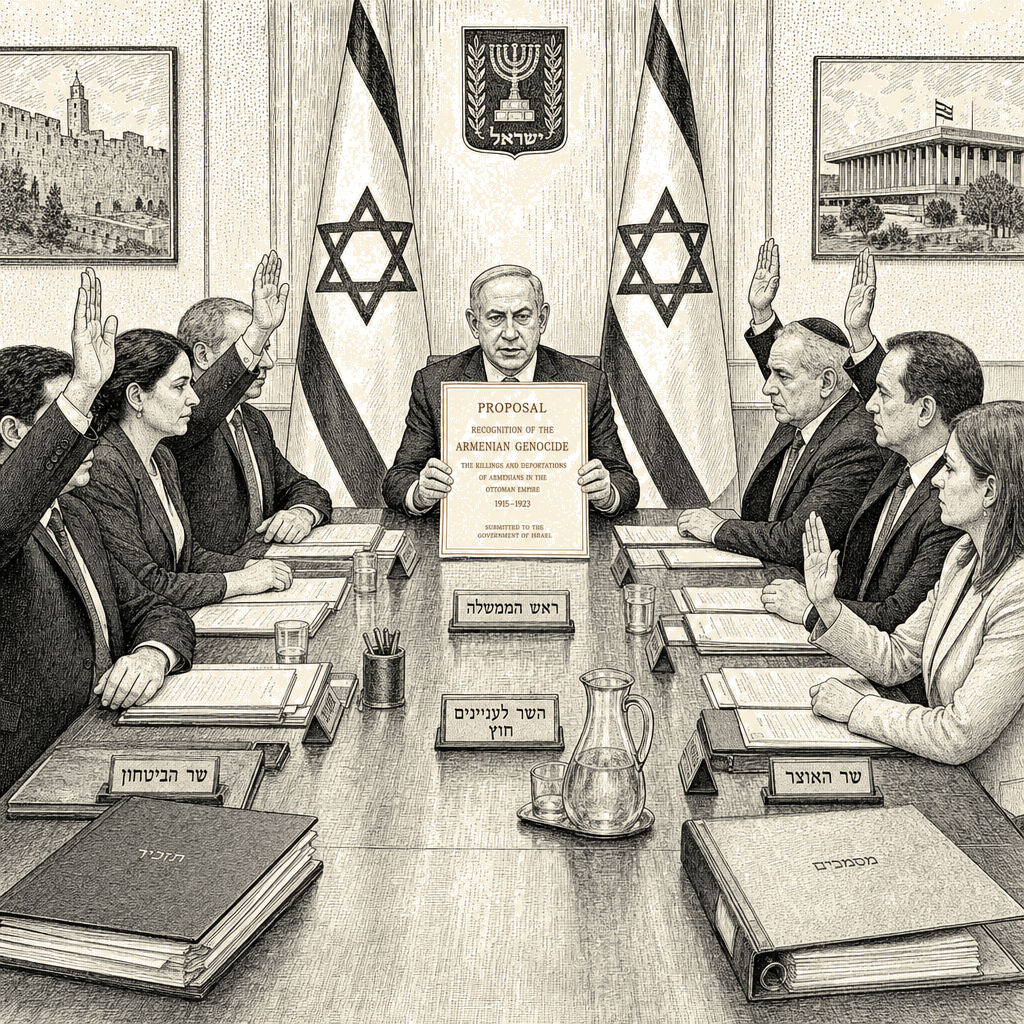
- The Israeli Cabinet unanimously approved formal recognition of the 1915 Armenian killings as genocide, executing a policy shift that formalizes deteriorating relations with Turkey while exposing the state to reciprocal diplomatic friction over contemporary Gaza proceedings.
- Foreign Minister Gideon Saar framed the measure as a moral duty aligned with 32 other nations, but the maneuver forfeits the strategic restraint Israel previously maintained to preserve intelligence and energy cooperation with Ankara.
- Turkey immediately characterized the decision as a politically motivated distraction from Israel’s legal exposures at the International Court of Justice, collapsing the historical recognition into a single narrative of state contradiction regarding Gaza.
- The proposal now advances to the Knesset, where coalition dynamics and the absence of documented defense or economic cost assessments leave the final legislative passage and operational implementation contingent on unresolved domestic and bilateral pressures.
Israel’s Cabinet voted unanimously on Sunday to formally recognize the mass killings of Armenians under the Ottoman Empire during World War I as a genocide, a policy shift announced by Foreign Minister Gideon Saar that reflects the deterioration of Israeli-Turkish relations over the past two decades. The decision, which requires Knesset approval, fulfills a long-standing advocacy goal but immediately triggered condemnation from Ankara, which dismissed the move as a politically motivated attempt to distract from Israel’s ongoing legal proceedings at the International Court of Justice regarding its military campaign in Gaza. The cabinet’s action places the legislation at the intersection of historical memory, shifting bilateral strategic calculations, and the ongoing rhetorical contest over contemporary international legal accusations, leaving the final legislative outcome and the operational costs to regional security cooperation unresolved.
Strategic costs and diplomatic alignments
Saar framed the decision as a “moral and historical duty” and invoked the precedent of 32 countries, including the United States, that have already recognized the genocide, situating Israel within an existing diplomatic alignment. This framing addresses a constituency within Israel and the Armenian diaspora that had long advocated for recognition.
The relationship with Turkey is the principal cost center of this decision. The vote formalizes a posture Israel had previously withheld precisely because the relationship had not yet decayed enough to absorb the diplomatic cost. For years, Israel avoided officially broaching the subject out of concern for damaging its strategic relationship with Turkey. That relationship has soured over the past two decades, particularly under Turkish President Recep Tayyip Erdogan, leading Israel to reassess its position.
Operational links potentially exposed by this deterioration include intelligence sharing on Iran, overflight rights, and energy cooperation. The public record does not document the impact on relationships with non-Turkish Turkic states such as Azerbaijan, a close Turkish ally and a regional adversary of Armenia, leaving a strategic exposure unaddressed in the cabinet’s public accounting.
Turkey has imposed documented asymmetrical diplomatic and security measures, including trade halts, overflight restrictions, and diplomatic downgrades, on other states that have recognized the genocide. The cabinet’s working assumption appears to be that the relationship has already decoupled from the recognition question. The critical operational question remains whether any of those operational links would survive a Turkish decision to suspend them, and whether the marginal cost of losing them was weighed against the marginal benefit of a 33rd-country recognition.
The reciprocity problem is structural. Israel faces active genocide accusations at the International Court of Justice and arrest warrant proceedings at the International Criminal Court regarding its military campaign in Gaza. Turkey’s Foreign Ministry immediately situated the Israeli decision within this context. Analytical context suggests Turkey’s invocation of the Gaza proceedings against Israel serves Ankara’s own strategic positioning, including its regional posture regarding Kurdish populations and its interest in countering parallel international legal scrutiny of its own domestic policies.
Rhetorical contest and narrative framing
Recognizing one genocide while facing legal proceedings alleging another creates a reciprocity problem that appeals to international alignment do not necessarily neutralize. The timing of the recognition ensures that in the global information environment it is received as statecraft rather than as an independent moral reckoning. The 1915 events and the contemporary Gaza war collapse into a single narrative of state contradiction.
Turkey’s Foreign Ministry swiftly condemned the Israeli decision, calling it a “politically motivated” step designed to distract from Israel’s own military actions. The ministry stated: “The Israeli government, which systematically persecutes the Palestinian people in full view of the world and is being tried at the International Court of Justice for genocide against the people of Gaza, aims to cover up its own crimes.”
Turkey invoked alongside the move the findings of a team of independent experts commissioned by the United Nations who accused Israel of deliberately shooting children in Gaza and repeated accusations of genocide. Israel rejected that report as a “libelous sham.” The information environment also includes the casualty figures: the Hamas-run Health Ministry estimates over 73,000 Palestinians killed since the Oct. 7, 2023 Hamas-led attack, which killed around 1,200 people according to Israeli officials. Israel says it does not target civilians and accuses Hamas of using civilians as human shields.
The global collapse of the two narratives empowers what Saar characterized as an “institutionalized campaign of denial and minimization, including a manipulative rewriting of history, mainly by the Turkish government,” by discrediting the messenger in the eyes of non-aligned states and scholars. The announcement does not document any articulated Israeli response to the parallel Turkey drew, leaving a gap in the state’s rhetorical mitigation.
Historical record and denial positions
Historians estimate that up to 1.5 million Armenians were killed by Ottoman Turks around the time of World War I, though recent scholarship often cites estimates ranging from 800,000 to 1.2 million. The event is recognized by a majority of genocide scholars as the first genocide of the 20th century.
Turkey rejects the genocide label, saying the death toll has been inflated and that those killed were victims of civil war and unrest. Saar addressed this directly, stating: “Despite the extensive and unambiguous historical documentation, the Armenian Genocide remains to this day the subject of an institutionalized campaign of denial and minimization, including a manipulative rewriting of history, mainly by the Turkish government.”
Legislative pathway and operational sequel
The measure still needs to be approved by the Knesset, Israel’s parliament, and a date for that vote has not been set. Cabinet unanimity does not resolve the outcomes at the legislative stage. Cabinet unanimity in Israel has, in recent legislative cycles, not always translated into Knesset passage, particularly on symbolic measures that do not bind individual MKs. Public records document multiple cases where unanimous or near-unanimous Knesset actions — dissolution bills, annexation proposals — have faced subsequent friction, coalition discipline failures, and unfinished passage.
The decision point that could break is the assumption that a cabinet endorsement is sufficient to discipline the coalition. Leading indicators of breakage include early whip counts, public statements from coalition MKs with Turkish- or Azerbaijani-origin constituencies, and any signal from the defense and intelligence caucuses that have historically been cautious about Turkey.
The announcement names no defense or intelligence official, no economic cost analysis, and no assessment of the impact on regional partners that the cabinet would have weighed. It does not address what the soured relationship means in practical operational terms, nor does it address the role of Armenian diaspora advocacy in Israel or the political infrastructure behind the vote. The omission of Azerbaijan from the strategic calculus and the absence of explanation for why the formal cabinet vote occurred now versus earlier leave the domestic coalition dynamics under-documented.
If Ankara perceives the move as a deliberate provocation tied to the ICC and ICJ proceedings, the retaliatory response could exceed the bounds of rhetorical condemnation, forcing Israel into a crisis-management posture that distracts from its primary security objectives and transforms a unilateral historical statement into a bilateral strategic liability. Documented mitigation language in the surrounding analysis suggests a structural decoupling of the historical mandate from contemporary foreign policy disputes, scoping Knesset consideration strictly as an educational and historical record to insulate the measure from retaliatory rhetoric.
The move to the Knesset leaves the initiative in a liminal space. Ultimate efficacy depends not on the historical consensus restated, but on whether Israel can navigate the intersection of 20th-century memory and 21st-century geopolitical fracture without allowing the former to be entirely consumed by the latter.
Analytical techniques used in this piece
This analysis applies the methods below. Each links to a short, plain-English explainer you can read and reuse.
- Pre-Mortem (Action Plan)
- Imagines the plan has already failed, then works backward to find out why.
- Quick Orientation
- A fast lay-of-the-land read of an unfamiliar domain.
- Red-Team Assessment
- Models a capable adversary probing a plan for the seams they would exploit.