Summary
- Republican defectors stalled the House legislative agenda by defeating a procedural rule, exposing the structural vulnerability of the chamber’s narrow majority to minority vetoes.
- The procedural collapse resulted from an aggregation of disparate policy demands, including the SAVE America Act and immigration legislation, rather than a single unified faction.
- Executive branch signaling by President Donald Trump altered member risk calculations by conditioning his signature on a bipartisan housing bill on the passage of the elections measure.
- The impasse compresses the legislative calendar for must-pass defense and appropriations measures, forcing leadership to navigate a recess period without resolving the underlying coalition fragmentation.
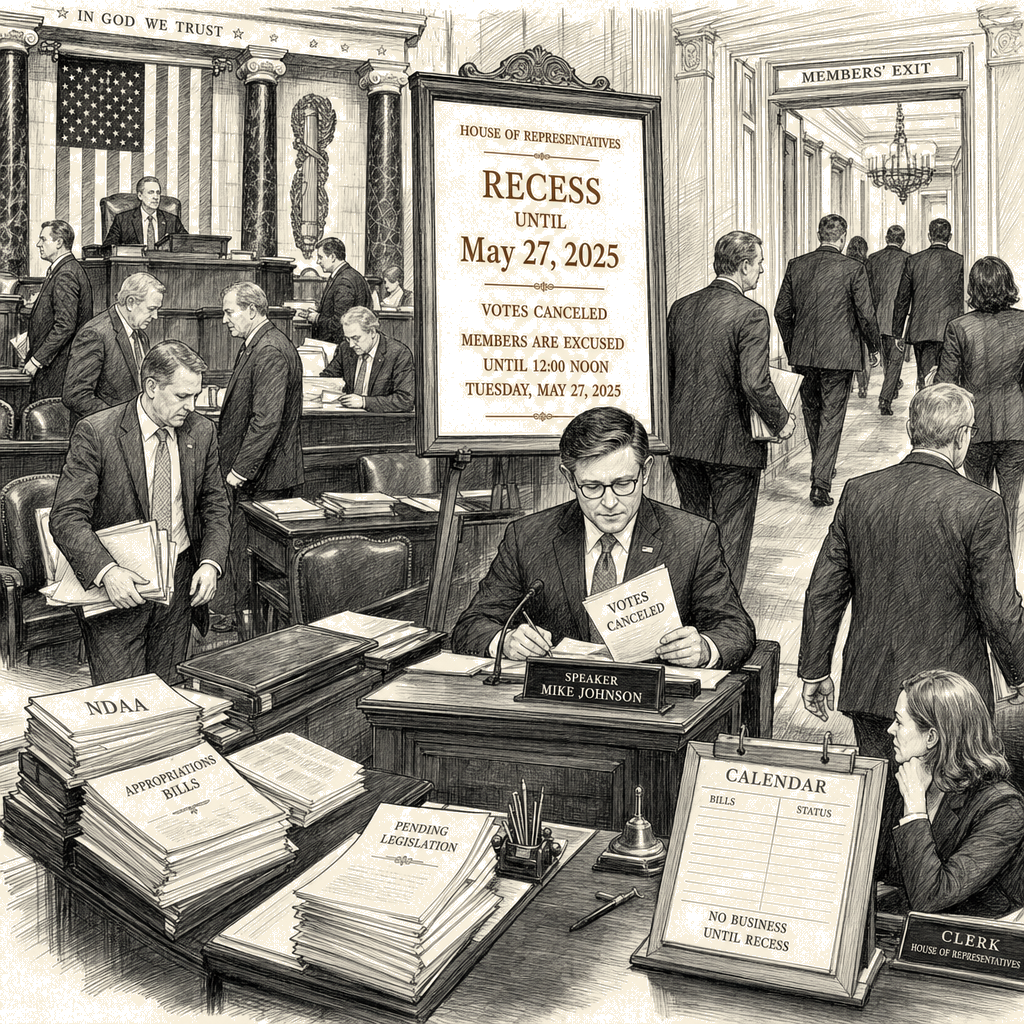
The House of Representatives entered an unanticipated nearly two-week recess after a 224-198 procedural vote defeated the rule required to advance the chamber’s legislative agenda. Fourteen Republicans joined unanimous Democratic opposition, halting floor business on the annual defense authorization and appropriations measures for the second consecutive week. Speaker Mike Johnson publicly acknowledged the constraint of the chamber’s narrow majority, stating, “We have the smallest margin in U.S. history. We’re nearing an election. People get very emotional about things, and sometimes they make irrational decisions.” The dispute highlighted the interaction between structural margin limitations, electoral calendar pressures, and external executive priorities.
Structural vulnerability and institutional architecture
The structural vulnerability in evidence is the interaction of a historically narrow margin with procedural mechanisms designed for larger majorities. Cox and McCubbins, in their framework of legislative cartel theory, characterize party leaders’ agenda control as “negative” — exercised by blocking floor consideration of bills lacking majority-of-the-majority support. When the majority’s margin is insufficient to absorb normal attrition, the House Rules Committee and the rule-vote mechanism become vulnerable to minority vetoes. The historical record of thin majorities establishes that formal rules do not guarantee governance; governance requires either super-majority coalitions on specific bills or the expenditure of significant political capital to enforce discipline. The current chamber lacks both the votes for the SAVE Act in its current form and the structural mechanisms to bypass the dissenting faction without Democratic support — a structural reality confirmed by leadership’s public admissions. The dependency-ordered sequence documented runs from structural margin to electoral calendar, presidential external pressure, triggering policy dispute, and procedural defection. The SAVE Act operates in this architecture as a triggering event rather than a structural cause. Removing the structural margin as a central driver would collapse the architecture: a wider majority would tolerate internal disagreement without procedural risk. As long as the margin is this narrow, the system will repeatedly confront the same risk surface.
Coalition dynamics and beneficiary positioning
Three identifiable coalitions are positioned to extract value from the procedural collapse. The Luna faction, led by Rep. Anna Paulina Luna of Florida, used the procedural hold to compel floor consideration of the SAVE America Act, a bill requiring proof of citizenship for voter registration. Luna’s documented statement — “I’m not stupid. I’m going to fight on the behalf of the American people” — frames the hold as a substantive policy demand rather than procedural disruption. The article identifies parallel demands from other Republicans, including for an immigration bill vote, indicating the defection coalition is multi-issue rather than single-cause.
President Donald Trump secured a procedural benefit from the impasse by publicly conditioning his signature on a bipartisan housing bill that had passed both chambers with broad bipartisan support on prior passage of the SAVE Act. He characterized the housing measure as “a yawn” relative to the elections bill. The article notes that neither chamber is expected to have the votes to pass the SAVE Act in its current form, meaning the executive priority assertion constrains legislative movement on other items.
Democratic members gained a documented rhetorical position. Rep. Jim McGovern of Massachusetts characterized the chamber’s situation on the floor as “unhinged,” stating, “What on earth are we doing here? Every week, wondering if someone’s going to throw a fit, if Donald Trump is going to post something crazy and blow everything up, if Mike Johnson is going to bring something to the floor when he doesn’t have the votes.” This opposition-source characterization of dysfunction is corroborated by the Republican Speaker’s own admission of “irrational decisions.”
Causal hypotheses for the dissenting bloc
The behavior of the dissenting bloc admits at least four distinct causal hypotheses, each grounded in documented conduct rather than inferred motive.
The first hypothesis is coordinated minority leverage. A faction of members, publicly identified by Luna, withheld their votes to compel floor consideration of the SAVE Act, a documented legislative behavior in thin-majority chambers: using procedural holds in a thin majority to force action on priority legislation that lacks sufficient votes for standalone passage. Leadership acknowledged this constraint; Johnson stated that neither the House nor the Senate currently possesses the votes to pass the measure in its current form.
The second hypothesis is uncoordinated grievance aggregation. The article reports that some members withheld votes over distinct demands, including an immigration bill, indicating that the 14-vote defection may not represent a single unified faction but rather an aggregation of individual members leveraging the procedural vulnerability of leadership to advance disparate policy priorities.
The third hypothesis is executive branch signaling altering member risk calculations. The documented convergence of Trump’s veto threat and the Luna faction’s stated priority is consistent with an executive-signaling pathway in which members calculate that the executive will veto compromised legislation regardless of their support, decreasing the electoral cost of defying leadership to demand ideological bills. The article does not document individual member calculations directly; the hypothesis is consistent with the documented conduct but is not directly confirmed by it.
The fourth hypothesis isolates electoral cycle timing. Rep. Thomas Massie, identified in the article as having lost his primary to a Trump-endorsed candidate, articulated a testable claim on the floor: “I think people are past their primaries and are getting restless. There are people who normally wouldn’t vote against the rule and are doing it.” This aligns with David Mayhew’s framework in Congress: The Electoral Connection, which posits that legislative behavior and cohesion are fundamentally driven by electoral calculations and the pursuit of reelection. The case for this mechanism is conditioned on the electoral calendar: as the primary season advances, the share of members for whom a defection carries no near-term electoral cost should grow. The article does not enumerate the 14 defecting Republicans’ primary status, leaving Massie’s hypothesis in a partially specified state. A relevant test: if the 14 defectors were not disproportionately past their primaries, the behavioral mechanism would shift toward ideology or constituency pressure, and the predictive structure would change.
Forward scenarios and leading indicators
The forward trajectory depends on two critical independent axes: the degree of executive agenda centralization and the cohesion of the majority faction. Predetermined elements visible in the article include the mid-July recess return, an unchanged margin, and Trump’s publicly stated priority ordering. Critical uncertainties include whether Johnson can assemble a working coalition on the rule when the House returns, whether Trump will modify his position on the housing bill or SAVE Act sequencing, and whether the recess itself changes the political dynamic.
The first scenario is a concession path: when the House returns, leadership brings the SAVE Act to the floor in some form, either as a standalone vote or as a substantive amendment to must-pass legislation. The article’s note that neither chamber is expected to have the votes to pass the bill in its current form lowers this scenario’s probability, but a modified form remains conceivable.
The second scenario is a continued impasse: the procedural pattern repeats in mid-July under a different triggering dispute. The article’s documentation of a “second week in a row” gives this scenario non-trivial weight, especially given the multi-issue character of the defection coalition.
The third scenario is a bypass mechanism: leadership attempts to move must-pass items — the annual defense authorization and appropriations measures — under procedures that do not require a rule vote, such as suspension of the rules or unanimous consent. This constrains policy scope but preserves calendar movement before the August district work period.
The fourth scenario is a leadership change: the Speakership itself becomes unstable. The article does not name a specific challenger, and Johnson’s framing attributes the impasse to individual member behavior rather than a directed removal effort, leaving this scenario with a low probability.
A fifth, lower-probability trajectory is a structural rules change: if the paralysis becomes chronic, a coalition of members and leadership might attempt to alter fundamental chamber rules — such as modifying the discharge petition threshold or the “empty chair” mechanism — to bypass the minority faction. Leading indicators would be the introduction of rules package amendments or formal proposals to alter the Committee on Rules’ jurisdiction.
A sixth trajectory, representing reversion to the historical norm of thin-majority governance through transactional politics, involves executive pressure receding or shifting to targeted negotiations while leadership trades committee assignments or specific policy concessions to reconstitute a working majority. This is the established pattern for thin-majority chambers; its probability depends on whether the executive de-escalates priority enforcement.
The continued-impasse scenario would be visible in continued public alignment between Luna and her defecting cohort during the recess, in the absence of any publicly visible deal, and in further Trump statements reiterating the SAVE Act as priority. The bypass mechanism would be visible in the procedural structure of bills that leadership announces for the mid-July return. The concession path would be visible in publicly reported vote-counting activity on the SAVE Act. The leadership-change scenario would require visible defection from a Johnson ally on a previously routine procedural matter. The rules-change scenario would be visible in the introduction of formal rules package amendments. The transactional-reversion scenario would be visible in successful passage of procedural rules with minor defections and the scheduling of compromise bills.
Consequences, sequel, and frame audit
A brief disruption has sequenced effects. The article identifies the annual defense authorization and appropriations measures as stalled items. A two-week recess compresses the calendar before the August district work period and the pre-election window. The immediate sequel will be determined by whether Trump maintains the veto threat on the housing bill and whether the dissenting faction coordinates around a single procedural demand or fractures into competing grievances. The structural reality, as articulated by the Speaker, is a majority with the “smallest margin in U.S. history,” operating in an environment where procedural norms require a level of cohesion that current factional dynamics do not consistently supply.
Robust strategies for institutional actors — those that perform adequately across multiple scenarios — include maintaining a visible legislative record through committee work and public positioning, which yields electoral benefits regardless of floor outcomes. Scenario-dependent strategies depend on correctly predicting executive behavior: if Trump continues to veto bipartisan compromises, the documented behavior consistent with primary-season autonomy indicates that members who have secured their primary nominations but face competitive general elections will demand ideological concessions; if Trump signals willingness to sign compromises, the optimal posture shifts to supporting leadership to deliver constituent benefits.
The article documents the chamber’s rhetorical temperature, not just its procedural state. McGovern’s “unhinged” characterization is a documented opposition-source characterization. Johnson’s “irrational decisions” admission is a documented Republican-source characterization of the same situation. Massie’s “past their primaries” framing offers a behavioral hypothesis. Luna’s “fight on the behalf of the American people” framing offers a substantive defense. Trump’s “yawn” framing of the bipartisan housing bill offers an executive-priority assertion. The convergence of these frames — opposition characterization, Speaker admission, behavioral hypothesis, substantive defense, executive priority — documents the chamber’s operating tempo without resolving it. The framing contest is itself a substrate signal: the absence of a single dominant narrative across the coalition corresponds to the procedural fragmentation the vote exposed.
Coverage gaps and analytical limits
The article does not provide a complete enumeration of the 14 defecting Republicans, their primary status, or the full coalition dynamics that produced the vote. Massie’s primary-status hypothesis accordingly remains an empirically testable claim that the present reporting does not confirm or disconfirm. The article also does not specify whether any leadership-cosponsored amendment to the SAVE Act is in development, and does not name a specific challenger to the Speakership should the leadership-change scenario materialize. The article does not document individual member calculations behind the executive-signaling pathway, leaving the third hypothesis substrate-consistent but substrate-unconfirmed.
Analytical techniques used in this piece
This analysis applies the methods below. Each links to a short, plain-English explainer you can read and reuse.
- Bayesian Hypothesis Network
- Updates the probabilities of competing hypotheses as evidence accumulates.
- Domain Induction
- Builds a working mental model of a domain from the ground up.
- Scenario Planning
- Builds a small set of distinct, plausible futures to plan against.
- Allison’s Three Lenses
- Reading a state’s action as rational actor, organizational output, and bureaucratic politics at once.
- Bayesian Reasoning
- Starting from base rates and updating beliefs proportionally as evidence arrives.
- Nash Equilibrium
- A standoff where no party can do better by moving alone, so the stalemate holds.