Summary
- U.S. District Judge Paul Friedman issued a preliminary injunction blocking the Department of Defense from enforcing its journalist escort policy after finding the regulation likely violates the First Amendment and functions as retaliation.
- The court’s retaliation determination incorporates a documented record of insulting statements by President Donald Trump and Defense Secretary Pete Hegseth into the litigation record, constraining future executive branch policy variations.
- Department of Defense spokesperson Sean Parnell announced an appeal and argued the removal of escort requirements restores an environment vulnerable to unauthorized intelligence disclosures.
- The Freedom of the Press Foundation warned that continued executive branch attempts to bypass the injunction should trigger judicial sanctions or contempt proceedings.
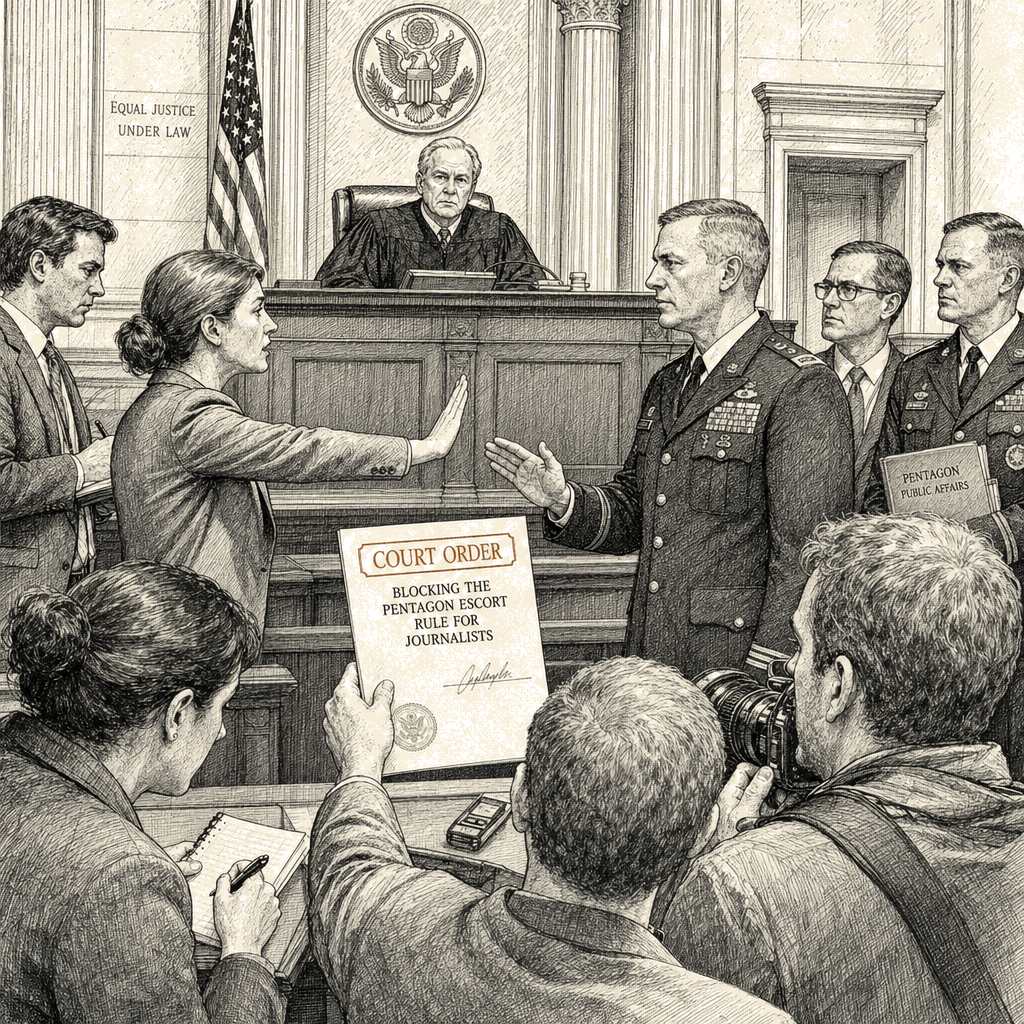
U.S. District Judge Paul Friedman issued a preliminary injunction on Tuesday blocking the Defense Department from enforcing its journalist escort policy at the Pentagon, ruling the regulation likely violates the First Amendment and constitutes retaliation. The decision marks the third time the court has ruled against the department’s evolving press-access restrictions since October 2025, establishing a procedural posture where the judiciary’s documented-conduct record now actively constrains the executive branch’s future policy design. While the department has announced its intent to appeal and defended the policy as a national security necessity, the court’s retaliation finding shifts the analytical focus from baseline press access to the legal consequences of executive branch rhetoric.
Strategic Posture and Future Constraints
U.S. District Judge Paul Friedman rested Tuesday’s ruling on two findings: a likelihood of success on the First Amendment claim and a likelihood of success on the retaliation claim. The retaliation finding is the strategically significant element because it imports a documented record of statements by President Donald Trump and Defense Secretary Pete Hegseth into the review of any future Pentagon policy variation. Friedman noted “numerous instances” of administration officials insulting The New York Times and other news organizations, finding the plaintiffs were “likely to succeed on their claim that the policy was retaliatory.”
This documented-conduct record creates a binding constraint on the executive branch. Future Department of Defense moves cannot easily reverse that record without disavowing the underlying conduct, which would incur political costs. Courts typically read successive policy variations as continuous conduct when the underlying decisionmaker is unchanged, meaning any narrower escort policy inherits a record the Department of Defense did not author and cannot easily rebut.
An alternative game structure for resolving this dispute involves shifting from a binary access model to a tiered, clearance-based one. As formalized by mathematician John Nash, the equilibrium under this positive-sum structure would involve the press accepting heightened individual accountability for classified information in exchange for physical access, and the Pentagon relinquishing blanket physical restrictions. The current strategy of iterative policy revision suggests the executive branch has not yet committed to this alternative structure, opting instead to repeatedly test the judiciary’s tolerance for incremental encroachment.
Procedural Posture and Litigation Paths
The litigation has produced a sequential dynamic in which each Pentagon variation is reviewed against a record the court has built since October 2025. The chronology runs: the department adopted a policy allowing credential revocation for unauthorized information collection; Friedman ruled the original policy unconstitutional in March 2026; the department adopted a revised policy requiring journalists to be escorted by Defense Department personnel at all times; a divided three-judge panel of the U.S. Court of Appeals for the District of Columbia Circuit granted an emergency stay in late April; and Friedman issued the current preliminary injunction on July 1, 2026.
This dispute demonstrates a repeated game of institutional iteration. The decision-clarity taxonomy presents four branching paths: the Pentagon abandons the escort requirement and reverts to pre-October norms; the Pentagon narrows the policy to a fact-bound justification for specific areas; the D.C. Circuit reverses the preliminary injunction on appeal; or the Supreme Court grants review to resolve the First Amendment scope question. A strategic-interaction framework reframes these into three intervention paths: accepting the injunction and forcing the Pentagon to pursue leak mitigation through internal security protocols; pursuing the currently stated reversal intervention via appeal; or employing a defer-and-monitor strategy that prolongs the appellate process with intermittent stays to chill reporting without triggering definitive contempt sanctions. The department’s stated appeal threat carries medium credibility, functioning partly as a sunk-cost signal. The divided late-April panel stay indicates the appellate court is threshold-sympathetic to national-security rationales, but the divided vote signals the merits are not preordained.
Press Access and Institutional Costs
The current equilibrium favors The New York Times on the merits question while leaving the operational question open. The Times has won three consecutive rulings, and its litigation posture carries high credibility as a future-shadow commitment; the Department of Defense cannot cheaply buy it off.
The scope of the injunction’s applicability to non-Times reporters remains unresolved. The UPI report noted it is “uncertain whether the order applies to all credentialed reporters or only those working for The New York Times.” If the injunction is read narrowly, the policy remains in effect against other outlets, producing an asymmetric press environment in which the Times has restored access while competitors remain subject to escort requirements. This outcome carries its own First Amendment profile that other plaintiffs would have standing to test. If the injunction is read broadly, the policy is effectively suspended for the credentialed press corps, and the Department of Defense’s policy-design space contracts to either narrower area-specific restrictions or to operating under pre-October access norms.
The Pentagon’s national-security claim, articulated by spokesperson Sean Parnell, is weakened as a litigation commitment device but remains grounded in factual assertions not directly rebutted in the record. The court has not found that unauthorized disclosures did not occur; it has found that the enforcement policy is retaliatory. The future-shadow of further litigation makes the national-security claim operate more as a public-justification posture than a binding legal constraint on department behavior.
Framing the Dispute
The parties characterize the same conduct—unescorted journalist presence—as either a security vulnerability or a constitutional protection. The Pentagon frames the issue around operational security and adversary protection, treating the interaction as zero-sum. Parnell argued that “unescorted access to the Pentagon allowed journalists to observe activity patterns and develop relationships that contributed to repeated unauthorized disclosures of operational plans and intelligence.” He added that “the court’s order effectively restores that risky environment at a time when protecting our military’s secrets is more critical than ever,” contending that removing the policy will make it easier for “sensitive and classified information to reach our adversaries.”
The New York Times frames the issue around constitutional press function and the public’s right to know. Media relations executive director Charlie Stadtlander called the ruling “well-reasoned” and stated it “reaffirms the First Amendment rights of the press to cover the Pentagon without restrictions designed to prevent the public from knowing what the military is doing.”
The court frames the dispute through First Amendment protection and anti-retaliation doctrine. Friedman wrote, “This Court has spoken at several points about the critical importance of protecting the freedoms enshrined in the First Amendment. Those who drafted the First Amendment believed that the nation’s security requires a free press and an informed people and that such security is endangered by government suppression of political speech. That principle has preserved the nation’s security for almost 250 years.”
The Freedom of the Press Foundation frames the dispute around judicial authority enforcement and the disputed legitimacy of further workarounds. The group warned that “the DoD can’t be allowed to punish journalism or evade court orders without consequences” and stated, “If the Pentagon keeps trying to avoid this ruling, the court should respond with sanctions or contempt.”
The court’s retaliation finding serves as the bridge that resolves the present dispute in favor of the press frame while preserving the security frame as future-litigation material.
Operational Adaptations and Next Steps
The analytically significant variable is the Pentagon’s next move, with the appeal being the path on which the equilibrium is most likely to flip. If the D.C. Circuit affirms on the merits, the equilibrium moves toward the Pentagon, and the Times is positioned to seek further review. If the Circuit reverses and the government prevails at the Supreme Court, the constitutional scope question is resolved at a higher level.
The Department of Defense retains information-control tools that fall outside the court’s review. The Pentagon could shift information flow to off-record briefings, non-credentialed advisory channels, allied-nation liaisons, or leaks engineered through political appointees. Such moves would render press-access restrictions moot without requiring a win on the legal question, trading legal risk for transparency erosion. The press-access equilibrium is the visible constraint, but the operational transparency equilibrium is the deeper one, and the Department of Defense’s information-control toolkit extends well beyond credential revocation.
If the Pentagon continues the iterative revision cycle to test the limits of the injunction, the conflict will likely trigger the sanctions or contempt proceedings warned of by the Freedom of the Press Foundation, shifting the battleground from First Amendment access doctrine to the enforcement of judicial authority. The court’s institutional posture toward further workarounds remains untested; while it has signaled through three rulings that it views the constitutional question as settled on the present record, a sanctions order would be a discrete commitment device the court has not yet issued. If the Pentagon develops non-access-based leak prevention mechanisms, the dispute may stabilize at a new equilibrium.
Analytical techniques used in this piece
This analysis applies the methods below. Each links to a short, plain-English explainer you can read and reuse.
- Decision Clarity
- Articulates the real stakes, stakeholders, and interests behind a decision facing a third party.
- Strategic Interaction (Game Theory)
- Models a situation as a game — players, moves, payoffs, and likely equilibria.
- Tit-for-Tat
- Reciprocity as strategy: match the other side’s last move — reward cooperation, punish defection.