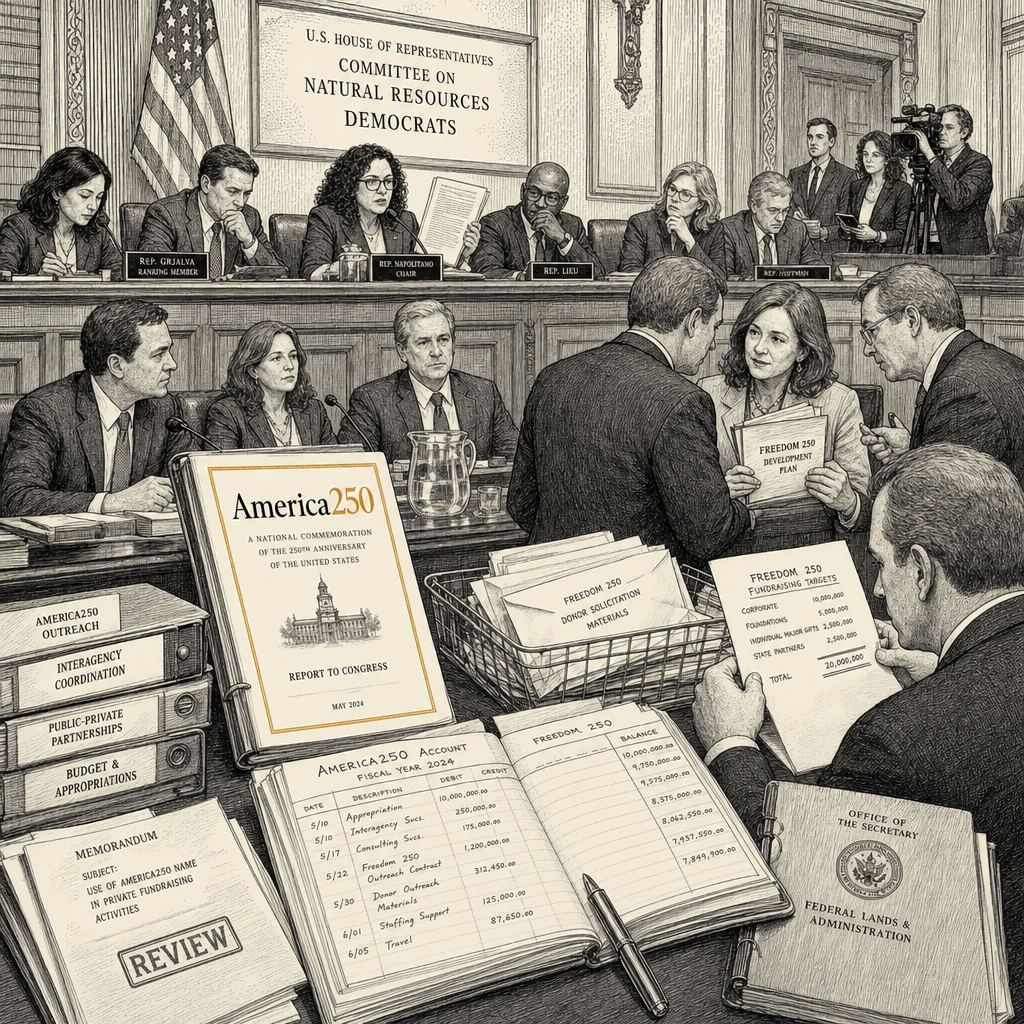
The strongest finding on the public record, corroborated across two independent organizations, is the contract-allocation pattern: Public Citizen researcher Alan Zibel and Revolving Door Project program director Toni Aguilar Rosenthal each document that of more than $120 million in public funds directed to the anniversary, over $100 million has gone to projects and entities with ties to the Trump administration, with some of those contracts going to Event Strategies Inc., the firm that helped organize Trump’s Jan. 6, 2021 rally near the U.S. Capitol. This sits in a different evidentiary category from the legal claims in the 55-page House Democrats’ report titled “From Vanity to Insanity: How the White House Cheated the American People out of their 250th Birthday,” released Thursday and led by Rep. Jared Huffman of California, the ranking Democrat on the House Natural Resources Committee. Freedom 250 spokesperson Danielle Alvarez called the allegations “categorically false” and a “partisan smear.”
Contract allocation and influence architecture
The contract pattern links the anniversary to entities connected to Trump administration activity. Aguilar Rosenthal co-authored a separate report on Freedom 250’s contracts identifying the routing of funds to Event Strategies Inc. The Democratic report describes Freedom 250, created via executive order in 2025 as an LLC under the National Park Foundation—the nonprofit arm of the National Park Service—as “a shadow organization capable of infiltrating the celebrations and injecting America’s 250th with Trump’s extreme, partisan agenda.” The foundation’s board now includes a number of Trump loyalists, including Chris LaCivita, a senior adviser on Trump’s 2024 campaign. Secretary of the Interior Doug Burgum, who serves as ex officio director of the NPF board, told CNN the organization is “run out of the White House.”
Aguilar Rosenthal stated that “there is little visibility into the origins and destinations of donations in general,” and that the funds could, in the worst case, be operating as “a slush fund” for the administration and its allies.
Competing evaluative criteria
Three evaluative criteria structures divide the parties.
Statutory mandate vs. executive authority. Democrats and the congressionally chartered America250 commission evaluate legitimacy against the original bipartisan mandate. Huffman cited an “understanding” that $100 million of the $150 million Congress appropriated to Interior would flow to America250; the Democratic report says America250 has only received $25 million. Freedom 250 responds that no federal funds were “specifically earmarked for one entity over the other,” calling diversion allegations “baseless.” Unless Congress writes a directed earmark, agencies may allocate; the diversion claim is therefore political rather than legal absent specific statutory language. The article does not produce the appropriations text.
Donor intent and financial routing. The Democratic report alleges that donors who intended to support America250 were given banking information for Freedom 250, a practice the report says could constitute wire fraud. Alvarez stated that “every major sponsor received documentation identifying Freedom 250 as the recipient’s organization before funds were transferred, and donors were free to decline.” If sponsors received identification, the donor-confusion premise weakens; the claim then turns on whether the documentation was materially misleading rather than merely naming a different entity. No named donor appears on the record in the source article supporting the wire-fraud characterization. Zibel called the allegation “very troubling” without asserting documentary proof.
Historical framing and cultural messaging. Democrats and critics allege Freedom 250 has injected a “partisan agenda” and an “explicitly sectarian religious bent” into materials and events, including a state fair on the National Mall and a prayer gathering on the Mall. Freedom 250 and the administration operate on a criterion of nationalistic celebration, evidenced by a UFC fight outside the White House and a July Fourth fireworks show opening with a presidential rally, as well as the “Patriot Games” high school athletic competition scheduled for August. The report further notes that the summer’s highest-profile anniversary events include these gatherings and that several, including the state fair and prayer gathering, have drawn criticism for what critics describe as a sanitized presentation of history and an overtly Christian bent.
Evidentiary weighting and vulnerabilities
The competing claims sort into three tiers of evidentiary robustness. Documentary evidence and statutory grounding carry the most weight. The contract-allocation pattern is corroborated across two independent watchdog organizations; the appropriations statute and lack of earmark language are public record. Named-source testimony and counterparty rebuttals carry middle weight. Huffman’s “understanding” is his characterization; Alvarez’s documentation statement is on the record; Burgum’s two statements are on the record; Aguilar Rosenthal’s contracting findings are on the record. Unnamed whistleblowers and ideologically aligned advocacy carry the least weight. The Democratic report is based on interviews with unnamed whistleblowers, sworn congressional testimony, internal Freedom 250 documents not produced in the source article, and other written responses, along with research from advocacy organizations Public Citizen and Revolving Door Project.
Under this weighting, the contract-allocation pattern is the most robust finding; the fund-diversion claim sits in the middle as political rather than legal; the wire-fraud allegation is the most fragile because the documentary rebuttal directly counters the donor-confusion premise.
Evidentiary vulnerabilities exist on both sides of the dispute. The Democratic report relies on hidden premises. The “understanding” of $100 million for America250 is an unnamed-source assertion about informal agreements; it does not displace appropriations text absent a directed earmark. The “shadow organization” framing assumes the LLC-under-NPF creation is itself improper; the foundation’s nonprofit arm is congressionally authorized, the executive order is on the public record, and the “shadow” characterization therefore functions as political argument rather than strict legal reality. The “wire fraud” characterization presumes donor intent to give to a different entity; no named donor is on the record in the source article. The report’s evidentiary base—unnamed whistleblowers, internal documents not produced, and research from ideologically aligned organizations—is the kind of record a prepared audience would probe before accepting conclusions.
Stress points exist in Freedom 250’s defense. Alvarez’s categorical denial does not address specific claims about Event Strategies Inc. contracts, the Davos solicitation by CEO Keith Krach—a former Trump administration official—or Burgum’s statement to CNN that the organization is “run out of the White House.” Burgum’s May testimony that he was “not aware of the final decision maker on Freedom 250” sits in tension with his later CNN statement; both are on the record and require reconciliation. The Krach Davos activity—appearing to solicit international participation at the World Economic Forum with offers of “toolkits for countries”—sits in tension with Alvarez’s statement that Freedom 250 does not accept foreign donations, creating exposure to potential emoluments or foreign influence inquiries.
Investigation trajectory and governance gaps
Huffman stated his investigation will continue, especially if Democrats reclaim the House in the fall midterm elections, at which point he did not rule out subpoenas or criminal referrals. Zibel characterized the existing House Democrats’ work as giving “House Democrats, should they take the majority next year, months and months of investigative work to do,” with “pretty rich target opportunities.” The White House referred a request for comment to Freedom 250, which told NPR it does not speak for the White House.
The governance gaps that emerge from the documented record are:
- Chain-of-command opacity: Burgum’s contradictory statements on the decision-maker
- Contracting transparency: the routing of public funds to entities with documented connections to the Jan. 6, 2021 rally organizer
- Foreign-engagement boundaries: Krach’s Davos solicitation against the entity’s stated non-acceptance of foreign donations
These gaps are produced by the criterion of executive authority exercised through an LLC created under a congressionally authorized foundation; a statutory-mandate framework, applied through direct appropriations to a chartered commission, would not permit these governance gaps to develop in the same form.
Raising the documentary-evidence weight tilts the donor-confusion claim decisively toward Freedom 250’s rebuttal and away from the wire-fraud allegation. Raising the statutory-grounding weight weakens the diversion framing because no earmark language is produced. Raising the unnamed-source weight tilts the fund-diversion claim toward the Democratic position but does not produce a finding of criminal conduct. The ranking is robust to moderate weight perturbation.
The dispute is robustly documented at the level of contract-allocation patterns and political alignment; the strongest legal claims in the Democratic report—wire fraud and statutory diversion—depend on documentary evidence and named-witness testimony that the public record, as surfaced in the source article, does not yet contain. Huffman’s stated intent to continue the investigation is the response the current evidentiary weight most directly supports. Freedom 250’s characterization of the report as a “partisan smear” is undercut by the contract-allocation pattern, which is corroborated across two independent organizations.
The resolution depends not merely on the factual accounting of funds but on which evaluative criteria—statutory mandate, executive authority, donor disclosure, or historical framing—ultimately prevail in the public and legal assessment of the semiquincentennial.
Analytical techniques used in this piece
This analysis applies the methods below. Each links to a short, plain-English explainer you can read and reuse.
- Multi-Criteria Decision Analysis
- Scores competing options against several weighted criteria at once.
- Red-Team Advocate
- Argues the adversary’s case in full to expose what a plan underrates.