Summary
- The Defense POW/MIA Accounting Agency resolves an eighty-two-year missing-in-action case through a sequential chain of archival research, third-party site location, and modern forensic analysis.
- Diplomatic access constraints and tropical evidence degradation govern the eight-decade timeline between the initial aircraft loss and the final positive identification.
- Archival records from the Royal Thai Air Force Museum provide the critical geographic link that enables third-party researchers to locate the crash site in Lampang Province.
- Forensic specialists apply skeletal and DNA analysis to confirm the identity of the remains, closing the evidentiary loop opened by the initial post-war search failure.
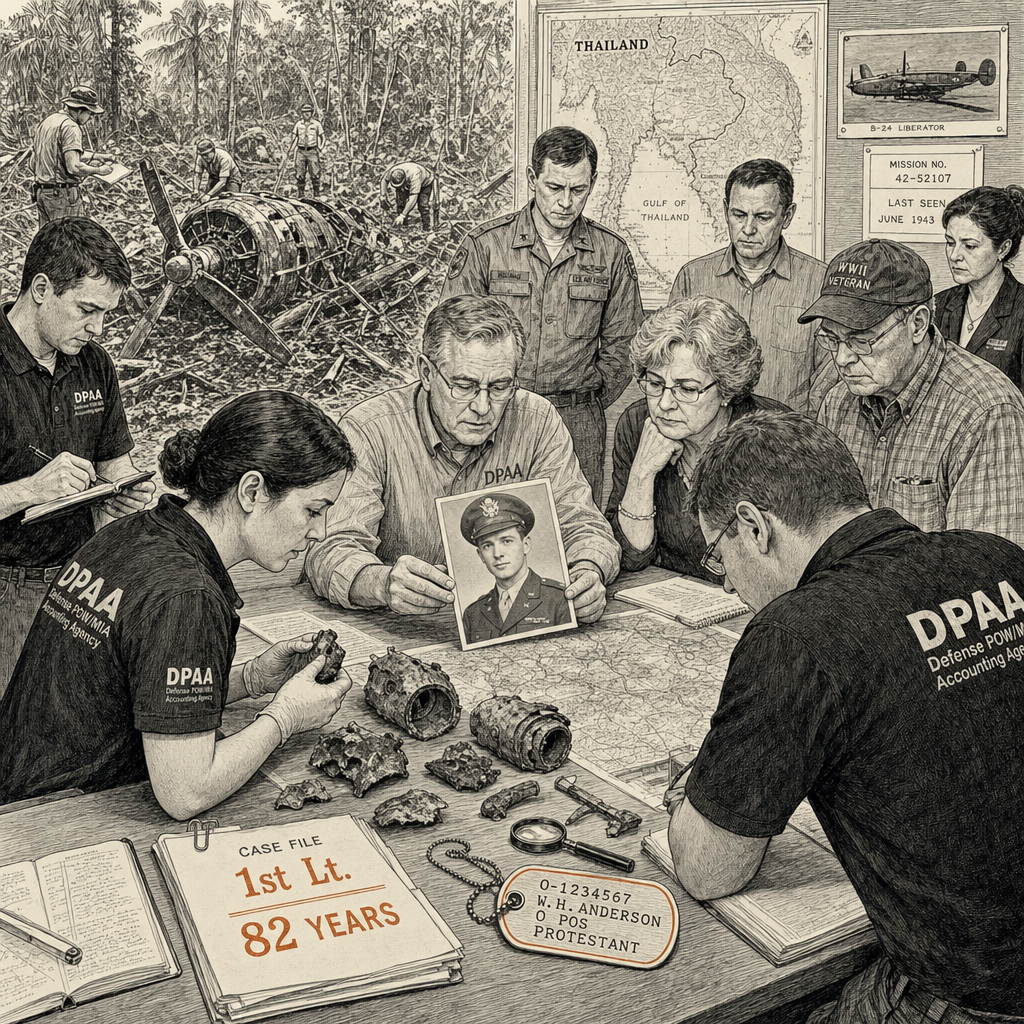
The Defense POW/MIA Accounting Agency (DPAA) identified the remains of 1st Lt. Franklin H. McKinney on May 15, 2026, resolving an 82-year missing-in-action case for a 21-year-old U.S. Army Air Forces pilot who vanished during a November 1944 reconnaissance mission over Southeast Asia. The identification follows an 82-year gap governed by Cold War-era bilateral access constraints and tropical evidence degradation, which delayed the recovery and forensic analysis of the crash site in Lampang Province, Thailand. United Press International publicly reported the identification on July 2, 2026, detailing how wartime archival reports, third-party researchers, and modern forensic techniques converged to locate, excavate, and identify the missing airman, whose name will receive a rosette on the Tablets of the Missing at the Manila American Cemetery.
The Identification and Memorialization Process
The Defense POW/MIA Accounting Agency (DPAA) identified the remains of 1st Lt. Franklin H. McKinney, a 21-year-old U.S. Army Air Forces pilot, on May 15, 2026. United Press International publicly reported the identification on July 2, 2026. McKinney served as a pilot with the 35th Photo Reconnaissance Squadron, 14th Air Force. His home of record is listed as Rhode Island, a designation indicating where he joined the service rather than his state of origin.
A rosette will be placed next to McKinney’s name on the Tablets of the Missing at the Manila American Cemetery in the Philippines, and he will be buried with full military honors. The DPAA describes its mission as providing “the fullest possible accounting for our missing personnel to their families and the nation.” Memorial administrators at the overseas cemetery update the Tablets of the Missing when an identification is made, linking the forensic identification directly to memorialization.
The Operational Loss and Initial Search Failure
On Nov. 5, 1944, McKinney departed a U.S. base in Yunnanyi, China, on a photo reconnaissance mission over Burma and Thailand in an F-5 Lightning aircraft. He failed to return from the mission. The 14th Air Force’s photo reconnaissance mission linked combat operations to intelligence collection in the China-Burma-India theater.
Personnel from the American Graves Registration Service (AGRS) searched along McKinney’s planned flight path to the Chinese-Thailand border immediately after the war but found no sign of a crash. The immediate post-war AGRS search failed because wartime U.S. air operations in the Burma-Thailand corridor were conducted without the kind of on-the-ground Allied presence that could document losses; Lampang Province was a theater where Allied ground forces had not established persistent positions during the war.
Archival Leads and the Recovery Sequence
A wartime report from the Royal Thai Air Force Museum (RTAF) later provided new leads. The report described a plane that was hit by lightning, exploded, and crashed in a wooded area in Lampang Province, Thailand, near the time McKinney’s aircraft vanished. The RTAF report identified the aircraft as an American-built F-5 Lightning tied to a 35th PRS unit assignment. This archival document connected the U.S. operational record to a Thai national archive.
The RTAF wartime report surfaced the crash, but the report appears to have been filed and not systematically mined against U.S. loss records for decades. This delay is a probable consequence of the bilateral relationship’s posture during the Cold War, when U.S. military access to Thai facilities for archival recovery was constrained.
In 2018, third-party researchers, rather than DPAA staff, found a crash site in that region that they matched with McKinney’s plane. The reliance on third-party researchers suggests that bilateral diplomatic clearance to work in the area opened in a measured fashion before DPAA-direct access did. In 2022, a DPAA recovery team excavated the site and found human remains, deploying once the agency could authorize its own team. Modern forensic techniques eventually identified the remains as McKinney’s, establishing the formal account-for date of May 15, 2026.
System Architecture and Structural Constraints
The McKinney case illustrates the operational architecture of U.S. missing-in-action recovery. Field researchers work from wartime operational records—including flight plans, unit assignments, and after-action reports—to reconstruct a missing service member’s last-known location and plausible search area. Without the operational record, researchers have no search area. Recovery teams, operating under bilateral arrangements with foreign governments, conduct excavations and transport recovered material to DPAA laboratories. Forensic specialists apply modern forensic techniques to match remains against reference samples from family members; without forensic methodology, recoveries cannot yield names. The DPAA mandate provides the institutional home for this work.
This architecture is subject to upstream structural constraints that governed the 82-year timeline. The DPAA mandate is structurally conditional on bilateral diplomatic access to host-nation territory. Forensic methodology is structurally bounded by the rate at which physical evidence degrades in the depositional environment; tropical heat, moisture, and biological activity shorten the window in which DNA and skeletal markers remain analyzable. The four-year gap between the 2022 recovery and the 2026 account-for determination reflects DPAA laboratory queue throughput constraints and the methodological requirements of degraded-evidence work in tropical settings. Diplomatic posture governed when the site could be worked, and evidence degradation governed what could be recovered when work was authorized.
Evidentiary Gaps and Competing Hypotheses
The identification of the remains rests on a primary hypothesis (H1) that the remains are McKinney’s, supported by flight-path correspondence placing McKinney’s planned route across the Burma-Thailand border with Lampang Province within that operational geography. The RTAF report’s identification of the aircraft as an American-built F-5 Lightning tied to a 35th PRS unit assignment strains cross-Allied alternatives, and the 2018 third-party match serves as corroborating evidence. Under H1, the 2022 recovery and the May 15, 2026 forensic identification constitute a doubly-decisive test that the substrate reports they passed.
Alternative hypotheses remain theoretically possible but not affirmatively eliminated by the available substrate. H2 posits the remains belong to a different airman, such as a non-U.S. Allied airman (e.g., British RAF or RNZAF crewman) operating in the same theater and period, whose crash was retroactively matched to McKinney’s file. H3 posits the remains are from an unrelated, later crash that opportunistic researchers attached to the McKinney case. Under H2, the forensic identification must specifically rule out non-U.S. personnel through skeletal and DNA markers, but the substrate does not detail that exclusion.
Regarding the aircraft’s loss, the archival hypothesis attributes the catastrophic explosion to a meteorological event, specifically a lightning strike, as described in the RTAF report. Alternative hypotheses, including undetected anti-aircraft fire or mechanical failure, remain theoretically possible. The DPAA’s public identification report did not document alternative causal testing and did not publicly address the causation question, as the investigation focused on the physical recovery of the wreckage rather than on adjudicating the precise sequence of the aircraft’s loss.
The substrate’s silence on the alternative-elimination step constitutes a residual evidentiary gap rather than a reason to doubt H1. The substrate does not enumerate the population of Allied aircraft lost in the Lampang corridor during the November 1944 window, and it does not describe the skeletal-marker or DNA work that would distinguish a U.S. airman from a British, Australian, or New Zealand peer. Resolution of these gaps would require a historical review of U.S.-Thai military and diplomatic access arrangements from 1944 to 2018, a forensic review of the DPAA’s lab-throughput profile and tropical-degradation success rates, and an enumeration of all Allied aircraft lost in the corridor during the relevant window.
Strategic Context and Broader Agency Efforts
The operational loss occurred within the broader Allied intelligence effort in the China-Burma-India theater. An Air Force article on the 35th Photo Reconnaissance Squadron states: “Photo reconnaissance work by the 35th and the intelligence derived from it helped turn the tide of the war in China.” This statement attributes strategic significance to the squadron’s work and to the intelligence products McKinney’s mission would have supported.
The McKinney identification is part of a broader, ongoing DPAA effort to identify long-unknown military remains. MSI previously reported on this broader effort, including a planned March 2026 exhumation of 88 unidentified USS Arizona unknowns for DNA analysis.
Analytical techniques used in this piece
This analysis applies the methods below. Each links to a short, plain-English explainer you can read and reuse.
- Domain Induction
- Builds a working mental model of a domain from the ground up.
- Process Tracing
- Reconstructs the step-by-step causal pathway of a specific historical event.
- Quick Orientation
- A fast lay-of-the-land read of an unfamiliar domain.