Summary
- The U.S. Department of Homeland Security defines the relevant event of a June 24 deportation flight as its completion, locating safety at the moment of arrival and terminating institutional responsibility at the custodial hand-off.
- The departmental statement employs lexical choices and presuppositions that frame deportation as restoration and responsibility as a custodial property, functioning to foreclose accountability questions regarding the subsequent placement of deportees in a high-risk seismic zone.
- Independent reportage juxtaposes this administrative framing against documented conduct on the ground in Venezuela, structuralizing an empirical counter-frame that tests the institutional claims against the observable realities of morgue searches and blocked rubble access.
- The formal transfer of custody coincides with the deployment of the deportees into geologically active coastal infrastructure, leaving the individuals at the intersection of two failing systems when the physical environment collapses.
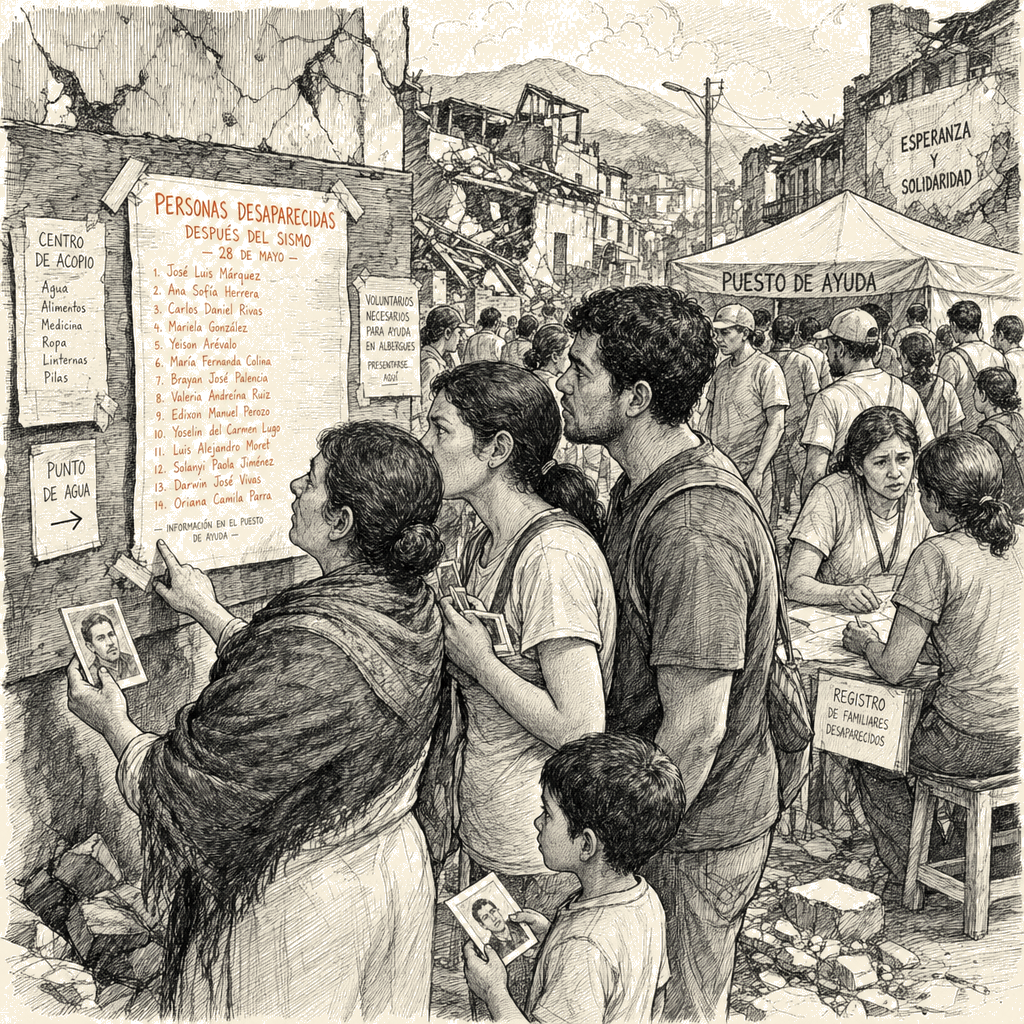
The U.S. Department of Homeland Security framed its June 24 deportation of 146 Venezuelan nationals as a completed administrative action, asserting that the individuals “safely reached Venezuela” and that the agency was “no longer responsible” following the custodial hand-off. Less than eight hours after Flight 164 landed in Caracas, twin earthquakes struck the coastal region where Venezuelan authorities housed the deportees, killing at least 2,200 people and leaving 50,000 missing. The departmental statement defines the relevant event at the precise moment of arrival, utilizing lexical mechanisms that sever U.S. institutional accountability from the subsequent physical and infrastructural collapse, while independent reportage documents the practical consequences of this bureaucratic severance for the deported individuals and their families.
Institutional Framing and Lexical Mechanisms
Robert Entman’s four framing functions applied to the DHS statement reveal specific structural choices. The problem definition frames the situation as a natural disaster striking a country to which migrants had been “returned home,” positioning accountability for the deportees’ fate as a Venezuelan problem. The causal interpretation separates the earthquake as the cause of death from the deportation as the act of placing people in proximity to the earthquake, utilizing the hand-off as a causal cut. The moral evaluation is absent from the DHS statement, which carries no explicit moral judgment, whereas the independent reportage carries one implicitly by documenting the practical reality of the “no longer responsible” designation. The treatment recommendation is implicit, framing the situation as a Venezuelan disaster-response problem by describing the Venezuelan government’s phone lines and the limits of available information without proposing U.S. action.
George Lakoff’s framework of conceptual metaphor and lexical choice highlights the mechanics of the DHS phrasing. The phrase “returned home” frames deportation as restoration rather than placement. The term “illegal aliens” carries criminalizing vocabulary that pre-classifies the deportees’ status. The assertion that the flight “safely reached” Venezuela locates safety at the moment of arrival rather than across the period of vulnerability.
These phrasings embed specific presuppositions. “Safely reached” presupposes that arrival is the salient endpoint. “No longer in ICE custody” presupposes that custody, rather than the deportation itself, is the relevant locus of responsibility. “No longer responsible” presupposes that responsibility is a custodial property that can be relinquished by the transfer of a person.
Institutional lexicalization diverges sharply between the sources, contrasting the DHS use of “illegal aliens” with the BBC’s use of “Venezuelan nationals.” Critical discourse frameworks associated with Norman Fairclough and Teun van Dijk identify extensive passivization and agent deletion in the description of the deportation process. Phrases such as “were returned,” “had been detained,” and “were transferred” obscure institutional agents and present enforcement actions as automated background conditions, while active-voice attribution is reserved exclusively for the DHS spokesperson.
An audit of the statement’s propaganda function reveals a divergence between its professed ideal and its actual function. The professed ideal is administrative accuracy—noting that the flight completed, the deportees transferred, and custody ended. The actual function is to foreclose accountability questions about what occurred after the hand-off. Applying the Institute for Propaganda Analysis (1937) framework, the statement employs Glittering Generalities through positive vocabulary such as “safely,” “home,” and “returned,” which bypass critical evaluation. It also utilizes Card Stacking through selective emphasis that omits contradictory facts, anchoring the narrative at the moment of arrival while excluding the coastal hotel, the seismic hazard of La Guaira, and the absence of U.S. consular or disaster-response channels.
Jason Stanley’s diagnostic framework characterizes the DHS phrasing as “not-at-issue content”—a presupposition closed to direct challenge—that manages the symbolic environment by establishing a definitive institutional boundary treated as a settled legal fact rather than a contested political claim. This effect closes the loop on U.S. institutional accountability before the disaster unfolds. The not-at-issue vocabulary includes “safely,” “home,” “illegal aliens,” “returned,” “custody,” and “responsible,” with each term performing its function through assumption rather than assertion. For this gap to remain invisible, the audience must hold specific prior beliefs: that “reached” constitutes the relevant threshold of safety; that Venezuela is “home” for individuals who had lived in the U.S. for years and were detained in U.S. facilities prior to the flight; that responsibility for a person ends when custody ends, regardless of who selected the destination; and that disaster-response responsibility lies exclusively with the receiving government. The evidence supporting this classification lies in the alignment between the statement’s claims and the article’s facts at the specific level the statement claims—the flight did land, the deportees did reach Venezuela, and ICE custody did end. The undermining evidence lies in the gap between what the statement’s vocabulary promises and what the documented conduct reveals.
The Structural Counter-Frame and Documented Conduct
The sourcing structure reflects the Herman and Chomsky model of filtering, where official sources supply authoritative definitions of the event, as seen in the DHS statement operating as the primary institutional voice. The BBC coverage juxtaposes this DHS administrative voice against the named individuals and family accounts it has independently gathered, with the two institutional voices occupying the same article and often the same paragraph. The BBC’s reportage functions as a structural counter-frame that tests the DHS claims against documented conduct. The reporting does not argue against the DHS statement; it places the statement’s claims against observable facts and lets the gap stand.
The documented conduct on the Venezuelan side illustrates the practical reality of the custodial hand-off. Abelardo Rincón, 23, lived in the U.S. state of Georgia for six years, working at a car dealership, before his detention during the Trump administration’s immigration enforcement. He married and was expecting a daughter. After arriving in Venezuela, Rincón called his family from the hotel to say he was back; he is now missing. His grandfather, Jose Rincón, traveled to a morgue in Caracas and viewed at least 200 bodies searching for him, telling BBC Mundo that Venezuelan authorities blocked him from visiting the hotel rubble, telling him there was “no life” at the site.
Darwin Eliecer Serrano Lopez, 35, was detained in Chicago and held in four detention centers before being placed on the flight. He called his cousin Paola Chacón at 5:32 a.m. local time to say he had returned after four years in the United States. The first quake struck less than 30 minutes later, according to his cousin. Chacón stated she believed her cousin was dead, adding: “We are going to stay here until we can take his body home.” Mildrey Sarazo, Lopez’s wife, noted she had not seen her husband in three years and had not told their daughters, ages nine and 15, about his deportation or disappearance. “We want to bury our relatives,” she said. “We want them to hand him over so we can identify him and be certain.”
Anderson Daniel Salcedo, 22, lived in the United States for three years, sending money home. He was found alive at Caracas’s university hospital after being trapped under rubble for nearly two days, according to Reuters, and his legs were amputated. His grandmother, Marlene Lozano, stated: “He spent 40 hours in that hole, he didn’t have an ID, they couldn’t account for him because he had no documents. We had no way to communicate with him and didn’t know anything.” The family of Daniel Alejandro Nunez, 28, also struggled to find information. His stepfather, Jose Alejandro Abache, told BBC Mundo: “We’ve searched for him in hospitals, in morgues – everywhere.” Lisbeth Portillo, 58, survived the hotel collapse, telling the Associated Press she was lying on a bed in a second-floor room shared with 16 other women when the building crumbled. “I saw the woman next to me start to fall… they were all screaming for help,” she said. “I was born again - God gave me a second chance.”
Relationship Mapping and Chain of Custody
The sequence of events forms a distinct chain of custody: U.S. Immigration and Customs Enforcement (custody) to Flight 164 (transit) to Venezuelan authorities (transfer of custody) to Hotel Santuario La Llanada (housing) to the earthquakes (infrastructure failure).
The causal links demonstrate U.S. immigration enforcement initiating the deportation flight to Venezuela; the flight’s existence is a U.S. action, while Venezuela’s involvement is limited to receipt. Flight 164 carried 146 Venezuelans, including 19 women and seven children, a passenger composition documented by the ICE Flight Monitor, an initiative of Human Rights First that tracks deportation flights. This independent witnessing relationship establishes the flight and its demographics outside DHS accounts. The U.S. deportation flight causally led to the placement of 146 people in Hotel Santuario La Llanada in La Guaira; the hotel location was selected by Venezuelan authorities after the U.S. chose the country, meaning the U.S. selected the country of destination. The earthquakes causally triggered the hotel collapse, resulting in the deaths and disappearances of the deportees; this outcome was independent of the deportation but strictly contingent on the location.
Dependency relationships further map the vulnerabilities. Venezuelan authorities held a dependency relationship with the deportees for housing, documentation, and medical exams; survivors told the BBC the deportees underwent medical exams and received documentation before being housed. The families hold a dependency relationship on Venezuelan morgues, hospitals, rubble sites, and government phone lines as the only available channels, because, by the DHS formulation, “ICE is no longer responsible.”
Non-obvious structural vulnerabilities exist at the transition points. The point where U.S. bureaucratic liability is formally terminated and Venezuelan state responsibility begins coincides precisely with the deployment of the deportees into a geologically active coastal zone. La Guaira and the surrounding northeastern coastal corridor are confirmed by multiple sources as a high seismic risk zone, characterized by coastal plains susceptible to liquefaction and proximity to the San Sebastián Fault. The grafting of the logistical infrastructure of transnational immigration enforcement onto the physical infrastructure of the host nation creates a compounding failure point.
Rhetorical and linguistic relationships define the public understanding. The DHS spokesperson statement enters the public record as a defense against anticipated accountability questions, defining the relevant event as the flight’s completion. The BBC’s empirical reportage acts as an institutional counter-frame, documenting what “no longer responsible” looks like in practice. The juxtaposition of the spokesperson’s “safely reached” against Jose Rincón’s account of viewing at least 200 bodies, and against Marlene Lozano’s description of her grandson trapped without identification, tests the DHS frame against documented conduct. The linguistic relationship between phrases like “safely reached,” “returned home,” and “no longer responsible” and the audience’s understanding of the U.S. role is one of framing rather than pure information; the statement transmits a definition of U.S. responsibility rather than facts about the deportees’ condition.
Consequences, Sequel, and Scale
The article leaves the U.S. side of the relationship chain at the hand-off, and the DHS statement quoted in the article makes the identical cut. The documented conduct on the Venezuelan side—morgue searches, blocked rubble access, a man trapped without identification—demonstrates what that cut looks like from the receiving end. The two ends of the chain are connected by the choice of country and the choice of destination; the DHS formulation’s “no longer” is the linguistic mechanism that disconnects them. When the physical infrastructure collapses, the bureaucratic severance of responsibility leaves individuals at the intersection of two failing systems—unaccounted for by the departing U.S. enforcement apparatus and inaccessible to the overwhelmed host-nation disaster response, which restricted rubble access and told families there was “no life” at the site.
The coverage constructs the event primarily as a tragic coincidence of timing, a construction relying on episodic narrative selection, institutional sourcing practices, and a formal transfer of custody that severs U.S. state responsibility at the precise moment Venezuelan state infrastructure fails. Shanto Iyengar’s framework of episodic framing explains this focus on concrete individual instances, such as Rincón and Serrano Lopez, rather than broader thematic contexts. Erving Goffman’s primary frameworks indicate the event is keyed as a natural disaster in a humanitarian context, rather than as a sequence initiated by state enforcement logistics. These framing layers select human tragedy and bureaucratic disconnect as the most salient elements, structurally isolating the event as a localized catastrophe compounded by bad timing. This framing obscures the continuous structural relationship between the enforcement logistics that transported the individuals and the infrastructural vulnerabilities they encountered upon arrival, rendering the full sequence of state action and institutional failure analytically fragmented.
The scale and structural context of the event underscore the severity of the infrastructural failure. Twin earthquakes struck less than eight hours after Flight 164 landed on June 24, consisting of a magnitude-7.2 foreshock and a magnitude-7.5 mainshock, according to the U.S. Geological Survey. UN-cited figures report a toll of at least 2,200 killed, more than 10,000 injured, and 50,000 missing. The area of La Guaira, where the hotel stood, was particularly hard hit by the seismic activity.
Analytical techniques used in this piece
This analysis applies the methods below. Each links to a short, plain-English explainer you can read and reuse.
- Frame Audit
- Surfaces the frame an argument adopts and what that framing quietly includes or excludes.
- Propaganda Audit
- Reads a message for propaganda technique — loaded framing, manufactured consensus, and demonization.
- Relationship Mapping
- Extracts the network of ties among people, institutions, and entities.