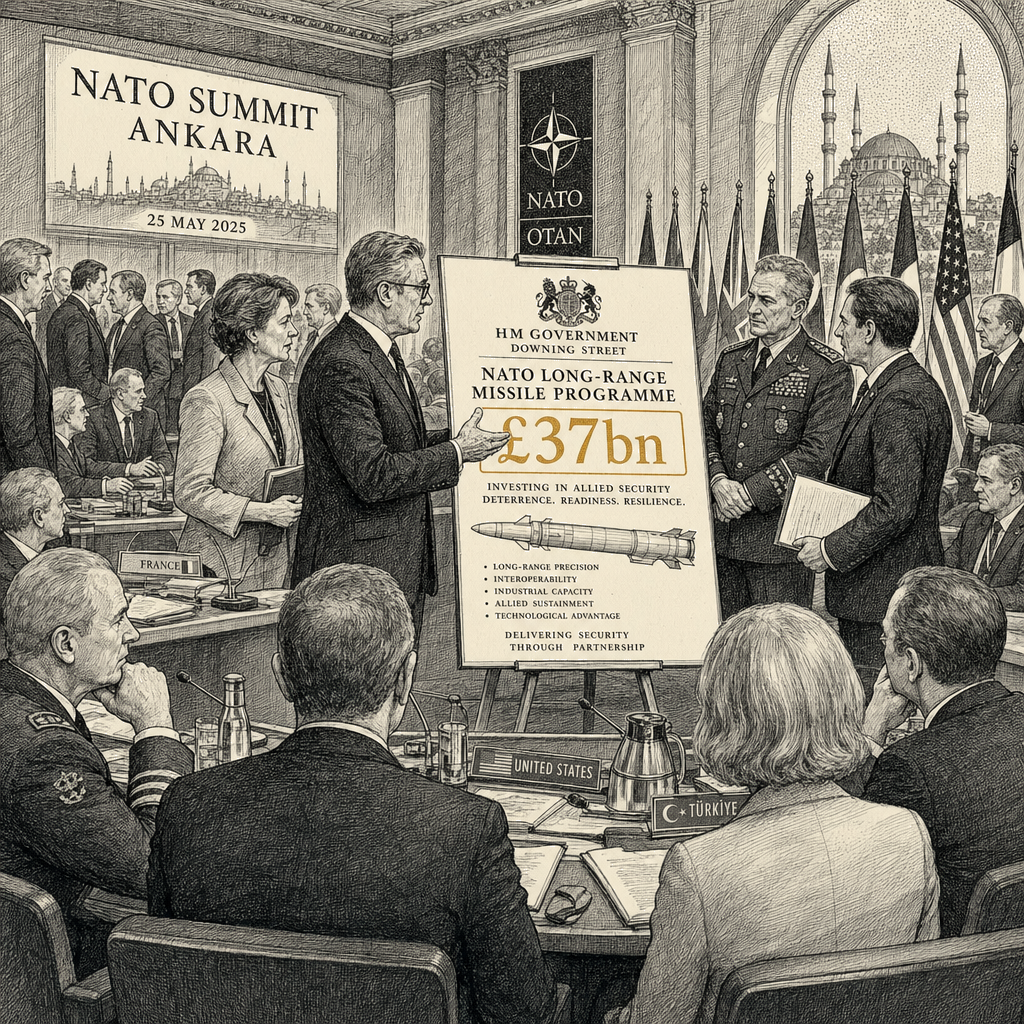
Downing Street announced the £37bn ($50bn) Deep Precision Strike long-range missile programme on 8 July 2026 ahead of the NATO summit in Ankara, establishing a UK-led, twelve-nation procurement coalition intended to signal alliance deterrence resolve while deferring actual operational capability to the 2030s. The initiative, designed to strike high-value targets up to 200 miles away with a potential range extension to 1,250 miles, restructures European burden-sharing by creating a sub-coalition that bypasses the thirty-two-nation consensus mechanism and positions the United Kingdom as a secondary hub for defence industrial coordination alongside the United States. This strategic signalling equilibrium emerges against a backdrop of documented military friction, including a 30 per cent surge in Russian military activity around UK waters and over 700 NATO fighter jet scrambles, while exposing a credibility gap between the alliance’s deferred capability investments, unresolved US-side force posture reviews, and immediate operational demands from Ukraine.
The Deep Precision Strike programme, described by the UK government as “among the alliance’s most advanced weapons” intended to “strike high-value military targets deep behind enemy lines,” carries a reference-class base rate for multinational NATO weapons programmes meeting initially declared in-service dates of roughly 10 to 30 per cent. Inside-view adjustments yield a probability range of roughly 15 to 35 per cent that the programme meets its stated 2030s in-service date, with a conditional median slippage of approximately three to seven years against the initially declared horizon. Historical precedents documented in US Government Accountability Office major defence acquisition reports, notably the F-35 and Eurofighter Typhoon, illustrate ten-to-fourteen-year development cycles with documented cost overruns and schedule delays.
The twelve-nation Deep Precision Strike structure amplifies coordination friction relative to the six-nation Future Combat Air System structure, increasing the precedent risks of requirement divergence visible in the protracted schedule disputes of similar European programmes. Inside-view drivers distinguishing the programme cut in both directions. Distributed cost burden across twelve nations and the programme’s foundation on existing capability rather than clean-sheet development provide supportive conditions. Conversely, the requirement to align twelve distinct national procurement cycles, harmonise intellectual-property regimes across twelve jurisdictions, and manage rapid technological shifts in drone warfare and air defence—which could render initial specifications obsolete—act as constraining factors. Mid-cycle requirement updates historically trigger further delays.
Because the missile is “not expected to be operational until the 2030s,” the timeline creates a near-term capability gap. Interim systems, specifically Storm Shadow and SCALP, fill the long-range strike requirement during this period. The deployment of these interim systems prompts likely Russian adaptations in air defence and electronic warfare, which feed back into the Deep Precision Strike specification, requiring the 2030s system to be designed to penetrate evolved defences developed to counter interim capabilities. The article does not identify a publicly named prime contractor for the programme.
Concurrently, Ukrainian long-range drone and missile strikes have, according to the Royal United Services Institute’s institutional analyses of operational-to-procurement feedback loops, positioned Ukraine as a live requirements-generator for NATO’s next-generation strike capabilities. The UK government noted that Ukraine’s strikes “significantly impacted Russia’s ability to sustain their offensives” and “proved that the effective use of long-range systems can have game-changing impacts on the battlefield.”
The twelve-nation structure creates a sub-coalition that bypasses the alliance’s thirty-two-nation consensus mechanism, theoretically accelerating procurement timelines for the participating subset. The United Kingdom emerges in a leadership role, positioned as a secondary hub for European defence industrial coordination alongside the United States. The relationship map inside the alliance shows a bipartite organising structure between European member states and the United States, with the UK anchoring the European side.
A twelve-nation European-led strike capability alters the alliance’s relationship to US-supplied capability through two documented strategic logics. As a partial substitute, it reduces US forward-deployed long-range strike demand in Europe. As a strategic complement, it enables a US force-posture pivot toward the Indo-Pacific. These substitute and complement framings are not mutually exclusive on the available record; both operate as documented strategic logics for European capability-building, and which dominates remains an empirical question dependent on US Department of Defense strategic guidance not present in the source material. The industrial-base consolidation effect concentrates benefit among participating nations’ prime contractors.
The equilibrium outcome of this burden-sharing dynamic, framed through Thomas Schelling’s 1960 coordination-game structure in The Strategy of Conflict, demonstrates a pattern where members under-invest in specific conventional capabilities while over-signalling political commitment. Capability programmes like Deep Precision Strike attempt to resolve this dynamic through targeted, high-value procurement rather than across-the-board budget increases.
This resolution is complicated by US pressure. The Trump administration demands that allies reach 3.5 per cent of GDP on defence by 2035, a target set against the broader 2025 summit agreement to spend 5 per cent of GDP on defence and security by 2035. The UK government has committed £300bn to defence by 2030 through its Defence Investment Plan, which is a distinct commitment from the 3.5 per cent of GDP by 2035 target, and the UK has not set out a plan to meet the 3.5 per cent target. US Defence Secretary Pete Hegseth is reported to have announced in June 2026 a six-month review of US forces in Europe, though a date and announcement the analyst cannot independently confirm from the available record.
Leading indicators determining which reference class better predicts the procurement outcome include shifts in the twelve-nation cost-sharing agreement, the progress of parallel European programmes such as the Future Combat Air System as a proxy for industrial health, and the outcomes of the US force posture review. An allied refusal to commit to its share of the £37bn would disrupt the programme’s leadership structure, while US accommodation of continued UK sub-target spending would weaken the correlation between US pressure and UK budget adjustments. Ultimately, the equilibrium of the summit interaction constitutes a multilateral signalling equilibrium in which capability is deferred, alliance internal friction is deferred via the UK spending plan, and adversary response is framed rhetorically. The strategic value of the announcement is in the signalling; the operational value is in the 2030s.
The announcement operates within a deterrence framework, developed in Schelling’s The Strategy of Conflict, functioning as a capability investment intended to shift the strategic equilibrium by signalling long-term resolve. Prime Minister Sir Keir Starmer stated the initiative would “help bring European allies together to keep Nato safe for years to come” and emphasized, “We must step up to deliver a stronger, more European Nato.” Foreign Secretary Yvette Cooper described the initiative as “part of a recognition that we’re in a more dangerous world” and stated the project is “about how we make sure we have a stronger Europe within a stronger Nato.” Cooper added that the capability sends a clear message that “Nato is stronger, more European and ready to defend our citizens” and would allow allies to “hit high value military targets and the logistical engines that drive armies, deterring any aggressor and strengthening our mutual security.”
The Stockholm International Peace Research Institute’s institutional analyses of NATO-Russia interactions frame the underlying “friction equilibrium” dynamic in aerospace and maritime engagements. NATO has scrambled fighter jets to intercept Russian aircraft approaching allied airspace more than 700 times, and Russian military activity around UK waters has surged 30 per cent, producing a stable but high-cost peacetime friction equilibrium where both sides incur recurring operational costs to test and signal boundaries without crossing into direct kinetic conflict.
Against this backdrop, Kremlin spokesperson Dmitry Peskov stated that “a settlement of this conflict through political and diplomatic means remains preferable” for Russia, while simultaneously asserting that “no new weapons Kyiv would receive from NATO could prevent Russia from continuing its military operation until its objectives were achieved.” Peskov characterised the run-up to the summit as “not statements about constructive engagement and dialogue but rather statements of a confrontational nature.”
Russia’s “political and diplomatic” framing performs a belief-updating function. By signalling that no NATO capability expansion will alter Russian operational calculus, the statement attempts to lower allied estimates of the marginal deterrent value of additional weapons deliveries, shifting the deterrence threshold downward. This effect operates through persuasion rather than commitment and is bounded by the same credibility discount that places the framing at the non-commitment-signalling end of the credibility hierarchy.
Across the three named players with stated positions, the Trump administration’s pressure constitutes a commitment device rather than non-commitment signalling because the costs of follow-through are partially sunk; the review itself is a stated policy action with observable downstream effects on NATO planning. The UK’s stated commitment is bounded by political continuity, with the BBC framing the event as Starmer’s “final NATO summit as prime minister,” a characterisation the source provides but which the analyst cannot independently confirm from the available record. The central pattern reveals an alliance announcement that signals resolve at the diplomatic register while deferring operational capability to a horizon a decade away. The credibility gap between declared positions and operational capability—across the programme’s timeline, the alliance’s spending commitments, and the Russian framing of settlement—constitutes the primary analytical content of the strategic interaction.
The strategic interaction is grounded in documented kinetic and operational conduct. Russia invaded Ukraine in 2022, establishing the causal, kinetic relationship driving the current alliance posture. Ukrainian President Volodymyr Zelensky used a speech at the summit to urge allies to deliver “urgently needed air defence systems” to protect Ukraine from escalating Russian attacks, highlighting a dependency-asymmetric position. Zelensky’s request for air defence is reported as urgent and unmet in the source material, while Ukraine’s own long-range strikes on Russia are reported as having “game-changing impacts on the battlefield.” This creates a dual reality where Ukraine functions simultaneously as an unfulfilled dependent requesting immediate defensive capabilities and as a proven operational generator of offensive requirements.
A reduction in Russian kinetic operations would contradict the causal relationship driving NATO’s deterrent signalling, but the source does not indicate such a reduction. Conversely, a US signal that the twelve-nation programme is treated as additive without enabling force reallocation would weaken the strategic complement logic, and an ally-side confirmation of air-defence delivery schedules would resolve the dependency asymmetry; neither contradicting condition is present in the available record.
Analytical techniques used in this piece
This analysis applies the methods below. Each links to a short, plain-English explainer you can read and reuse.
- Probabilistic Forecasting
- Puts calibrated probabilities on what happens next.
- Relationship Mapping
- Extracts the network of ties among people, institutions, and entities.
- Strategic Interaction (Game Theory)
- Models a situation as a game — players, moves, payoffs, and likely equilibria.
- Mutually Assured Destruction
- Deterrence by guaranteeing that any attack is suicidal for the attacker.