Core analytical claim
The dispute between the 162-page July 4 White House Domestic Policy Council report on the National Museum of American History and Smithsonian Secretary Lonnie G. Bunch III’s July 8 staff email — obtained by NPR, which published its reporting on July 9 — turns on competing definitions of what a national history museum is for rather than on any single factual claim about discrete exhibitions. Each text treats its preferred standard as definitional rather than contestable, and the dispute’s analytical substance lies in that parallel structural move.
How the dispute is being framed
The 162-page July 4 White House Domestic Policy Council report, titled “Saving America’s Story: How Ideological Capture at the Smithsonian Institution’s National Museum of American History Erases Our Heritage,” proceeds from a textual premise that a national museum’s function is the curation of what the report calls “the noble, honest story of the great country we know and love.” The report’s criticisms—that the museum underemphasizes the Founding Fathers, insufficiently celebrates the nation’s 250th anniversary, and engages in what the report labels “anti-white,” “illegal alien,” and transgender activism—are linked by the warrant that the cited curatorial deviations constitute departures from a defined patriotic baseline. The report characterizes National Museum of American History director Anthea Hartig, who has led the museum since 2019 and is concurrently president of the Organization of American Historians, as “an activist advancing an ideological agenda contradictory to the museum’s founding purpose of fostering patriotism.” The July 4 release by the Domestic Policy Council constitutes an institutional deployment of state authority to set the terms of public debate, utilizing the formal apparatus of government to legitimize a specific historical narrative.
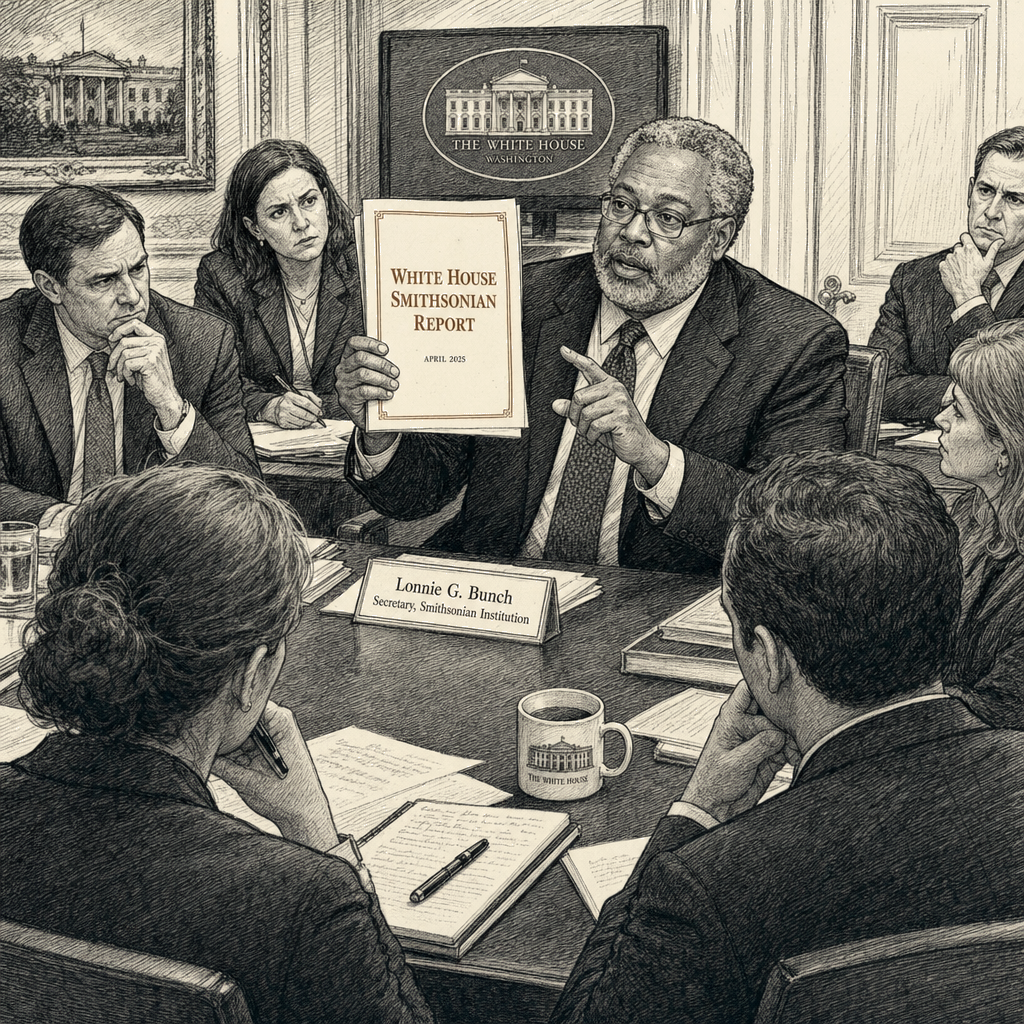
Secretary Bunch’s July 8 email to staff operates within a different frame. The email characterizes the report as “not a fair characterization of the work and totality of the National Museum of American History” and invokes “scholarship, nonpartisanship, independence, accuracy and integrity,” asserting that “our work is driven by scholarship, accuracy and an uncompromising commitment to tell the fullness of America’s story.” Within the secretary’s frame, the report’s criticisms appear as a mischaracterization because the White House conclusions collide with the museum’s self-understanding as a scholarly institution rather than a civic-religious one. The email additionally references the Smithsonian’s institutional structure, stating the institution has “worked alongside partners across government — from the White House to Congress to our governing Board of Regents — guided by our enduring mission to increase and diffuse knowledge.”
Communication scholar Robert Entman’s four framing functions specify how each text’s frame populates problem, cause, moral evaluation, and remedy; discourse scholar Teun van Dijk’s ideological square specifies how each text’s lexical choices perform in-group and out-group moves; and argumentation scholar Douglas Walton’s dialogue-type taxonomy alongside pragma-dialectics specifies the report’s structural coherence issues. These approaches are complementary: Entman’s functions specify the frame’s content, van Dijk’s square specifies the frame’s rhetorical structure, and the Waltonian and pragma-dialectical approaches specify the frame’s procedural coherence. Within the report’s frame, the problem is institutional capture by a “radical, activist ideology”; the cause is curatorial and directorial choices consistent with the cited ideology; the moral evaluation is betrayal of the museum’s patriotic purpose; the recommended treatment is removal of “improper ideology” per the executive-order framework. Within the secretary’s frame, the problem is an external characterization inconsistent with the institution’s actual work; the cause is the report’s framing; the moral evaluation turns on the institution’s commitments to scholarship and accuracy; the recommended treatment is continuation of the existing mission. The two frames select different content in and out: the report selects celebratory emphasis on founders and 250th-anniversary commemoration as the appropriate object of curatorial attention; the secretary’s frame selects comprehensive representation across periods and populations.
The report’s framing further operationalizes what Teun van Dijk identifies as the ideological square, with each of the four moves mapped to specific verbatim passages: emphasizing the positive in-group (“the noble, honest story of the great country we know and love”); emphasizing the negative out-group (“anti-white,” “illegal alien,” and “indoctrinate” activism); de-emphasizing the negative in-group (omitting mention of the administration’s own executive-order pressure documented elsewhere in the source article); and de-emphasizing the positive out-group (framing Hartig’s scholarly and professional standing merely as that of an “activist”). The text additionally employs what cognitive linguistics identifies as metaphors of contamination and purification, framing the museum’s scholarly output as a corrosive agent subject to capture by an ideology “fundamentally opposed to telling the noble, honest story.”
The two paradigms can be labeled without ranking the paradigms on scholarly merit: a dominant-tradition paradigm of civic nationalism, wherein national history functions as a cohesive, celebratory narrative centered unambiguously on the Founding Fathers and the 250th anniversary, and a counter-tradition paradigm of aspirational pluralism, wherein history is an ongoing, contested project and the founding ideals function as an aspirational baseline to interrogate the national trajectory. The term “counter-tradition” denotes the aspirational pluralism perspective’s institutional position relative to the current executive-branch status quo, not the perspective’s scholarly standing. The two paradigms agree on the institution’s existence and on the legitimacy of founder reverence; the two paradigms diverge on whether critical examination of founder legacy is patriotic devotion or patriotic betrayal. The secretary’s remarks on NBC’s “Meet the Press” on Sunday represent a synthetic position that attempts to honor both paradigms, stating, “It’s really important for people to understand that America is [as] much an ideal as it is a place, that it’s a series of aspirations that have really shaped who this country is. And so for me, what is so powerful is to say, ‘Let us honor the words of Thomas Jefferson and the founders, but let us use those to challenge us to be better.’” The report’s framing forecloses the synthetic position by treating critical use of founder language as itself ideological capture.
Structural coherence and definitional baselines
A coherence audit of the report, applied symmetrically, surfaces a structural issue on the strongest charitable reading: the patriotic baseline is asserted rather than operationalized. The source article records that President Trump’s March 2025 executive order called for the removal of “improper ideology” from the Smithsonian’s offerings, and the public record the source article supplies does not specify what separates an exhibition reflecting scholarly re-evaluation of the founders from one the executive order’s framework would identify as improper. The report’s framing of Hartig treats “fostering patriotism” as a settled referent rather than as a term whose content depends on the operative conception of national narrative; the report itself supplies the conception rather than testing the conception. From a pragma-dialectical standpoint, the report departs from the rules of critical discussion by employing ad hominem characterization against Hartig, and exhibits structural failures in premise construction, with definitional drift around “patriotism” and “ideological capture” shifting the evidentiary burden by presuming a singular, state-sanctioned definition of American history as the baseline. The report’s discursive posture is a further coherence question: the document is formatted as a quasi-administrative inquiry or audit, but the document functions operationally as a persuasion dialogue, with breaches of Douglas Walton’s rationality norms regarding relevance and burden-of-proof allocation.
A parallel coherence question arises within the secretary’s frame. The reply treats “scholarship” and “the fullness of America’s story” as self-evidently compatible with the institution’s patriotic and congressional mandate, and the reply treats the White House contrary reading as self-evidently a mischaracterization. Operationally, the specific phrasing functions as a coherence-audit counter-citation to the report’s “indoctrination” claim, re-anchoring curatorial authority to established scholarly norms (“scholarship, accuracy… tell the fullness of America’s story”). The report, for the report’s part, treats “fostering patriotism” as a settled referent whose content the museum’s curatorial choices have deviated from. The structural move is parallel: both assert an authoritative baseline — one patriotic-narrative, the other scholarly-comprehensive — and both identify the other party’s framing as the deviation. Sociologically, what discourse studies identify as a re-keying is at work: where the Smithsonian operates under a primary framework of scholarly inquiry and the diffusion of knowledge, the report seeks to re-key the identical exhibitions and educational resources as political proselytization, shifting the perceived nature of the curatorial activity from objective historical education to ideological indoctrination. The public record the source article supplies does not specify which standard holds institutional primacy when the two standards conflict.
A counterframe that makes both visible as frames would treat the institution neither as a temple of fixed national narrative nor as a neutral scholarly archive but as a site where the contest over national meaning is itself the institutional purpose — and would then ask which institutional venue is authorized to adjudicate the contest. The dialectical resolution the source article’s record does not yield is whether a Smithsonian whose exhibitions explicitly critique aspects of the founder-era record can simultaneously be described, in the report’s vocabulary, as fostering patriotism.
Who benefits and institutional authority
The Smithsonian’s 1846 charter, established by an Act of Congress signed by President James K. Polk on August 10, 1846, specifies that the institution’s 21 museums and 14 education and research centers, together with the National Zoo, are “meant to be run independently of the federal government.” Oversight is vested in the secretary and a Board of Regents that includes Vice President JD Vance, Supreme Court Chief Justice John Roberts, and other members appointed by Congress. The secretary’s invocation of “scholarship, nonpartisanship, independence, accuracy and integrity” draws on the structural independence to shield the museum from what the email characterized as an incomplete assessment. The White House’s prior executive orders calling for the removal of “improper ideology” and the August 2025 request for a “comprehensive internal review” of eight Smithsonian museums, including the National Museum of American History, represent an executive-branch effort to assert discursive and administrative influence over an independent cultural trust, testing the boundaries of the Smithsonian’s chartered autonomy.
If the dominant-tradition paradigm prevails, the executive branch obtains a precedent by which a national museum’s curatorial direction can be conditioned on a state-supplied definition of patriotism, with the “improper ideology” framework providing the operational test. If the counter-tradition paradigm prevails, the Smithsonian’s chartered independence holds against direct executive-branch re-keying of the exhibitions, and curatorial authority remains anchored to the scholarly-comprehensive standard the museum’s leadership invokes. Each outcome redistributes authority over national narrative: the first concentrates the authority in the executive branch’s interpretive apparatus, the second preserves the authority’s location in the institution’s chartered self-governance under Board of Regents oversight.
What happens next
The July 4 report, together with the March 2025 executive order and the August 2025 review request, indicates an ongoing escalation of executive-branch attention to the institution across a roughly fifteen-month arc. Whether the escalation proceeds through the Board of Regents, through curatorial self-adjustment, through congressional action, or through further executive action is a question the public record the source article supplies does not resolve. The source article documents a clash between two definitions of museum purpose that each text treats as settled while the other text treats as the core matter in dispute — a clash whose terms are now visible in both the Domestic Policy Council’s published report and the secretary’s staff email, a clash whose resolution will turn on which institutional venue is treated as authoritative over the museum’s interpretive direction.
The specific public criterion by which an exhibition reflecting scholarly re-evaluation of the founders would be distinguished from one falling within the executive order’s “improper ideology” framework remains unspecified in the public record the source article supplies. The criterion would resolve with the public text of any forthcoming Smithsonian review or Board of Regents determination. Whether the Board of Regents will be formally engaged as the venue for resolving the interpretive dispute remains an open question in the source article’s record, an open question which would resolve with subsequent reporting on regents’ actions or statements.
Additional considerations
The two revised drafts apply different analytical vocabularies to substantially the same evidentiary record. One mapping uses Entman’s four functions to specify how each text’s frame populates problem, cause, moral evaluation, and remedy. Another mapping uses van Dijk’s ideological square to specify how each text’s lexical choices perform in-group and out-group moves, and uses Walton’s dialogue-type taxonomy together with pragma-dialectics to specify the report’s structural coherence issues. The two mappings are complementary rather than competing: the Entman mapping specifies the frame’s content; the van Dijk mapping specifies the frame’s rhetorical structure; the Walton and pragma-dialectical mapping specifies the frame’s procedural coherence. A combined mapping is available without forcing a choice.
The designation of “dominant-tradition” and “counter-tradition” paradigms carries an asymmetry risk under §5.5 symmetric-application discipline. The labels as deployed name institutional position relative to the current executive-branch status quo and not scholarly standing, but the verbal contrast of “dominant” with “counter” can be read as a hierarchy claim unless the explanatory clause travels with the labels. The corpus retains the labels with the clause attached.
Documentary verifications clarify the timeline and source material. The Washington Post’s same-day coverage (timestamped July 8, 2026) and the Daily Beast’s explicit statement that the email was “sent to staff on Tuesday, obtained by the Washington Post on Wednesday” establish that the email’s transmission date was July 8, 2026. NPR’s July 9, 2026 publication date is the date of journalistic reporting, not the date of the email. The bracketed editorial fix “[as]” inserted in the transcribed Bunch quote (“America is [as] much an ideal as it is a place”) addresses an apparent transcription omission in the source NPR article. Web sources uniformly confirm that the Smithsonian Institution was established by an Act of Congress signed by President James K. Polk on August 10, 1846, and the analytical record carries the specific date when citing the charter’s establishment.
Analytical techniques used in this piece
This analysis applies the methods below. Each links to a short, plain-English explainer you can read and reuse.
- Coherence Audit
- Tests whether an argument hangs together — spotting contradictions, gaps, and circular reasoning.
- Frame Audit
- Surfaces the frame an argument adopts and what that framing quietly includes or excludes.
- Worldview Cartography
- Maps the clashing worldviews underlying a dispute.