Summary
- Senior U.S. officials signal declining prospects for a comprehensive nuclear agreement with Iran as Washington imposes unilateral deadlines for Strait of Hormuz access.
- The U.S. administration leverages reimposed financial sanctions and resumed military strikes while demanding Tehran transfer control of its buried enriched uranium stockpile.
- Iranian hard-liners interpret the June interim memorandum of understanding as preserving national authority over commercial shipping routes in the strait.
- The United States and Iran lack mutually agreed verification frameworks for maritime transit and nuclear material disposal, increasing the probability of negotiation breakdown.
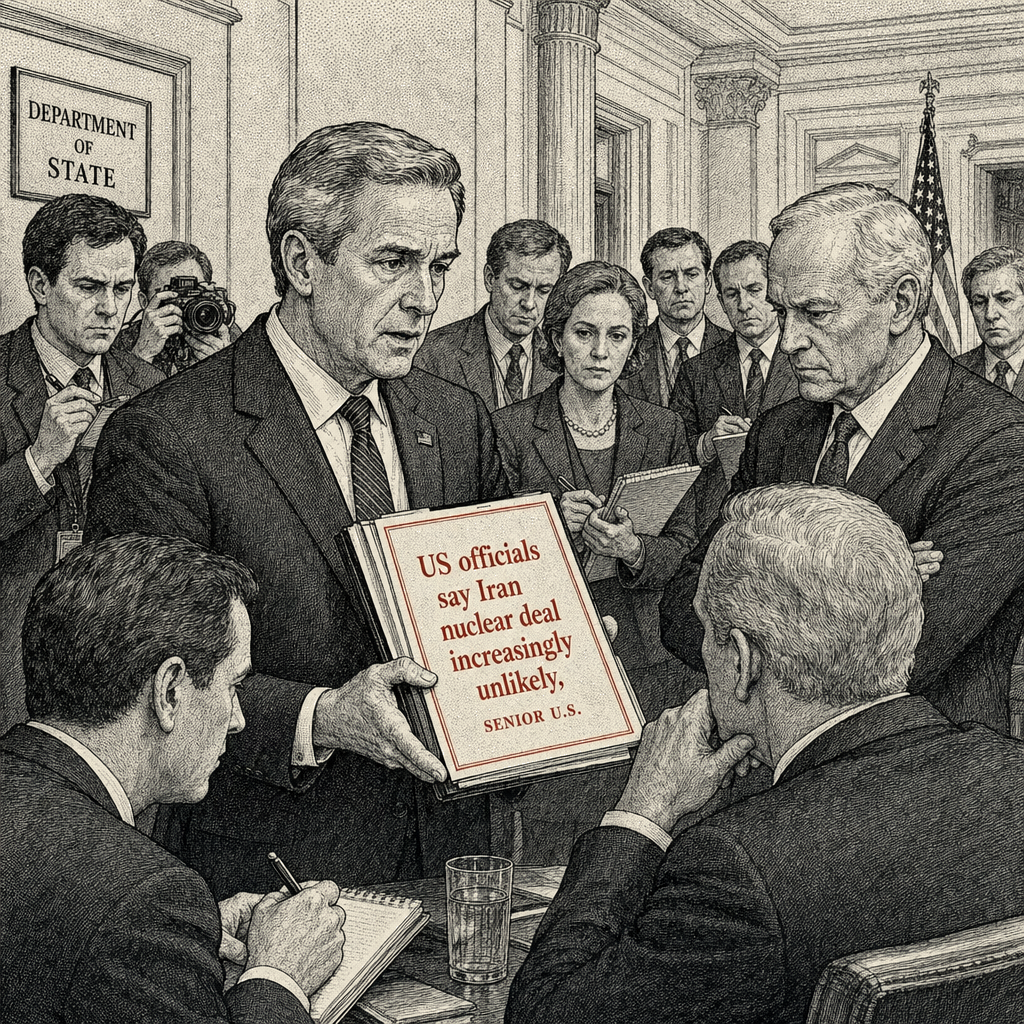
Senior U.S. officials have signaled to reporters that a comprehensive nuclear agreement with Iran is increasingly unlikely, marking a rare public acknowledgment that the Trump administration’s core foreign policy objective of capping Tehran’s nuclear program may not be achievable through ongoing peace talks. The pessimism emerges as Washington demands Iran publicly commit to reopening the Strait of Hormuz and cease fire on commercial shipping, while simultaneously demanding the transfer of Iran’s buried enriched uranium stockpile to U.S. control. The divergence between stated diplomatic goals and documented coercive actions on both sides highlights a fundamental disagreement over the interpretation of the June interim memorandum of understanding, compounded by the absence of mutually accepted verification architectures for both maritime transit and nuclear material disposal.
Documented Positions and Leverage Dynamics
Senior U.S. officials have articulated a three-part position for Tehran: Iran must declare the Strait of Hormuz open, cease firing on commercial shipping, and hand over control of its buried enriched uranium stockpile. The demand regarding the strait is grounded in the documented reality that the waterway handles approximately 20% of the world’s oil and gas flows, with supplementary energy data indicating the strait accounts for roughly one-fifth of global oil and petroleum product consumption and approximately 34% of global crude oil trade. The U.S. leverage posture incorporates active, named instruments, including the U.S. Treasury Department’s announcement of new sanctions targeting “a leading Iranian businessman, Ali Ansari, and entities linked to him,” alongside the reimposition of sanctions on Iranian oil sales and the resumption of military strikes.
The Iranian position, as documented through the conduct of hard-liners, involves interpreting the June interim agreement as preserving Iranian control of the waterway. Iranian forces have engaged in the operational practice of firing on commercial ships that do not transit along designated routes. Concurrently, Iranian diplomats have maintained a parallel track, recently communicating to the U.S. that the decision to shoot at commercial ships was “a mistake” and that both sides should continue negotiations. This creates a distinct leverage asymmetry: the U.S. alternative to a negotiated agreement is composed of named, active sanctions and military instruments, while the Iranian alternative remains opaque to outside observers, consisting of hold-and-resist postures on the strait, retention of the enriched uranium stockpile, accelerated nuclear latency, or walking away from the 60-day negotiation window. When both parties hold credible alternatives, leverage to force concessions diminishes and the probability of breakdown increases.
Governing Timelines and Sequel Pathways
The negotiation operates under two distinct timelines of differing weight. The 60-day window established by the interim memorandum of understanding remains the only jointly agreed timeline for reaching a final nuclear agreement, though the period could be extended. Separately, one senior U.S. official indicated that Iran should promise to reopen the strait by Saturday or face serious consequences, a unilateral procedural criterion that other officials did not corroborate with a firm deadline.
If the strait demand remains unmet, the U.S. strategic calculus shifts toward either military containment of the nuclear material or a strategic walk-away. U.S. officials have noted the availability of low-cost military options to block access to the nuclear material indefinitely, paired with the documented verification constraint that Washington would have trouble confirming how much uranium was destroyed in such an attack. The buried location of the uranium compounds this verification gap, constraining both the military and diplomatic alternatives. Either sequel leaves underlying proliferation risks unresolved.
If the procedural Saturday deadline passes without a public statement from Tehran, potential Iranian sequels include continued maritime disruptions to leverage global energy prices, acceleration of nuclear latency, or abandonment of the negotiation window. The 1980s Tanker War in the same waterway provides a limited historical analogue of attacks on commercial shipping and naval response operations by outside states, though direct parallels remain constrained by the specific nuclear dimensions of the current dispute. The reported Iranian admission of a “mistake” may not survive the next round of sanctions and strikes. Throughout these pathways, potential verification criteria such as International Atomic Energy Agency standards for uranium disposal or the United Nations Convention on the Law of the Sea transit-passage framework remain uninvoked in public reporting, leaving the political acceptability of third-party monitoring an open question.
Textual Interpretation and Public Framing
The core dispute over the Strait of Hormuz functions as a text-interpretation problem rooted in the June interim memorandum of understanding. The agreement committed Iran to “make arrangements to restore shipping and ensure safe passage of commercial ships” while pledging both sides to maintain the “status quo” on Iran’s nuclear work and U.S. sanctions. Iranian hard-liners read this text as establishing control-with-restrictions, preserving Iranian authority over passage by firing on ships outside designated routes. U.S. officials read the same text as requiring an open-and-deconflict posture, demanding that Iran “release a statement declaring that the Strait of Hormuz is open.” The divergence centers on whose authority governs passage rather than the phrasing of the agreement itself.
Public framing by the U.S. administration introduces additional variance. President Donald Trump framed the dispute in moral and emotional terms, stating, “They violate the agreement every day, they lie, they cheat, they kill people,” before signaling conditional commitment to the process: “They’ll never build a nuclear weapon under our deal, but I don’t know if we’re going to have a deal.” The variance in U.S. statements—where one official projects a firm Saturday deadline and others suggest no firm deadline exists—admits two analytical readings. The U.S. position may be actively in motion, representing a perception gap separable from the substantive bargaining problem, or the mixed messaging may constitute strategic ambiguity maintained across spokespersons to preserve leverage while leaving room for either escalation or de-escalation. The available reporting does not resolve between these readings.
The dispute features a people-problem layered on a substantive dispute. The principals’ commitment posture is itself a variable: the U.S. position appears committed in declarative terms but conditional in a way the U.S. has not specified to Iran; the Iran-side hard-liner conduct and the Iran-side “mistake” admission point to internal Iranian division or deliberate ambiguity. Stated demands diverge from documented conduct on both sides. The U.S. states the agreement’s goal is preventing a nuclear weapon while reimposing sanctions and resuming strikes; Iranian hard-liners’ conduct diverges from the diplomatic-track admission that the shooting was an error. The available reporting does not specify whether the hard-liners conducting the shooting operations and the officials acknowledging the “mistake” represent competing state organs or a single principal speaking in different registers for different audiences.
Unresolved Variances and Information Boundaries
The analytical record retains unresolved variances in U.S. statements, treating them interchangeably as potential perception gaps or calibrated strategic ambiguity, because the source material does not definitively resolve the administration’s internal signaling strategy. Similarly, the internal coherence of the Iranian position is recorded as an ambiguity regarding whether hard-liner conduct and diplomatic concessions map to distinct state organs or a unified command utilizing deliberate ambiguity.
The absence of invoked verification architectures highlights a reliance on unilateral declarative criteria over mutually accepted objective benchmarks. The parties have not named objective criteria by which each would judge the other’s compliance with the interim memorandum of understanding. U.S. officials frame the strait question in declarative terms rather than behavioral terms, establishing a unilateral procedural criterion backed by the threat of escalating consequences. The reporting establishes the factual boundaries of the Treasury Department’s sanctions announcements on Ali Ansari while leaving the precise factional mapping of Iranian state organs and the independent verification of those specific Treasury actions outside the documented record.
Analytical techniques used in this piece
This analysis applies the methods below. Each links to a short, plain-English explainer you can read and reuse.
- Domain Induction
- Builds a working mental model of a domain from the ground up.
- Principled Negotiation
- Works a negotiation from interests, options, and objective criteria rather than positions.
- Quick Orientation
- A fast lay-of-the-land read of an unfamiliar domain.
- Brinkmanship
- Manufacturing shared risk at the edge of catastrophe to force the other side to blink.
- Mutually Assured Destruction
- Deterrence by guaranteeing that any attack is suicidal for the attacker.