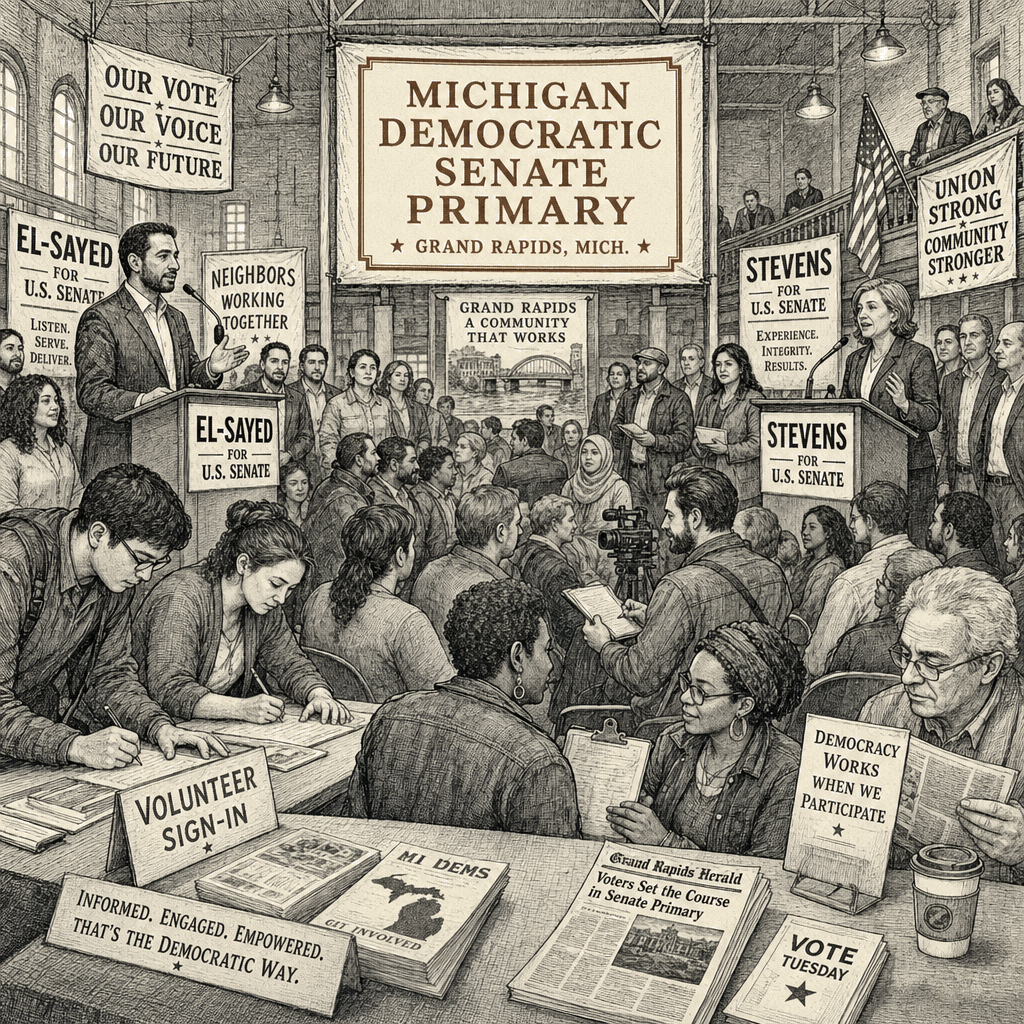
The alignment of institutional and progressive support
The race’s two candidates have assembled coalition architectures that align with documented institutional and ideological divides in the Democratic Party.
For Stevens, the endorsement lineup includes Senate Minority Leader Chuck Schumer, former Michigan Gov. Jennifer Granholm, former U.S. Sen. Debbie Stabenow, several unions, pro-Israel groups, and EMILY’s List. The largest outside spender on advertising in the primary, according to AdImpact data, is the United Democracy Project, a super PAC affiliated with the American Israel Public Affairs Committee. Groups supporting Stevens have significantly outspent El-Sayed’s supporters on total ad buys.
For El-Sayed, the coalition includes Sen. Bernie Sanders, Rep. Alexandria Ocasio-Cortez, and the United Auto Workers. El-Sayed supports Medicare for all, free child care, has called Israel’s actions in Gaza a “genocide,” and wants to abolish U.S. Immigration and Customs Enforcement. He has campaigned with influencer Hasan Piker, who has faced allegations of antisemitism.
Stevens, whose views are less overtly progressive, supports a healthcare public option, removing the Social Security payroll tax cap on earnings above $184,500, and nationalizing paid family leave.
Explanations for the reported tightening
The available evidence is consistent with three explanations for the reported tightening of the race; the reporting does not directly discriminate between them.
A spending-driven shift would predict that media markets with the heaviest UDP and Stevens-aligned ad presence show the largest movement toward Stevens. The article does not provide geographic or temporal disaggregation of ad exposure against vote intention, so this hypothesis is consistent with the tie but is not directly diagnostic of it.
The consolidation of institutional support follows the exit of state Sen. Mallory McMorrow, who had tried to position herself as a middle-path alternative but struggled to compete with El-Sayed’s antiestablishment appeal and to raise sufficient funds before suspending her campaign on July 5. The diagnostic question is where McMorrow’s voters went. If they moved disproportionately to Stevens, the tightening would be consistent with a coalescence of establishment Democratic support. If they moved disproportionately to El-Sayed, the race would not have tightened to a tie. The article does not contain post-withdrawal vote-flow data.
The tightening may also represent a measurement artifact. El-Sayed’s earlier front-runner standing was drawn from early polls without specification of likely-voter screens, sample composition, or timing relative to McMorrow’s exit. Drawing on the historical record of Michigan politics, El-Sayed’s 2018 gubernatorial primary run, in which he placed second in the Democratic primary to Gretchen Whitmer, would be expected to leave residual name recognition that could inflate early horse-race numbers relative to subsequent issue-driven information. On this reading, the Stevens private poll showing roughly 20% of voters undecided is less a shift in voter preference than a settling of the race toward a baseline the early polls overstated.
The release decision itself adds information. The article reports that the tie-poll was circulated by Stevens’ campaign, and that El-Sayed called it biased while maintaining that he remains the front-runner. Campaigns typically release internal polling they expect to be received as favorable. A campaign releasing a tie-poll in a two-candidate race is choosing to define parity as the news. That signal is consistent with the race being competitive at a level the public framing of front-runner understates.
Mobilization processes and friction points
The Stevens campaign’s mobilization relies on institutional transfers of credibility and resources, evidenced by Schumer’s endorsement and the United Democracy Project’s status as the largest outside ad spender. The friction point in this process is the conversion of institutional credibility into base enthusiasm. Stevens described herself as a “workhorse” competing against a “show horse,” emphasizing her legislative record over El-Sayed’s background to bridge this gap. Stevens is a four-term moderate congresswoman and declined an interview request from the Journal.
The El-Sayed process relies on grassroots and digital transfers of energy, linking national progressive figures and digital influencers to local UAW networks and Democratic Socialists of America-aligned activists. El-Sayed said he is “not technically or practically DSA,” though supporters at his events have included DSA-aligned activists. The friction point here is the general-election interface. The establishment argument posits that this mobilization process generates high primary turnout but fails the general-election swing-voter test. The race has drawn attention from DSA members, whom Trump and other Republicans have attacked as “communism.”
Multi-dimensional alignment and voter sentiment
The contest’s alignment is multi-dimensional, encompassing overlapping domestic and foreign policy divides. El-Sayed’s characterization of Israel’s actions as a “genocide” and Stevens’ support from pro-Israel groups represent a documented foreign policy divergence. The simultaneous presence of domestic policy divides indicates a broader coalition division alongside the foreign policy debate.
At a park gathering before a debate, 34-year-old regulatory analyst Nikolai Pieniazek, wearing a Bernie Sanders cap, said: “Younger voters don’t think of socialism as a boogeyman.” Pieniazek said he works for El-Sayed because Stevens is backed by AIPAC, corporate interests, and Schumer.
At a church basement event in suburban Detroit, roughly 250 people packed in to hear El-Sayed. Retiree Bev Clark, 68, said: “The government has been stuck in the mud, and I don’t hear Haley Stevens saying anything that will change that. El-Sayed is independent in his thinking. He’s really dynamic.”
El-Sayed argued for a regulated capitalism, saying the U.S. is in “nonfunctional capitalism that creates trillionaires and makes it harder for every person to create basic wealth.” He said he would rather have an economy that “makes a thousand millionaires than one billionaire.”
Editorial framing and forward forecasting
The Wall Street Journal frames the contest as a “battle for the future of the Democratic Party.” That framing is editorial and reflects the publication’s assessment. The available evidence, on the question of what the tightening actually reflects, supports a narrower claim: the race is within the margin the reported private poll identifies; roughly one in five primary voters is undecided; and the spending asymmetry favoring Stevens has not, as of the article’s July 12 publication, produced a clear Stevens lead in any cited public measurement. The race is the first major electoral test for Democrats since the collapse of progressive candidate Graham Platner’s Maine Senate campaign.
The relevant reference class for forecasting downstream effects is open-seat Senate contests in states carried by the opposing presidential candidate. The first reference is Senate primaries in swing states where the institutional wing backs a moderate and the progressive wing backs an insurgent. If the historical pattern of insurgent primary victories in swing states observed in recent cycles applies, the base rate for insurgents winning these primaries has increased; however, the general election success rate for progressive insurgents in states recently won by the opposing presidential candidate remains dependent on the swing-voter margin, as debated by political analysts and reflected in the establishment argument documented in the article.
Establishment Democrats have argued that Republicans are eager to run against El-Sayed in the general election, according to reporting by The Wall Street Journal, because his left-wing policy views could turn off swing voters in a state that President Donald Trump carried in 2016 and 2024. El-Sayed dismissed the electability criticism in an interview, saying: “It’s risky to put up a candidate who does not actually have clear positions on most of the issues that everybody wants. It’s risky to tell people that the best thing we can do with our tax dollars is send them abroad to drop bombs on other people rather than to invest here.”
The Michigan-specific reference is the open seat vacated by incumbent Democrat Gary Peters, who is not seeking a third term. Republicans are expected to nominate former Rep. Mike Rogers, who narrowly lost Michigan’s 2024 Senate election. The article characterizes holding the seat as a precondition for Democrats to have “a realistic chance of reclaiming the Senate majority” in November. Inside-view adjustments to the baseline forecast depend on whether the electability argument holds. The Stevens campaign rests on the assumption that swing voters in a Trump-won state are highly sensitive to left-wing policy positions and nationalized cultural disputes. The El-Sayed campaign’s counter-assumption is that swing voters are more responsive to economic populism and anti-establishment messaging. The general election forecast hinges on whether the winning coalition’s mobilization process can be extended to the broader November electorate without declines in turnout among the non-aligned faction.
Evidence constraints and methodological boundaries
The binding constraint inside the primary is the undecided fifth of the electorate, since the article reports no public measurement of post-McMorrow movement that would let an analyst decompose it. The August 4 result will be decided by which of the three explanations best tracks the underlying shift; the post-primary evidence, including vote share by demographic, ad-market-by-ad-market movement, and the size and direction of McMorrow’s displaced vote, will distinguish them. The article does not supply a base rate for progressive-versus-establishment Democratic Senate primaries of this configuration, and one cannot be supplied from training without citation. The directional claim the available evidence does support is that the race reads as genuinely contested rather than as a settled front-runner hold.
Analytical techniques used in this piece
This analysis applies the methods below. Each links to a short, plain-English explainer you can read and reuse.
- Differential Diagnosis
- Lists the candidate explanations for a symptom and rules them out one by one.
- Probabilistic Forecasting
- Puts calibrated probabilities on what happens next.
- Process Mapping
- Lays out a process end to end — steps, hand-offs, and bottlenecks.
- Allison’s Three Lenses
- Reading a state’s action as rational actor, organizational output, and bureaucratic politics at once.