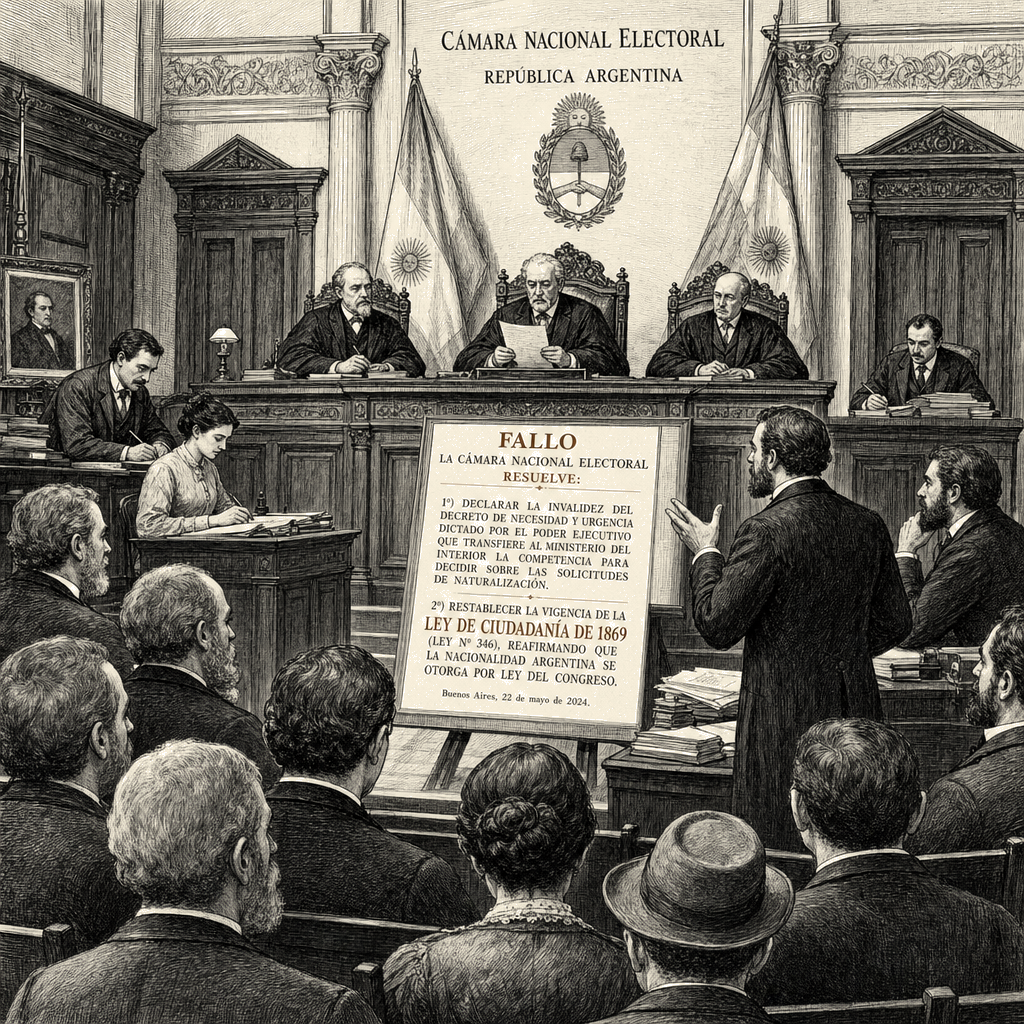
Argentina’s National Electoral Chamber on 16 July 2026 declared Emergency Decree 366/2025 “absolutely and irreparably null” — a categorical ruling that struck down President Javier Milei’s attempt to transfer citizenship-naturalization authority from federal judges to the National Directorate of Migration by emergency decree. The court grounded its finding in a structural incompatibility: the administration characterized naturalization as an administrative procedure subject to efficiency optimization, but Argentina’s Constitution classifies citizenship as a gateway to political rights that falls under the electoral-matter prohibition on emergency decrees. The decree, signed in mid-2025 and published in the Boletín Oficial on 29 May 2025, was part of a broader immigration reform package that also imposed health insurance requirements and restricted free public healthcare and education access for nonpermanent residents. The National Directorate of Migration — the agency designated to receive the transferred authority — lacked the operational infrastructure to process citizenship applications, with no dedicated office, no inter-agency coordination, and persistent staffing constraints, independently undermining the decree’s efficiency rationale. The categorical invalidation swept in the broader package while constraining the administration to a legislative path requiring a congressional supermajority it has not yet assembled.
The question at the center of Argentina’s citizenship ruling is not whether an executive can streamline bureaucracy. It is whether a government can reclassify a constitutional right as an administrative convenience — and bypass Congress in the process. That distinction drove the National Electoral Chamber’s decision to invalidate the instrument through which Milei sought to move naturalization authority from federal judges, where it had resided for 157 years under Citizenship Law 346 of 1 October 1869, to the National Directorate of Migration, an executive agency. The ruling hinged on a constitutional provision Argentina’s 1994 reform preserved intact: the prohibition on emergency decrees — decretos de necesidad y urgencia (DNUs) — touching electoral matters, a category the court found includes citizenship because it governs the right to vote and participate in democratic life.
Constitutional hard ceiling
Argentina’s citizenship-granting architecture operates as a clean three-level hierarchy. The Constitution delegates citizenship legislation to Congress. Congress enacted Citizenship Law 346 on 1 October 1869. That statute designates federal judges with electoral jurisdiction as naturalization adjudicators. Decree 366/2025 attempted to install an unauthorized cross-link from the executive branch through the Migration Directorate, bypassing the constitutional chain entirely.
The court’s ruling rests on Article 99, Section 3 of Argentina’s Constitution, which explicitly bars emergency decrees on criminal issues, taxation, electoral matters, or the system of political parties. The government argued that transferring naturalization authority was an administrative efficiency measure — one that would free judicial resources and place decision-making where immigration records already lived. That argument, the court determined, was a policy preference, not a constitutional justification. Emiliano Herrera, co-founder of Herrera & Flamenco Abogados, said: “The government’s arguments, such as improving administrative efficiency or reducing judges’ workloads, are matters of political discretion that should be debated by Congress and do not constitute a constitutional emergency authorizing the executive branch to legislate by decree.”
The attempted cross-link failed because the Constitution’s electoral-matter provisions create a double lock — prohibition on emergency decrees for electoral matters plus requirement of special congressional majorities to amend electoral laws — that no efficiency rationale can override. The mismatch between constitutional reservation and DNU framework was the root cause of the decree’s failure. The 1994 necessity-and-urgency decree framework contains no binding pre-promulgation constitutional certification requirement. The executive’s internal legal assessment was wrong, no institutional checkpoint caught the error before publication, and the decree entered force under the DNU’s immediate-effect default. Herrera noted that the court also distinguished between a person’s immigration status and the legal right to obtain citizenship by naturalization, concluding that the two are governed by different legal frameworks — a distinction that made the decree’s encroachment on judicial territory independently clear.
Operational breakdown
Even if the constitutional question had been resolved differently, the Migration Directorate was not ready to assume the role. This finding rests on practitioner testimony rather than an official audit, but the evidence is specific and on-record. Immigration attorney Javier Segura, founder of Cassiopeia Immigration Services, said the proposal “looked like a good idea on paper” but “in practice it appeared that the Migration Directorate was never prepared to assume that responsibility.” He reported that “there was no coordination between agencies,” that “many officials learned about the change only after the decree had already been published,” and that the directorate “never created a dedicated office to process citizenship applications” while facing “staffing and resource constraints.”
The administration’s central justification — that the Migration Directorate was better equipped because it already maintained applicants’ records — is publicly falsified by implementation evidence. The named petitioner’s case illustrates the concrete effect: a Chinese citizen living in Oro Verde, in Argentina’s Entre Ríos province, since 2015, who operates a supermarket with no criminal record, had his residency application denied by the Migration Directorate and faced deportation proceedings from the very agency the decree had empowered, despite meeting the requirements under Argentina’s citizenship law. Even if the decree had survived constitutional review, its operational design created a bottleneck that denied citizenship to qualifying applicants.
The proximate cause of the implementation failure was a compressed timeline without transition planning. The political dynamics of the broader immigration reform package rewarded speed over preparation; the administration likely sought to limit pre-publication opposition from the judiciary and the immigration bar; the directorate’s existing record-keeping infrastructure led decision-makers to overestimate its capacity to absorb a fundamentally different function.
The firewall between deportation and citizenship
The applicant’s case also exposed a legal distinction the decree had attempted to erase. The court ruled that immigration status and citizenship by naturalization are governed by separate legal frameworks — and that the Migration Directorate’s authority over one did not extend to the other. Under this reasoning, the directorate could enforce immigration law, including residency requirements and deportation proceedings, but it could not use that enforcement power to override an independent statutory path to citizenship.
The ruling granted the applicant citizenship and declared the decree unconstitutional — resolving his legal status not despite the deportation proceedings but independently of them. The court’s structural distinction created a legal firewall: the administrative machinery of immigration enforcement cannot reach across to block eligibility determinations that belong to the judiciary.
For the applicant, who had lived in Argentina for nearly a decade and whose case had wound through a system that simultaneously offered him a path to citizenship and pursued his removal, the ruling resolved a contradiction the decree had produced. The firewall’s implications extend beyond his case: by establishing that the two frameworks operate under separate legal regimes, the ruling limits the executive’s ability to use immigration enforcement as a de facto gatekeeper of citizenship eligibility.
Collateral invalidation
The court’s language — “absolutely and irreparably null” — swept in the entire decree, not just the citizenship provisions. The decree was part of a broader immigration reform package that also imposed health insurance requirements and restricted free public healthcare and education access for nonpermanent residents. Those provisions lost their legal basis without receiving independent judicial scrutiny on their own merits. Future challengers may attack the weakest constitutional link in a package decree to invalidate the entire instrument, including provisions the administration considers settled gains. The administration now faces the prospect of reintroducing those provisions as standalone legislation — a process that requires congressional passage, committee review, and political negotiation rather than executive signature.
Precedent and constrained path
Segura described the invalidation as “unusual,” noting it is “rare for a court to strike down such a measure so categorically.” The ruling signals to other Argentine courts that similar executive decrees on constitutional fundamentals — particularly those touching political rights — will face rigorous scrutiny. The administration is now constrained to a legislative path for any future citizenship reform. That path requires a supermajority for electoral-law amendments, as the Constitution mandates. The president’s coalition made strong gains in the 2025 midterm elections but remains short of an overall majority; whether it can assemble the votes for the specific supermajority threshold the Constitution requires for this domain is unresolved in available reporting.
Whether the Milei administration files an appeal — and to what court — is unaddressed in available reporting. The ruling’s practical effect on citizenship applications already submitted under the Migration Directorate’s brief authority — applications submitted between the decree’s publication on 29 May 2025 and the court’s ruling on 16 July 2026 — is unresolved, with no official guidance on whether those applications will be transferred to federal judges or deemed void. The structural gap that allowed the decree to take effect in the first place — the absence of a pre-promulgation constitutional review gate in the DNU framework — is a design feature of the 1994 reform this ruling does not fix. The next executive decree that tests a constitutional boundary will operate under the same post-hoc review-only regime, and the institutional preventive measures the situation calls for — mandatory pre-signature constitutional certification from the Procuración del Tesoro de la Nación for any decree touching citizenship or electoral law, written capacity certification from the receiving agency before any reassignment of a government function takes effect, and mandatory interagency consultation before signing a DNU on citizenship or electoral matters — require congressional action the administration cannot implement unilaterally.
Analytical techniques used in this piece
This analysis applies the methods below. Each links to a short, plain-English explainer you can read and reuse.
- Red-Team Assessment
- Models a capable adversary probing a plan for the seams they would exploit.
- Relationship Mapping
- Extracts the network of ties among people, institutions, and entities.
- Root-Cause Analysis
- Traces a symptom back along its causal chain to the conditions that actually generated it.