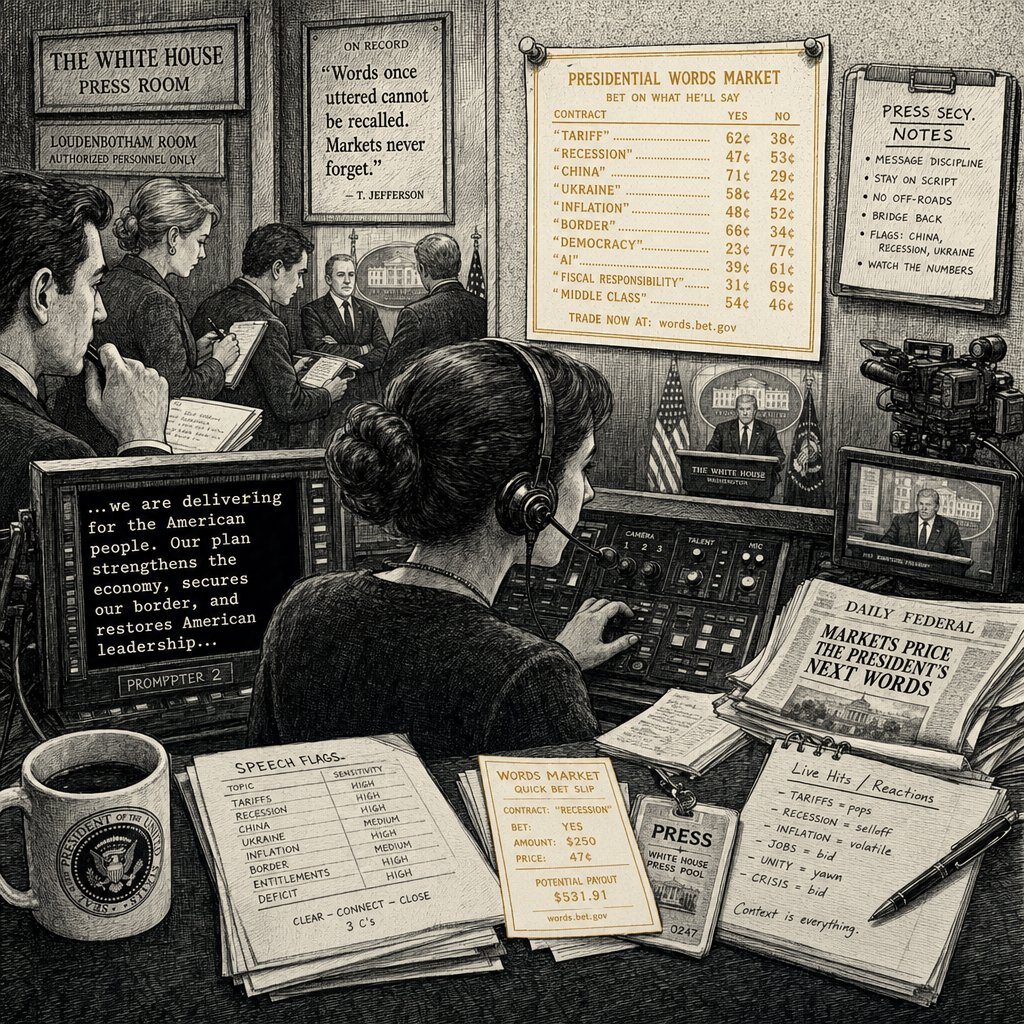
Gabriel Perez, deputy assistant to the president and Trump’s teleprompter operator since 2016, sits on unpaid administrative leave facing a CFTC investigation for allegedly making nearly $100,000 by betting on more than a dozen Trump speeches over three months — the State of the Union, a December primetime address, the World Economic Forum speech in Davos, and a March Medal of Honor ceremony among them. As recently as 2024, Trump praised him at a Reno campaign stop: “I have a guy, Gabe, he’s excellent… a good one is really like gold.” That personal endorsement now sits inside the same administration calling his alleged conduct a disgrace.
The striking feature of this case is not the profit. It is that the institutional machinery worked exactly as designed and Perez still walked away with roughly $100,000 before his suspension. The March 2026 ethics memo established the legal baseline. Kalshi’s surveillance unit monitored trading activity and flagged the anomaly. The CFTC’s enforcement pipeline processed the referral. Every link functioned. Perez still bet thirteen-plus times. That points to a breakdown in deterrence logic: the threat of punishment was credible, but Perez’s subjective calculation undervalued it until detection became certain.
The game’s payoff structure explains why each player acted as it did. For Perez, paid $175,000 annually, the conduct revealed that trading profit dominated salary and legal safety — he accepted the risk of criminal exposure and career destruction for a roughly $100,000 gain. For Kalshi, regulatory-license preservation dominated short-term trading revenue: enforcement head Robert DeNault confirmed the platform froze about $90,000 of Perez’s profits, banned him, and referred the trades to the CFTC, sacrificing trading fees to preserve its operating standing. For the White House, projecting enforcement competence outweighed protecting a longtime staffer — Press Secretary Karoline Leavitt called the alleged actions “a disgrace,” spokesperson Davis Ingle confirmed full cooperation, and the administration placed Perez on unpaid leave within hours of the probe becoming public.
The structure made detection a near-certainty over time. The betting was sequential and repeated — Perez bet, Kalshi monitored, the CFTC investigated, the White House suspended, across thirteen-plus speeches. Under incomplete information — Perez knew the prepared remarks, but neither he nor the market knew Kalshi’s exact detection thresholds — backward induction shows betting should have been irrational from the first decision. A roughly $100,000 expected gain against a $175,000 salary, frozen profits, criminal exposure, and career destruction: even a modest perceived detection probability should have deterred the first bet. It didn’t. Two mechanisms explain the gap. First, the high-profile insider cases that broke in April and May 2026 — a U.S. Army special forces soldier who made $400,000 on Polymarket ahead of the capture of Venezuelan leader Nicolás Maduro, and a Google software engineer who made $1.2 million on Polymarket using confidential company information — both involved Polymarket, not Kalshi, and may have led Perez to underweight Kalshi’s surveillance capabilities through an availability heuristic fed by incomplete base rates. Second, each early undetected bet lowered his subjective probability of future detection, converging on continued defection even as objective risk held constant. Between those mechanisms, a rational once-off gamble metastasised into a thirteen-bet statistical fingerprint that Kalshi’s surveillance architecture was specifically designed to find.
This is a failure of one-shot deterrence in a repeated-game environment. The enforcement architecture relied on the insider correctly estimating detection probability from the start, but it did not require real-time monitoring during high-profile events — it relied on post-hoc review that catches statistical patterns across many bets. The fingerprint should never have been printed if the first bet had been caught in real time. It was caught thirteen bets later, after profits had compounded and legal exposure had scaled. Deterrence-based systems work only when the shadow of the future is long and visible to the actor making the first move. The March memo made the threat visible. The thirteen undetected early bets made it seem distant.
The credibility of the institutional response matters more than its speed, because the question is whether the next insider will be deterred, not whether this one was punished. Kalshi’s claim that it “promptly flagged and referred these trades” passes the credibility test: the platform froze real money, banned a user, and cooperated with regulators — actions that cost it short-term revenue in exchange for preserving its CFTC operating license. The White House’s March memo, warning that using nonpublic government information to bet on Kalshi or Polymarket “is a very serious offence and will not be tolerated,” also passes: it was a public commitment backed by actual enforcement — unpaid leave and a live probe. Credibility flows forward. The next insider will calculate detection probability based on the precedent this case establishes, and the precedent is that detection comes from the platform, not from the White House.
The stakeholder map reveals an unusual distribution of authority, with several positions contested. The CFTC holds the highest combined power, legitimacy, and urgency — a definitive position in the Mitchell-Agle-Wood framework. Its settlement posture will set the precedent. A settlement that includes a fine but no policy recommendation treats the case as an isolated ethics violation. A settlement accompanied by a recommendation for structural rules — employment-verification requirements, real-time referral mandates, expanded jurisdiction over political-event contracts — treats it as the first case in a category.
Kalshi occupies a contested position the available reporting does not fully resolve. The platform controls the data that triggered the investigation, initiated the referral, and demonstrated that centralized, compliant platforms can police themselves — a competitive argument against decentralized, permissionless blockchain-based markets that cannot be surveilled or frozen. But Kalshi’s regulatory fate depends on CFTC rulings, and that dependence creates a countervailing vulnerability. The split turns on whether Kalshi’s power to refer the case makes it the dominant private actor in the enforcement chain, or whether its regulatory dependence on the CFTC makes it dependent on a public authority it cannot control. Both readings are defensible. The disagreement is itself a finding about contested authority in a system where the private platform and the public regulator share enforcement capability without sharing decision rights.
Perez himself sits in an equally contested position. He lacks institutional leverage and is on unpaid leave — power is gone. One reading puts him in the dependent category as the directly at-issue party whose settlement outcome the CFTC must resolve. A more analytically defensible framing treats him as demanding: legitimacy claims erode when a party is accused of wrongdoing, and urgency — settlement talks underway, livelihood at stake — does not redeem standing. The framework that better fits the facts treats Perez as urgent but lacking both power and standing.
The White House Institutional Ethics Apparatus holds definitive salience, but its public posture splits into two rhetorical functions serving the same interest. Leavitt’s personal condemnation — “a disgrace” — and Ingle’s institutional compliance language — “fully cooperating” — reflect different communicative postures rather than different interests. Leavitt signals moral contempt; Ingle signals procedural cooperation. Together they project enforcement competence. The underlying interest is identical: control the narrative, demonstrate institutional response, preserve White House credibility.
Three actors with substantial standing have not yet activated. The Office of Government Ethics — the statutory ethics oversight body for the executive branch — has not visibly engaged, a notable absence for an agency whose mandate covers the very question at hand. Congressional oversight committees remain dormant despite holding standing to investigate, a situation that could shift the dynamic from executive-branch self-correction to legislative scrutiny if they activate. The Department of Justice holds criminal referral authority and will become central if the CFTC settlement is perceived as insufficient.
Among absent parties with legitimate but structurally marginalized interests: other White House staffers with advance access to presidential remarks now face a new deterrence precedent but have no organized voice; prediction-market traders who lost money to Perez’s alleged insider bets are unnamed in coverage and have no standing to seek restitution; foreign governments watching a case involving the words of the sitting U.S. president have no stakeholder position in the current record.
The regulatory vacuum and where it’s heading. The Perez case is the first stress test of a regulatory vacuum around insider information in prediction markets, and the evidence already accumulating points toward the “Wild West” scenario as the default trajectory. Prediction markets are expanding in volume and political scope faster than the regulatory apparatus can govern them. Polymarket’s U.S. platform processed roughly $1.6 billion in trades in April 2026; the offshore crypto platform hit $9 billion the same month. A single World Cup market generated more than $4 billion in volume. Combined volume across Kalshi and Polymarket surpassed $130 billion in 2026. Four known insider cases have surfaced in the first significant period of prediction-market activity — Perez, the Army soldier, the Google engineer, and former congressman George Santos betting on his own State of the Union attendance. Each has generated headlines. None has produced a structural fix. The CFTC lacks clear statutory authority. Platforms resist employment verification as a competitive disadvantage. Public trust erodes in both prediction markets and government ethics simultaneously. Extrapolating two to three such cases per year from the observed frequency is not alarmism but arithmetic.
Three alternative scenarios could interrupt this trajectory, each with specific leading indicators. The “Walled Garden” scenario arrives when a comprehensive federal framework governs insider trading within two to three years: Congress defines “material nonpublic government information” for prediction-market purposes, requires platforms to verify trader identity against government databases, and mandates real-time surveillance referral to the CFTC. Markets continue to grow around the compliance infrastructure. Leading indicator: a bipartisan bill with more than twenty Senate co-sponsors and a CFTC rulemaking docket opening on political-contract governance. The “Precautionary Lockdown” scenario arrives when Congress imposes broad restrictions on a market that has not yet scaled politically — banning all federal employees from any prediction-market participation, or prohibiting political contracts entirely. Leading indicator: federal-employee blanket-ban legislation introduced or a CFTC advisory discouraging political contracts. The “Quiet Problem” scenario closes the Perez case with a fine and no policy recommendation, with no new legislation passing within twelve months, leaving the regulatory infrastructure where it was. Leading indicator: political-contract volume staying below five percent of total platform volume, and no congressional action within a year of the story breaking.
One interpretive risk attaches to the quiet path: a no-recommendation settlement could mean the CFTC believes the problem is contained, or it could mean the CFTC believes it lacks the tools to recommend structural change. Cross-reference with whether the CFTC explicitly declines to seek legislative authority — its posture on that question will resolve the ambiguity.
Two wild cards sit outside the four-scenario framework. If a prediction market accurately forecasts a major national security event — troop movement, sanctions package, diplomatic breakthrough — using insider-driven volume that regulators cannot distinguish from legitimate aggregate intelligence, the crisis collapses the space between prediction markets as useful forecasting tools and prediction markets as insider-trading vehicles. The market’s own information-aggregation success becomes the trigger for its constraint, forcing emergency legislation that bypasses the incremental policy process. An indicator that this may be unfolding: a prediction market shows abnormal volume concentration ahead of a non-public national security event, and the CFTC opens an investigation that fails to trace the volume to any single insider — revealing the forensic limits of detection. A Supreme Court First Amendment ruling that political prediction markets are protected speech would gut the CFTC’s enforcement authority entirely and dissolve the insider-trading question into a free-expression framework. Low probability, but a federal appellate court splitting from existing CFTC jurisdiction precedent on First Amendment grounds would create a circuit split the Court is likely to take.
Strategic implications. Platforms face a capital-allocation bet on regulatory trajectory: invest heavily in surveillance and identity verification now, positioning for the “Walled Garden,” or optimize for growth and defer compliance costs, positioning for the “Wild West.” If three or more insider cases emerge within eighteen months — a threshold already half-met by the four cases observed — government contractors and technology firms with political information access should preemptively restrict employee market participation, because mandatory regulation will eventually follow and first movers will have shaped the terms. Legal teams should prepare constitutional challenges to employee-ban legislation on First Amendment or property-rights grounds if the “Precautionary Lockdown” scenario begins to materialize. Any institution interacting with prediction markets should implement internal information barriers now, because the March 2026 White House memo already establishes criminal liability regardless of which scenario dominates. If a Cabinet-level official is ever charged with prediction-market insider trading, that event marks a shift from episodic scandal to systemic crisis, justifying pre-positioning a full government-affairs operation — the moment when the “Wild West” ends by force majeure.
Three questions to watch. Will Congress hold hearings on prediction-market insider trading, shifting the dynamic from executive-branch self-correction to legislative scrutiny? Will Kalshi or Polymarket announce voluntary employment-status verification, signaling movement toward the “Walled Garden” and forcing competitors to follow? And will the CFTC’s settlement with Perez include a structural-rules recommendation — employment-verification requirements, real-time referral mandates, or expanded jurisdiction over political-event contracts — or close as an isolated ethics violation? The answer signals whether the agency believes it has the tools to address the problem, or knows it doesn’t.
The information asymmetry is permanent: White House staffers will continue to have advance access to presidential remarks. The financial incentive is obvious. Detection and adjudication operate at different institutional layers — one private, one public, neither purpose-built for the collision they now face. Each prosecution tightens deterrence; each gap compounds the cost. The question is not whether government employees will use advance access to profit on prediction markets, but whether the institutions tasked with preventing insider exploitation can close the gap between warning and detection before the next case arrives. What no individual enforcement action alone can provide is an institutional architecture that deters the first bet rather than detecting the thirteenth. Kalshi’s detection of Perez was the warning product. The system still needs the architecture to make the warning stick.
Analytical techniques used in this piece
This analysis applies the methods below. Each links to a short, plain-English explainer you can read and reuse.
- Scenario Planning
- Builds a small set of distinct, plausible futures to plan against.
- Stakeholder Mapping
- Charts the parties to a situation — their interests, power, and alignments.
- Strategic Interaction (Game Theory)
- Models a situation as a game — players, moves, payoffs, and likely equilibria.