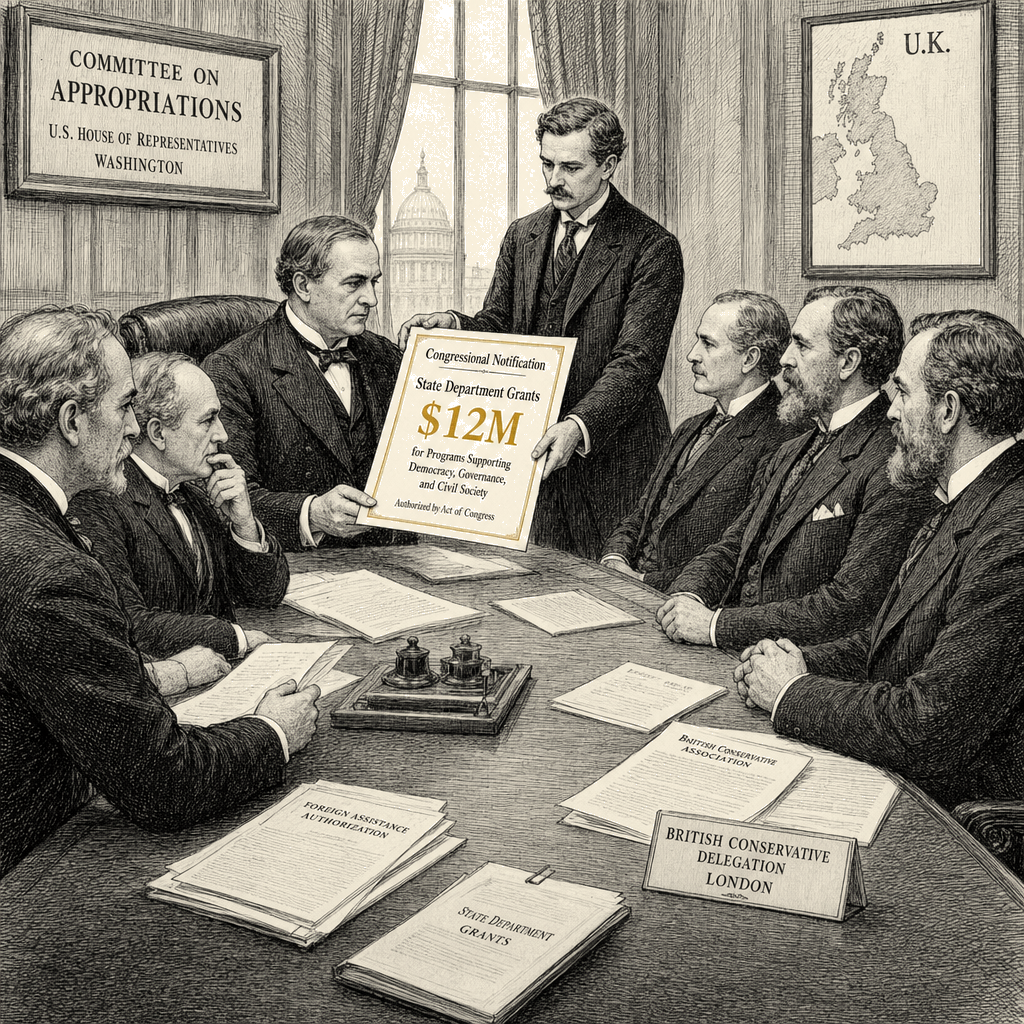
The Trump administration plans to direct $12 million in State Department funds to three UK organizations whose founders share a single political lineage — and it is using a procurement mechanism that guarantees no competing organization will be considered. The core finding is not the dollar amount. It is the decision to bypass the standard competitive process that would have exposed the ideological concentration of the recipients to public scrutiny.
The mechanism is the message
Two of the three grants — $7 million to the think tank 878 and $5 million to Free Speech Union International — are explicitly structured as sole-source awards. The third, $3 million to the Jobs Foundation, has an unspecified award structure that the article does not distinguish from the two confirmed sole-source grants, extending the procedural critique to all three by implication. The sole-source designation bypasses every safeguard that normally governs State Department foreign-assistance grants: public solicitation, independent panel review, and documented legal waiver. The former officials who spoke to The Guardian describe the bypass as “outrageous and absurd,” noting that sole-source awards “require significant legal justification to avoid required competitive processes.” The legal waiver documentation either exists (and becomes a public record that can be scrutinized) or does not exist (in which case the procedural critique becomes a legal one). The public does not yet know which, because the administration has not released it.
The practical consequence of the sole-source structure is that the normal grant process — which would surface alternative UK organizations capable of pursuing the same stated objectives — has been foreclosed. The UK’s Westminster Foundation for Democracy, established policy-research centres, and university research units with active programmes on migration governance, labour-market regulation, or digital-rights policy were never given a chance to compete. The fact that the State Department announced a separate, competitive $3 million European “civilizational bonds” NOFO the same week proves the department knows how to run a competitive process when it chooses to. The UK grants are aberrational not in form but in procedural posture and recipient selection.
The network the grant structure separates
The formal structure of the grant package presents three independent awards to three independent organizations. The personnel and institutional connections among the beneficiaries tell a different story. All three share lineage through the Brexit campaign and the UK Conservative Party. Jacob Rees-Mogg and Dr. Radomir Tylecote co-founded 878, which was incorporated in the UK only in March 2026 and has “pending” US nonprofit registration — a structure that means the $7 million cannot legally disburse through 878’s current US entity without a fiscal sponsor or intermediary, neither of which is identified in the source. Toby Young, a Conservative life peer, founded the Free Speech Union whose offshoot receives the $5 million award. Matthew Elliott, formerly chief executive of the official pro-Brexit campaign Vote Leave, is president of the Jobs Foundation; its chief executive, Georgiana Bristol, was development director of the TaxPayers’ Alliance.
The densest single node of network evidence sits outside the formal grant structure entirely. All three beneficiary principals — Rees-Mogg, Young, and Tylecote — were scheduled speakers at the inaugural UK edition of the Conservative Political Action Conference in London, organized by former Prime Minister Liz Truss, the same week the grants were disclosed. The shared platform does not prove coordination, but it is a structural adjacency that the grant structure visually separates. The formal mechanism presents three independent allocations; the network evidence reveals a coherent ideological cluster operating through a shared political platform.
The thematic coherence of the three grant descriptions reinforces the pattern. The 878 grant justification cites “common threats to Western civilisation, such as mass migration, censorship, lawfare and supranational governance.” The Free Speech Union International grant is for “promoting free speech and countering digital overregulation.” The Jobs Foundation grant is for “Countering Overregulation to Advance American Investment.” The vocabulary converges on anti-regulation and civilizational-decline themes associated with the populist wing of the conservative movement on both sides of the Atlantic. The policy coherence is a finding the grant structure does not name but that the parallel language makes visible.
The 878 “nonpartisan” framing in the congressional notification is directly contradicted by the group’s own website, which lists “mass migration,” “warfighting,” and “Judeo-Christian culture” as priorities. The justification the notification asserts is not the justification the group’s materials evidence.
The inverted application cycle
Toby Young told The Guardian that Free Speech Union International had not submitted a formal application. A sole-source award to an entity that has not formally applied inverts the normal grant cycle, under which the funder solicits and the recipient responds with demonstrated capacity and a programme plan. The notification either predates formal application — a procedural oddity for a sole-source justification, which normally requires a recipient to have demonstrated capabilities the department has already assessed — or the award was prepared without applicant input. Both readings signal ideological preference preceding institutional due diligence.
The State Department’s own spokesperson undermined the settled-picture framing: grants would “continue to undergo the Department’s standard and rigorous vetting process by grant professionals,” and decisions remain under “active deliberation.” The Jobs Foundation spokesperson said the grant was “under consideration for project funding.” The gap between the congressional notification’s posture — settled allocation with dollar figures and recipient names — and the beneficiaries’ public posture — “no formal application,” “under consideration” — places the notification in an uncertain procedural stage consistent with a preliminary intent statement rather than a near-final award.
Two-tier power landscape
The three beneficiary organizations occupy high-interest positions not by institutional weight but by political proximity to the grantor. The sole-source mechanism is what places them there. The parties with the strongest institutional claim to oversight are structurally disadvantaged by the same mechanism: competitive grant applicants cannot challenge an award they did not know existed; the US Congress received notification but has launched no active inquiry and has no competitive-bidding documentation to scrutinise; US taxpayers are a diffuse constituency with no organised mechanism for fiscal-stewardship objections; UK and European publics have no representation in a funding decision whose outcomes will shape their policy environments without their consent.
The five former State Department officials who spoke to The Guardian provide the institutional critique that anchors any legal challenge. They are unnamed, their former positions unspecified, and the “months-long effort by Trump-aligned individuals within the department to subvert normal funding procedures” is asserted without documentary support beyond the congressional notification itself. “Outrageous and absurd” is strong language carried entirely by unnamed sources. A skeptical reader has no basis for assessing whether these officials had direct access to the deliberations or are interpreting the same document the reporter obtained. But the critique is now in the public record, and the requirement for “significant legal justification” is a measurable standard.
The reputational chain
The diplomatic fallout travels through a concrete chain: public disclosure via The Guardian → foreign-leader condemnation → domestic accountability pressure → legal or procedural review. Incoming Labour Prime Minister Andy Burnham, confirmed Labour leader on 17 July 2026 and set to become prime minister on 20 July 2026, said he would be “very upfront” with Trump about disagreements. The grants hand him a concrete instance of perceived foreign-government intervention in UK civil-society funding in the same week he assumes office. German Chancellor Friedrich Merz, responding to the broader prospect of similar grants to German groups, warned: “I do not want the American government or institutions close to the government to interfere in German elections.” The Merz statement signals that European governments already view the UK grants as part of a broader pattern — the same-week European “civilizational bonds” NOFO extends the thematic reach beyond the UK.
The notification was presented to Congress, but the sole-source structure means no competitive alternatives were documented for review. The former officials’ criticism provides institutional cover for a legal challenge that is now both visible and contested in the public record. The GAO review path is the one that turns an anonymous-source story into an auditable record: if Congress requests a review, the legal waiver documentation either exists and becomes a public document, or it does not exist and the procedural critique gains institutional force.
Framing defects in the public record
The Guardian’s headline — “State Department plans $12M in grants to UK conservative groups” — presents the grants as a settled plan, but the article’s own sources undercut that certainty. The State Department spokesperson says decisions “remain under active deliberation.” Toby Young says no formal application has been submitted. The Jobs Foundation spokesperson says the grant is “under consideration.” A reader who absorbs only the headline takes away a done deal; the article’s own content describes a process still in motion.
The Jobs Foundation’s unspecified procedural status is not visually distinguished from the confirmed sole-source awards in the article’s structure. The procedural critique — “lack of competitive bidding” — is presented by former officials and extends by implication to all three recipients, though the article acknowledges the third may not apply. The Free Speech Union’s “We take no government money and have no political agenda” statement appears in the same report describing a $5 million US government award to an FSU offshoot. The article presents the contradiction but does not pursue it — whether “we” refers to the parent FSU only, with FSU International being a separate entity, or whether the statement is outdated, remains unresolved.
The sourcing asymmetry is structural: the article gives significantly more narrative space and more dramatic language to the five unnamed former officials — multiple vivid quotes across several paragraphs — than to the single on-record State Department spokesperson, who gets one neutral paragraph. The institutional defence is compressed while the critique is expanded. This is a feature of adversarial investigative reporting, not a factual error, but it is a framing effect that shapes reader inference.
What the sole-source mechanism enables
The precedent context sharpens rather than softens the departure. The United States routinely funds foreign civil society through the National Endowment for Democracy, USAID, and State Department democracy-promotion programs — an aggregate of roughly $2 billion per year, as documented by the Government Accountability Office and other oversight bodies. That routine funding exists precisely because the standard apparatus prevents the appearance that grantor ideology, rather than programmatic merit, drives recipient selection. These grants are aberrational in procedural posture and recipient selection, not in the fact of funding foreign civil society.
If the sole-source mechanism stands, it provides a template for any administration — of either party — to direct foreign-assistance funds to ideologically favoured groups without competitive review, bypassing the procedural safeguards that normally govern the use of public money abroad. The bypass is not a procedural detail. It is the structural gateway through which a political network becomes a funded pipeline. And unlike the competitive process, which forces public justification at every stage, the sole-source mechanism was designed to avoid exactly the scrutiny that the public disclosure has now forced it to face.
Analytical techniques used in this piece
This analysis applies the methods below. Each links to a short, plain-English explainer you can read and reuse.
- Red-Team Assessment
- Models a capable adversary probing a plan for the seams they would exploit.
- Relationship Mapping
- Extracts the network of ties among people, institutions, and entities.
- Stakeholder Mapping
- Charts the parties to a situation — their interests, power, and alignments.