
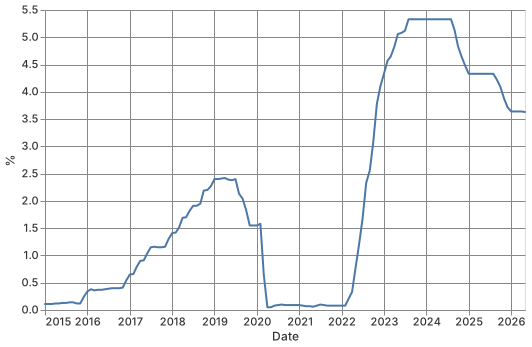
The Federal Reserve has held its benchmark interest rate steady since December 2025, with the effective federal funds rate at 3.63% as of June 9, according to FRED data. Policymakers remain divided on the next move — a possible rate reduction or a return to increases to combat inflation — leaving investors without a clear signal on direction.
Research published June 9 by Derek Horstmeyer, a finance professor and director of the Future of Finance Lab at George Mason University’s Costello College of Business, examined how nine S&P 500 sector exchange-traded funds performed under three interest-rate environments: increasing, flat and decreasing. The study used data going back to 1999 and defined interest-rate cycles as any six-month period in which the federal-funds rate moved in a particular direction.
The results cut against conventional wisdom that lower borrowing costs fuel growth in rate-sensitive sectors. The technology sector, often perceived as dependent on cheap capital for expansion, delivered the strongest returns during rising-rate cycles, averaging 1.24% a month with annualized volatility of 19.40%. Energy stocks performed similarly, posting average monthly returns of 1.31% with volatility of 23.34%.
“Contrary to the notion that cheaper capital fuels growth, the fast-growing technology sector has performed best when the Fed is increasing rates,” Horstmeyer wrote. Consumer staples and healthcare were the laggards during rising-rate cycles, delivering average monthly returns of 0.38% and 0.42%, respectively.
During flat-rate environments, materials and industrials were the top-performing sectors, with average monthly returns of 1.52% and 1.44%. Utilities and consumer staples were the worst performers in those periods but still delivered positive returns of 1% and 1.05% a month.
Decreasing-rate cycles produced the worst results across all sectors, accompanied by higher-than-average volatility. The average monthly return across all sectors during falling-rate periods was negative 0.31%, with annualized volatility of 23%. Healthcare and consumer discretionary stocks were the best performers in these conditions, delivering average returns of 0.29% and 0.31% a month, respectively. Financials averaged negative 1.32% and energy negative 1% a month, with energy posting volatility of 32%.
“Rate cuts may not deliver the outsize returns investors often associate with easier money,” Horstmeyer wrote, “while rate increases may further boost the surging tech sector, and a continued pause on rates could be best for all investors.”
The S&P 500 Index stood at 7,405.73 on June 9, near record levels after a months-long rally fueled by technology stocks.
The study excluded the real estate and communications sectors because they did not become defined sectors until 2015 and 2018, respectively.