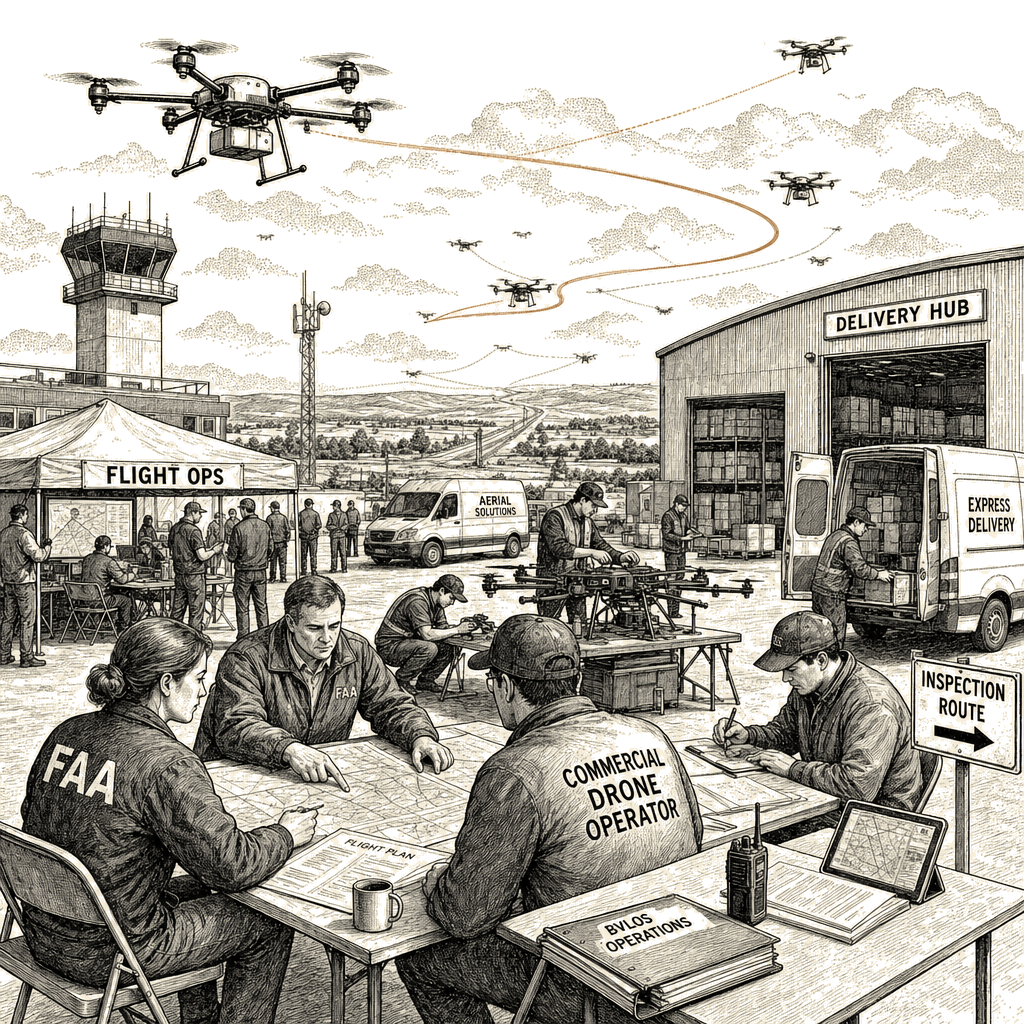
The Federal Aviation Administration is finalizing a new regulatory framework, called Part 108, that would for the first time allow drone operators to fly unmanned aircraft beyond visual line of sight at a commercial scale, according to an analysis published Thursday by Rochester Institute of Technology mechanical engineering professor Agamemnon Crassidis.
Current FAA rules require nearly all drone pilots to maintain continuous visual contact with their aircraft — a practice known as visual line of sight — severely limiting how far drones can fly. Under the existing Part 107 rule, which covers drones weighing less than 55 pounds, operators must also keep their craft below 400 feet in uncontrolled airspace, fly only during daylight with at least three miles of visibility, and remain at least five miles from airports. As of early 2026, more than 800,000 registered drones were operating under those restrictions, the vast majority in uncontrolled airspace.
A final version of Part 108 is expected within about a year, Crassidis wrote, and would permit flight beyond visual line of sight for a much broader range of operations, including fully autonomous flights and the use of larger and heavier drones.
“People could be allowed to fly drones beyond visual line of sight, beyond the few exemptions to current rules, within a year,” Crassidis said. He noted that the FAA has sometimes issued waivers and exemptions for beyond-visual-line-of-sight operations under the current framework, but said “the regulatory process has lagged behind current drone technology.”
The rule change is expected to unlock a wide range of commercial applications that have been largely stalled by the line-of-sight restriction, according to the analysis. Companies have pursued package delivery — including medical transplants and fast food — as well as pipeline and railroad-track inspection, forest-fire assessment, search and rescue, border patrol, environmental monitoring and precision agriculture. For many of these uses, drones would need to operate fully autonomously.
“Drone operators bear a lot of responsibility, but being allowed to operate beyond visual line of sight would raise the stakes,” Crassidis wrote. “It could also open tremendous economic opportunities.”
Integrating drones into the National Airspace System — the network of controlled and uncontrolled airspace used by crewed aircraft — remains the central challenge. In controlled airspace around airports and urban areas, air traffic controllers guide all flights and drone operators must already receive formal FAA authorization. In uncontrolled airspace, typically rural, pilots are responsible for their own navigation and collision avoidance, and drones share that airspace with crewed aircraft, which have absolute right of way.
Crassidis said his work on flight navigation systems indicates that artificial intelligence could produce “smart” drones capable of seeing and avoiding objects in the air, executing air traffic control commands, and performing fully autonomous takeoffs and landings. Parallel efforts by the Northeast UAS Airspace Integration Research Alliance, AURA Network Systems and General Atomics Aeronautical Systems are developing those capabilities with the FAA. The NASA-UAS-NAS project is investigating command-and-control technologies that would allow autonomous drones to operate in the same airspace as crewed aircraft, and the FAA Beyond program is developing new flight rules.
Several complications remain unresolved. Many drones are small and difficult for crewed aircraft to detect and avoid. The analysis noted that terrorists could exploit drones, raising the need for ways to capture or shoot down rogue drones or overpower their control signals. Regulators will face pressure to protect high-risk targets — such as sporting events, large public gatherings and critical infrastructure including the power grid and nuclear facilities.
“As Part 108 and other advances allow autonomous drones to surge, regulators will also have to consider public concerns about privacy, malicious actions and nuisance,” Crassidis wrote. “Increased education and awareness can ease these concerns.”
MSI previously reported on the FAA’s expanding role in drone airspace management, including the April approval of counter-drone lasers for the southern border alongside the Pentagon and the February alert to drone pilots after airspace violations at Coors Field.
China, the European Union and Japan have already set expanded rules for autonomous drones, Crassidis noted. The U.S. government, he said, “recognizes the vast economic and societal potential” of the technology.
The analysis was republished by United Press International from The Conversation under a Creative Commons license.