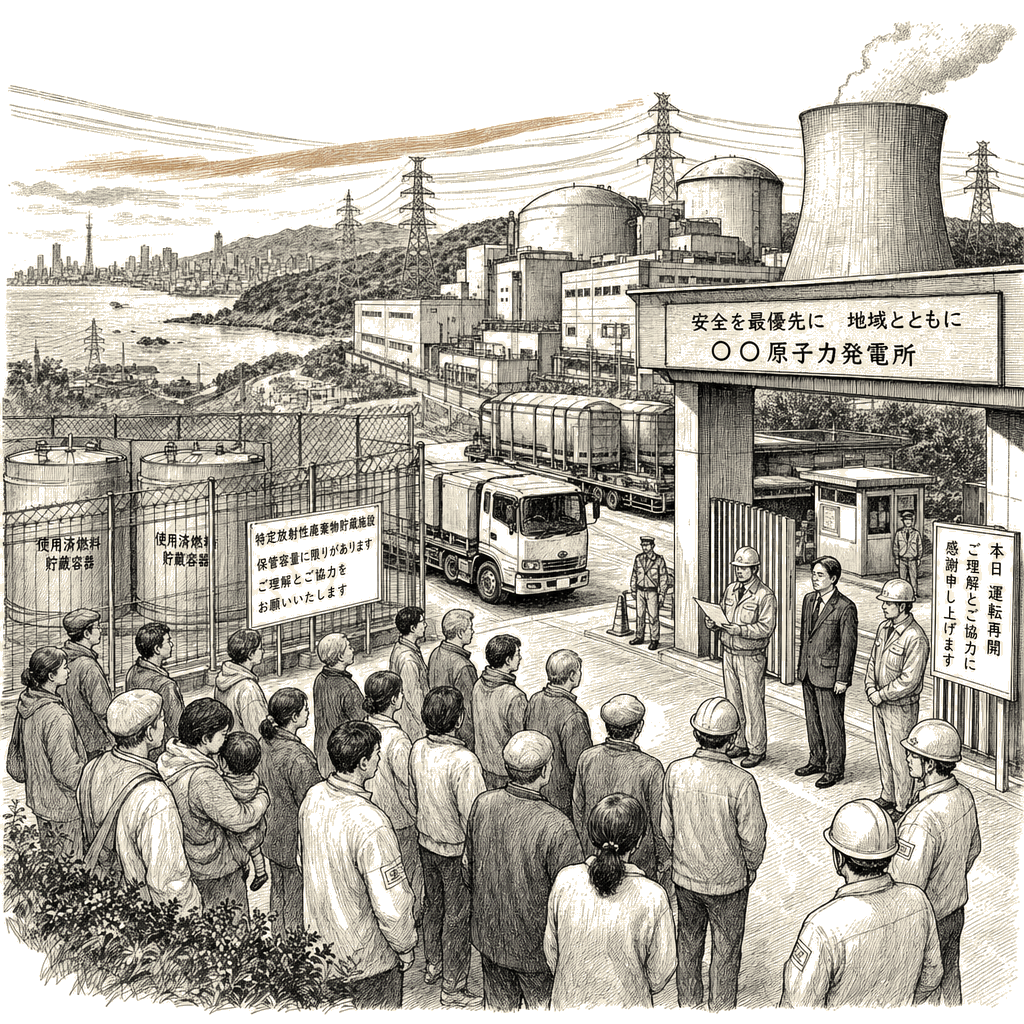
Japan resumed operations at Unit 6 of the Kashiwazaki-Kariwa Nuclear Power Station earlier this year, the first time the reactor had been online since the March 2011 Fukushima disaster prompted a nationwide nuclear shutdown. The restart, driven by surging electricity demand during a global oil crisis, has revived long-simmering concerns about what the country will do with the highly radioactive waste its reactors produce.
The spent fuel in the No. 6 reactor’s cooling pool is visible from a top-floor observation area. TEPCO said the pool is 88% filled. The Federation of Electric Power Companies of Japan said three plants — including Kashiwazaki-Kariwa — will see their cooling pools reach capacity within five years.
“Without solid (fuel management) plans, our power generation will stall sooner or later,” Kashiwazaki-Kariwa General Manager Takeyuki Inagaki said.
Only 15 of Japan’s 54 commercial reactors have restarted since the 2011 disaster, when a 9.0-magnitude earthquake and tsunami caused meltdowns at three TEPCO reactors in Fukushima. About 160,000 people fled the area, and some zones remain uninhabitable.
As of December 2025, cooling pools at 17 Japanese nuclear plants held more than 17,000 tons (15,422 metric tons) of spent fuel, using nearly 80% of total storage capacity, according to the Ministry of Economy, Trade and Industry.
Japan’s government, led by Prime Minister Sanae Takaichi, has pushed to bring more reactors online. That push produces more spent fuel, and without a viable permanent storage plan, industry officials worry reactors will have to shut down again when storage runs out.
Weeks after the Kashiwazaki-Kariwa No. 6 restart, Industry Minister Ryosei Akazawa wrote to Ogasawara village Mayor Masaaki Shibuya requesting a feasibility study for a high-level radioactive waste site on Minamitorishima, an uninhabited island about 2,000 kilometers (1,242 miles) south of Tokyo that the government owns.
“With a lot of spent fuel accumulating at nuclear power plants across the country, a final disposal of radioactive waste is a crucial challenge that must be resolved,” Akazawa wrote.
Minamitorishima is the fourth location to receive a feasibility study since the government began searching in the early 2000s. The Japanese military is already constructing a firing range for long-range missiles on the island as a deterrent to China, and the island sits atop deep-sea deposits rich in rare earth minerals.
Satoshi Takano, a member of a government panel studying final disposal, said the selection of a government-owned remote island “seems political,” adding, “There will be little opposition from a government-owned remote island.”
Some experts said the island, which sits on a geologically stable tectonic plate, could be technically suitable. Many residents on Ogasawara and two nearby islands expressed concerns about safety and tourism.
Ogasawara assembly member Yusuke Hirano told an assembly meeting he was “baffled” by the plan. “I think nuclear waste is incompatible with islands that are a UNESCO Natural World Heritage site,” he said.
The review process is expected to take about two decades. Municipalities participating in the first stage can receive up to 2 billion yen ($12.8 million) in government subsidies, and the next stage would bring up to 7 billion yen ($44.7 million). Funding details for a final study have not been disclosed.
Japan has long insisted on reprocessing spent fuel to extract plutonium and uranium for reuse, saying it helps a resource-poor nation meet its energy needs and reduces the toxicity and volume of radioactive waste. But a reactor designed for plutonium reuse, a key part of the recycling plan, has failed. Reprocessing cannot handle all the spent fuel, adding to a plutonium stockpile that is already large enough to arm thousands of atomic bombs, according to experts cited in the report.
Lila Okamura, a Senshu University professor and expert on environmental politics and nuclear waste management, said Japan faces a dual challenge: the large volume of normal reactor waste and the “massive and largely unknown high-level nuclear waste from the Fukushima disaster.” She said choosing and building a final disposal site would require 100 years, plus tens of thousands of years to monitor deep underground storage. “Japan should plan carefully and not rush the current plan that is full of uncertainties,” Okamura said.
The world’s first final disposal site for spent nuclear fuel is scheduled to open in Finland later this year. Britain, Germany and the United States have abandoned reprocessing largely because of high costs and technical challenges, while several other countries are discussing plans for direct disposal sites.
Inagaki said TEPCO is transferring spent fuel from the No. 6 reactor to other reactors at the Kashiwazaki-Kariwa plant that have more space, and the utility hopes to resume shipments to a dry-cask storage facility in northern Japan as a near-term solution. Other utilities with nearly full pools have announced plans to build dry-cask storage at their own plants.
Many residents worry that high-density storage of spent fuel could increase the risk of overheating. Mie Kuwabara, a civil activist in Niigata, said she is skeptical about the Minamitorishima plan. “It’s irresponsible to accelerate restarts and produce more spent fuel without deciding its final destination,” Kuwabara said. “It’s like saying that it’s OK to put a facility there because nobody is around to complain if there is a problem. It’s scary.”