In an analysis published June 12 in The Wall Street Journal, Pulitzer Prize-winning historian T.J. Stiles argues that the mechanism that turned John D. Rockefeller into the world’s first billionaire in 1916 is the same one that is now making Elon Musk the world’s first trillionaire: a fundamental transformation in how Americans define the value of a share of stock.
Stiles traces the modern stock market to a Gilded Age debate over what a stock certificate actually represents. In the late 19th century, most shares carried a “par value” of $100, meant to reflect $100 spent on physical capital — land, machinery, railroad track. The market price was expected to fluctuate around that figure, and investors looked for returns through dividends, not price appreciation. A share was seen as a concrete token of real stuff, in the same way a paper banknote was once seen as a token for gold.
Issuing stock that did not correspond to physical investment was called “watered stock” — a term borrowed from the practice of making cattle drink heavily before weighing them for sale. Financial journalist Henry Poor condemned the practice in 1869, warning that “such enormous additions to the capital of companies, without any increase of facilities” threatened to destroy the value of railway property. The editors of The Wall Street Journal itself argued in 1901 that U.S. Steel stock should “represent…the value of the plant.”
Yet financiers pushed a more abstract conception, one that tied a share’s value to earnings, growth, and market judgment rather than physical assets. Jay Gould, J.P. Morgan, Cornelius Vanderbilt, and others engineered deals that broke the old mental architecture.
The change was dramatized in the 1868 Erie War, when Gould and his ally Jim Fisk outmaneuvered Vanderbilt by issuing massive amounts of new stock to defeat a corner. “There are magicians’ skills to be learned on Wall Street, and I mean to learn them,” Stiles quotes Gould as writing. A judge ordered the Erie directors arrested for contempt; the board fled to New Jersey with account books and documents, according to contemporary newspaper reports cited by Stiles.
In 1889, New Jersey became the first state to explicitly authorize holding companies — corporations that exist to own other corporations. That legal innovation, Stiles writes, was central to the manufacturing merger boom of the 1890s, in which 4,277 firms consolidated into 257, and the 100 largest concerns quadrupled in size to control 40 percent of industrial capacity. The movement culminated in J.P. Morgan’s creation of U.S. Steel in 1901, capitalized at $1.4 billion — based not on construction costs but on what Morgan believed the market would bear.
Theodore Roosevelt, then a state assemblyman, had already attacked Gould in 1882 for using a “fraudulent company” — the Manhattan Elevated Railroad — to control New York City’s elevated lines. As president, Roosevelt continued to attack overcapitalization, but Congress lacked the will to override state corporation laws, and the holding company remained legal.
The old par-value system was dealt its final blow by the Supreme Court’s 1911 antitrust breakup of Standard Oil. Rockefeller retained his stake in all 33 spinoff companies. When a share of Standard Oil hit $567 in 1916, a journalist calculated that a pre-breakup equivalent share, including all spinoff holdings, was worth $2,014 — far beyond the old $100 par. That same year, Rockefeller became the world’s first billionaire.
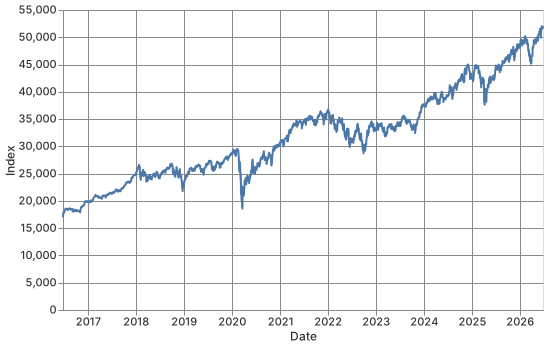
As of June 12, 2026, the Dow Jones Industrial Average stood at 50,848.75, according to Federal Reserve data — a market that values companies built on intangibles far more than physical plant.
Stiles writes that the modern abstraction of finance has clearly fueled innovation and growth, but also removed a simple, intuitive limit on corporate scale and wealth inequality. “It disciplined greed, in the interests of investors and the public,” he says of the old system, quoting a 1906 ethicist who declared that a majority of Americans believed it was “improper, intolerable, and wrong for monopolistic concerns to obtain more than a reasonable rate of interest.”
The historian suggests that Musk’s trillion-dollar net worth could be a “inflection point” similar to the one that produced antitrust law and the progressive income tax — a moment when public discontent leads to new rules. But, he concludes, “we’ve never replaced that ethic of restraint, that lost limit on shares.”