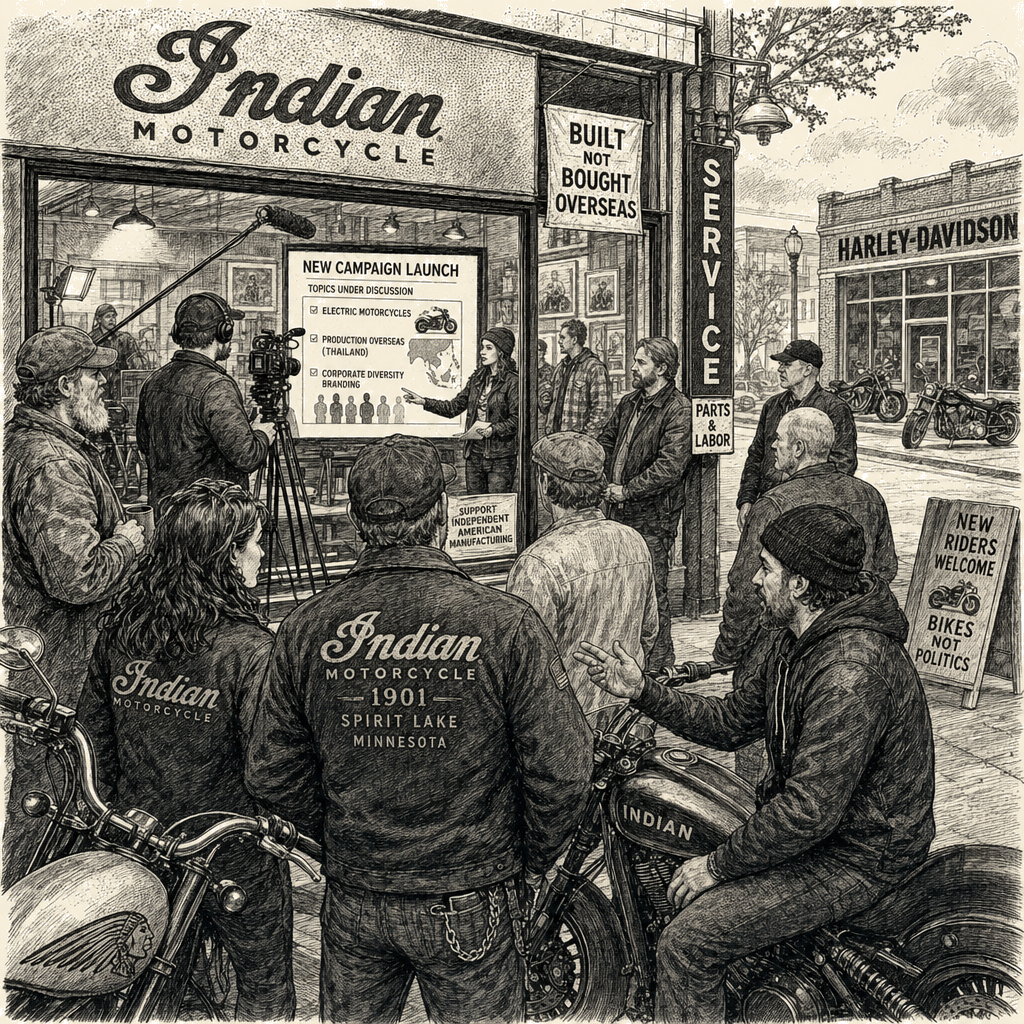
Indian Motorcycle, the perennial rival to Harley-Davidson in America’s heavyweight motorcycle market, launched an unusually direct social-media video in early June that criticized its larger competitor for making electric motorcycles, shifting some production to Thailand, and embracing diversity, equity and inclusion programs.
The video, produced by Minnesota-based Indian, featured a narrator with a tone similar to a campaign-attack ad. “They chased political trends,” the narrator said of Harley. “We back the people who matter.”
An Indian spokesman said the marketing was not political. “We are not afraid to say we believe Indian builds the better motorcycle, and we are not afraid to say Indian is closer to the riders and values that built American motorcycling,” he told the Wall Street Journal.
The video followed nearly two weeks of social-media commentary from conservative influencers criticizing Harley and praising Indian. The mixed-martial-arts fighter Sean Strickland tweeted a photo of an Indian touring bike, writing, “Every time I got on my harley I was indirectly supporting” radical ideology.
Robby Starbuck, who in 2024 successfully pressured Harley into dropping some diversity-focused policies, released a video arguing that DEI initiatives at two companies Harley CEO Artie Starrs previously led — Pizza Hut and Topgolf International — made him unsuitable to lead “the most masculine, pro-America biker brand.” Starbuck encouraged Harley riders to “make the switch” and told the Journal that Indian did not sponsor the video.
Indian Motorcycle, founded in 1901, has struggled for most of its existence, changing owners and sometimes going dormant. It was acquired by Polaris in 2011 and sold last year to Carolwood LP, a private-equity firm. The brand sold about 15,000 motorcycles in the U.S. last year, according to people familiar with the matter, compared with Harley’s nearly 83,000.
Mike Kennedy, hired as Indian’s CEO after the Carolwood acquisition, spent more than 20 years at Harley, including as vice president and managing director of the Americas. In a podcast interview last month, Kennedy said he had been “exited out” of Harley for being too pro-dealer and criticized the hiring of Starrs, who had no prior experience in the motorcycle industry.
“Harley made its choice,” Kennedy told the Journal. “Indian made ours. Indian chose a motorcycle leader for a motorcycle company.”
Neeru Paharia, a marketing professor at Arizona State University, said Indian’s approach carries risks. Direct attacks on a competitor are rare in advertising, she said, as are politically tinged messages. “If it’s perceived as inauthentic, as if you’re just trying to capitalize off cultural trends, people dislike that,” Paharia said.
The attack appeared to have minimal results. On Tuesday, a day after the video was released, Harley announced it was bringing some bike production back from Thailand to the U.S., a move the company said would create dozens of new jobs. The White House posted on X: “AMERICAN MANUFACTURING WIN!”
Harley’s share price has risen 6% since the clamor began. The company said in a statement that its “only agenda is getting back to basics.”
On Wednesday, a group of Harley dealers issued a letter praising Starrs’s leadership and condemning “divisive narratives.” Neil Noble of Navigant Motor Group, which operates six Harley dealerships in Texas, said the video has had no effect on business. “I was surprised that it was real,” said Noble, who is vice president of the Harley-Davidson National Dealer Advisory Council. “We do a lot of advertising, and we just don’t focus on our competitors.”
Some in Indian’s own community rejected the ad. One dealer said the company should fire its marketing agency, while some riders called the video an embarrassment.
Dave Friedl, a Florida resident who owns an Indian Scout, said: “I don’t like that they’re getting involved in politics. I don’t want a ‘red brand’ and a ‘blue brand’ in motorcycles. There’s too much of that already.”
Other riders supported the approach. Michael Lindbeck, a retiree in Alaska who owns six Harleys and two Indians, said the ad was spot-on. “Harley went too woke,” he said. “An electric motorcycle under the Harley brand, I don’t know what they were smoking.”
Brad Deshano, a law-enforcement officer in Arkansas, said he switched from Harley to Indian a decade ago, citing comfort. “My Harleys haven’t really left the garage since,” he said.