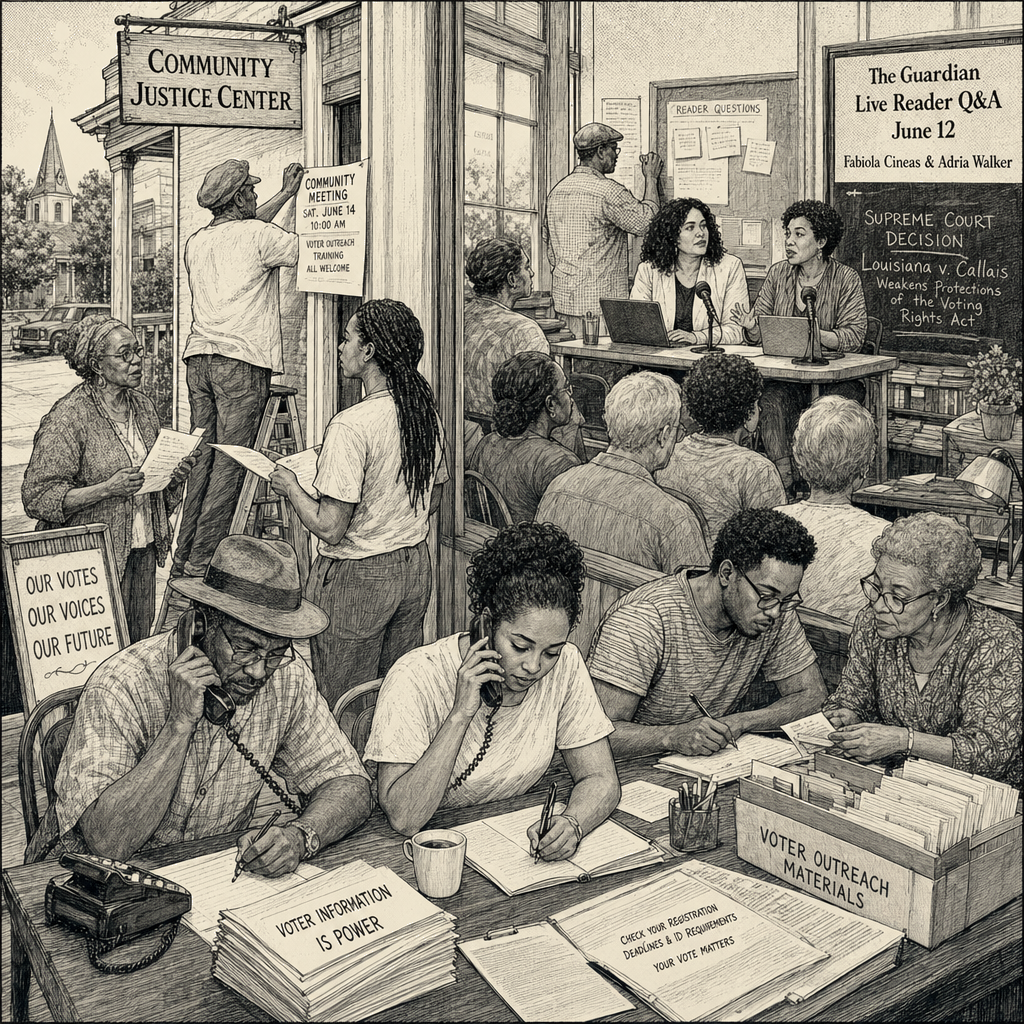
The Supreme Court’s April ruling in Louisiana v. Callais struck a massive blow to the Voting Rights Act, eliminating Section 2’s protections that had been a key tool for ensuring minority representation in Congress. Within days of the decision, Republican-led states in the South moved to redraw congressional maps to erase majority-Black districts. Some of those maps have already gone into effect ahead of the November midterm elections, according to Guardian reporters Fabiola Cineas and Adria Walker, who held a Reddit Q&A on June 12 to answer reader questions about their on-the-ground reporting.
Walker said that the post-decision moment appeared to be a “galvanizing moment” for voters and organizers. She described rallies in Montgomery, Alabama, and Jackson, Mississippi, that included children still in primary school alongside veterans of the civil rights movement. “I’ve talked to people from across the region who were particularly unsettled by many southern states’ rush to redraw maps,” Walker said. “Some people who have never voted before – some of whom weren’t even registered to vote – said that they felt spurred to action specifically because of how quickly southern states acted.”
Cineas addressed a reader question about Democratic strategy in the South, where the party does not control legislatures in Mississippi, Alabama, Tennessee, or Louisiana. She cited Alabama state Sen. Bobby Singleton, who has been involved in redistricting fights for decades. “He said his focus is on litigation, opposing any new maps Republicans present in the legislature, grassroots mobilization and working with Democrats across the south to turn out more voters, including voters who have never voted before,” Cineas wrote. She noted that Black people make up nearly 30 percent of Alabama’s population but are unlikely to control state politics due to racial polarization.
Walker pointed to an intergenerational dynamic among activists. Many older participants she spoke with were themselves youth organizers during the civil rights movement. “I have seen some younger people express frustration with older organizers,” she said. “There’s a lot of ongoing dialogue between older and younger voting rights activists, as they’re having to figure out how to bridge this gap.” Yet she emphasized that the large rallies in Montgomery and Jackson, held in May and June, demonstrated that the fight remains intergenerational.
In response to a reader asking about the Democrats’ chances in the midterms, Cineas said Democrats are currently favored to win the House but that the redistricting war has added “a lot of uncertainty.” She noted that former President Donald Trump began pressuring Republican states to gerrymander maps last year, and that several states have redrawn maps since then. Democrats responded by redistricting in California to gain more seats there, but suffered a blow when Virginia’s state supreme court rejected a voter-approved map that would have given Democrats four House seats.
Asked whether there was any good news, Cineas pointed to surging grassroots efforts. Civil rights organizations across the South have launched rallies and trainings in direct response to Callais, including the Black Voters Matter “We Got Us” campaign. A John Lewis “Good Trouble Lives On” weekend of action is planned for mid-July to register voters and bring organizers together. “State courts are becoming the new battlegrounds for redistricting fights,” Cineas said, “which is good because it shows the system is working as it should.”