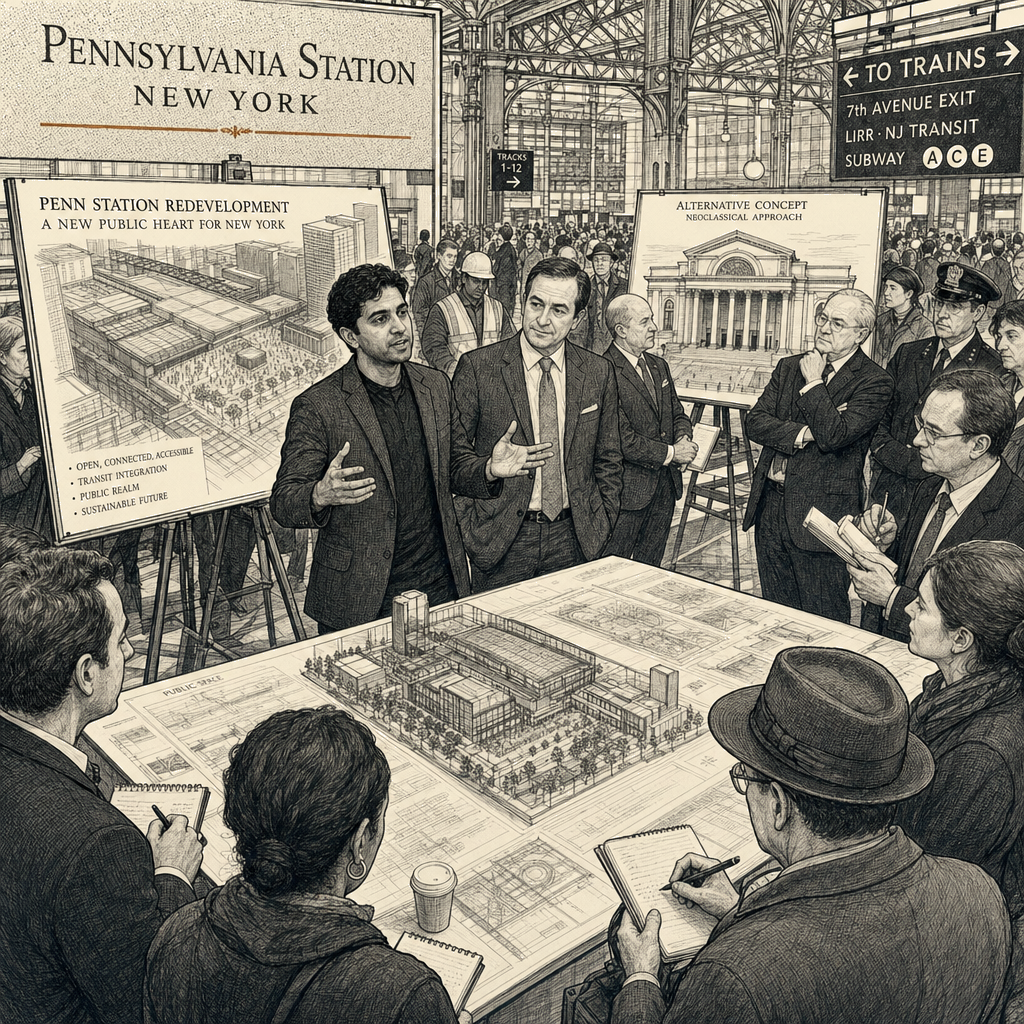
The Trump administration has selected a design team led by architect Vishaan Chakrabarti and former Transportation Department official Peter Cipriano to redevelop New York’s Pennsylvania Station, ending a competition that drew rival proposals for one of the United States’ most chronic infrastructure failures.
The winning consortium, Penn Transformation Partners, also includes former New York City Transit President Andy Byford, construction firm Skanska and architects HOK, according to the Wall Street Journal. The project is expected to cost roughly $8 billion.
The selection comes as more than a million World Cup fans arrive in New York City this month, many of them passing through Penn Station — the nation’s busiest transit hub, handling more than 600,000 passengers daily, more than John F. Kennedy, LaGuardia and Newark Liberty airports combined. The station was originally designed for 200,000 passengers a day. Last week, a man with a criminal history stabbed five people near the station’s “Pit” area, where NJ Transit commuters wait for trains cooled by mobile air conditioning units.
Andy Byford, who gained renown as “the Train Daddy” after stabilizing New York’s subway system in 2018, told the Journal that the quality of Chakrabarti’s design and Cipriano’s financial plans, combined with President Trump’s personal involvement, made this attempt different from earlier efforts.
“The game-changer is having the president of the United States — himself a New Yorker and a developer — wanting to do it,” Byford said.
Byford, 60, said delivering a new Penn Station would be his crowning achievement. “To me, this is the daddy,” he said.
The original Penn Station, designed by McKim, Mead & White in the Beaux-Arts style inspired by Rome’s Baths of Caracalla, opened in 1910. Its owner, the Pennsylvania Railroad, dismantled it beginning in 1963 as air travel and highways supplanted intercity train travel. Madison Square Garden was built atop the station by 1968, banishing sunlight and forcing commuters into a subterranean maze.
Previous redevelopment efforts by a succession of New York politicians failed for decades. Sen. Daniel Patrick Moynihan and Gov. George Pataki stood with President Bill Clinton in 1999 to pledge a new station. Gov. Eliot Spitzer thought he had a deal in 2008 to relocate Madison Square Garden, but was caught in a prostitution scandal while in Washington seeking federal funding. Gov. Andrew Cuomo pushed the Moynihan Train Hall, which opened across the street from Penn Station after 20 years but handles only about 10% of the station’s traffic. Gov. Kathy Hochul scrapped Cuomo’s planned office towers around the station, and the Metropolitan Transportation Authority under Janno Lieber pursued incremental improvements.
Cipriano, 35, who grew up in Bensonhurst raised by a single mother and was the first in his family to attend college, wrote his Baruch College master’s thesis about Penn Station a decade ago. After earning his degree in public affairs, he worked for the first Trump administration in the Transportation Department. He later worked for Halmar, the U.S. subsidiary of an Italian infrastructure giant, and hired engineers and architects to develop a plan that would leave Madison Square Garden in place.
In March 2023, a skeptical Chakrabarti agreed to meet Cipriano. “I, frankly, had all but given up,” Chakrabarti recalled. “I was blown away.”
Their design leaves the Garden intact but reclads its exterior with an elegant rectangular box featuring vertical fins and tall windows. The plan involves removing a 5,600-seat theater cutting across the Garden like a horizontal wedge, which Cipriano said opens structural possibilities for more sunlight, a better loading dock, a single-level concourse and fewer columns crowding train platforms.
The winning design evolved after the Trump administration’s Transportation Secretary Sean Duffy announced the federal takeover of the project last April. A competing group, backed by conservative donor Thomas Klingenstein and featuring architect Alexandros Washburn, proposed a neoclassical facade of Doric columns along Seventh Avenue and a public park, requiring the Garden’s relocation. That group was inspired by Justin Shubow, a critic of modern architecture.
Shubow dismissed the winning design as “ho-hum” and “lacking the grandeur of full-blown classical architecture.”
Cipriano and Chakrabarti retooled their design last winter, studying the works of French-American architect Paul Cret. The revised design features horizontal lines following the original Penn Station’s dimensions, a contemporary spin on fluted columns, and a coffered ceiling in the main hall depicting a street map of Manhattan with blue tiles forming the Hudson River. Four of the station’s original granite eagles will stand guard at the corners. Sweeping staircases from the Eighth Avenue entrance descend into a parabolic main hall whose soft curve will feature the world’s longest bar, with extensive retail space.
The design also includes an enormous presidential seal carved into a stone wall, crediting Donald J. Trump. “Why shouldn’t the person who commissioned the building be acknowledged?” Chakrabarti asked. He described the style as aiming for something enduring that transcends partisan politics.
The next 18 months will be vital, Byford said. The team will finalize a design, determine the project’s budget and timetable, and lobby for funding. Construction could begin before 2028.
“Could something go wrong?” Chakrabarti reflected. “No one can sit here and say nothing can go wrong. But I’ve never been so optimistic.”