President Donald Trump signed into law this week a roughly $70 billion immigration enforcement package that provides the Department of Homeland Security with its largest single infusion of funding for deportation operations, directing the bulk of the money to Immigration and Customs Enforcement and Customs and Border Protection through a partisan Senate process that required only 50 votes.
The legislation allocates approximately $38 billion to ICE, $26 billion to CBP, and $5 billion more broadly to DHS, with the funding available for use through Sept. 30, 2029, about eight months after Trump is due to leave office. While the law includes some appropriations for combating drug trafficking and child sexual exploitation, its primary focus is immigration enforcement, according to a summary of the bill.
At U.S. borders, more than $13 billion is designated for CBP’s agents, support staff and operations related to immigration enforcement. For interior enforcement, ICE is receiving more than $31 billion for personnel, state and local law enforcement cooperation through 287(g) agreements — which allow local police to conduct immigration enforcement on behalf of federal authorities — government attorneys arguing for deportations, transportation costs for repatriations, information technology improvements, facility and fleet maintenance, and general “necessary expenses for … mission support.”
The bill includes at least $350 million earmarked for “necessary expenses” related to enforcement in jurisdictions that do not actively cooperate with federal immigration officials, likely targeting so-called sanctuary cities. The law also prohibits the use of any funds — except as mandated by law — to “facilitate the release into the community” of a broad swath of immigrants, including through alternative-to-detention programs such as ankle monitoring or virtual check-ins.
Immigration advocates said the legislation omitted guardrails meant to hold the agencies accountable, such as reporting requirements and congressional oversight of detention facilities. The law comes after the longest DHS shutdown in history, during which Democrats had pushed for reforms tied to the funding following the deaths of two U.S. citizens, Alex Pretti and Renee Good, who were killed by immigration officers during roaming patrols in Minneapolis earlier this year.
Democrats had sought to require DHS officers to obtain judicial warrants before making arrests on private property; mandate verification that someone is not a U.S. citizen before detaining them; ban immigration officials from hiding their faces with masks; bar enforcement near schools, medical facilities and churches; stop profiling based on location, language, race or ethnicity; remove officers accused of use of force from the field during an investigation; and mandate body-worn cameras for accountability. None of those measures made it into the final bill.
The legislation passed the Senate through a partisan process requiring only 50 votes to advance rather than the usual 60. Senator Lisa Murkowski of Alaska was the only Republican to vote against it. Murkowski said that by funding the agencies for three years instead of the typical one-year appropriation, “it reduces Congress’s ability to apply reasonable checks on immigration policy for the remainder of this administration and into the next.”
The new law follows HR 1, which funneled $170 billion into immigration enforcement last summer through the same partisan process. Republicans are advocating for ICE and CBP to receive another multibillion-dollar payout amid the regular appropriations process for fiscal year 2027.
Since former DHS Secretary Kristi Noem’s ousting, her replacement, Markwayne Mullin, has aimed to reduce the public swagger of immigration enforcement while maintaining aggressive operations, expanding reliance on local and state authorities to enforce immigration laws, including by effectively putting bounties on children who entered the country alone. Border czar Tom Homan told a crowd last month that “mass deportations are coming” and has more recently threatened to send “more ICE agents than you’ve ever seen” to New York after the state’s governor signed legislation meant to protect immigrants.
ICE has remained in headlines as protesters inside and outside federal detention centers — notably at Delaney Hall in New Jersey — and lawsuits, including one against the ICE tent jail at Fort Bliss, Texas, have spotlighted what detainees allege are inedible food, inadequate medical care and other inhumane conditions. DHS repeatedly and consistently denies all such allegations.
The administration reportedly intends to proceed with plans to use warehouses bought under Noem for mass detention despite lawsuits and investigations, though officials may be considering reselling some of the facilities.
As of early April, more than 70% of the 60,311 detainees across the country had no criminal convictions, according to advocates. Krish O’Mara Vignarajah, president and CEO of the non-profit Global Refuge, said: “When funding is scaled to this unprecedented degree without accountability measures, it is longtime residents, children, people with legal status, and even US citizens who bear the brunt of the consequences.”
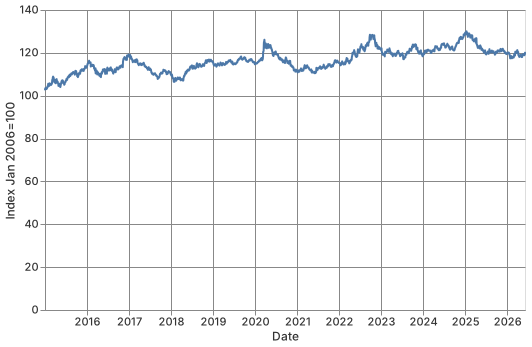
MSI previously reported that the House was set to vote on a $70 billion immigration enforcement funding bill and that Congress sent the nearly $70 billion package to Trump’s desk. The broad trade-weighted U.S. dollar index stood at 120.08 as of the article’s publication date, reflecting ongoing dollar strength that shapes the economic backdrop for immigration-related fiscal policy.