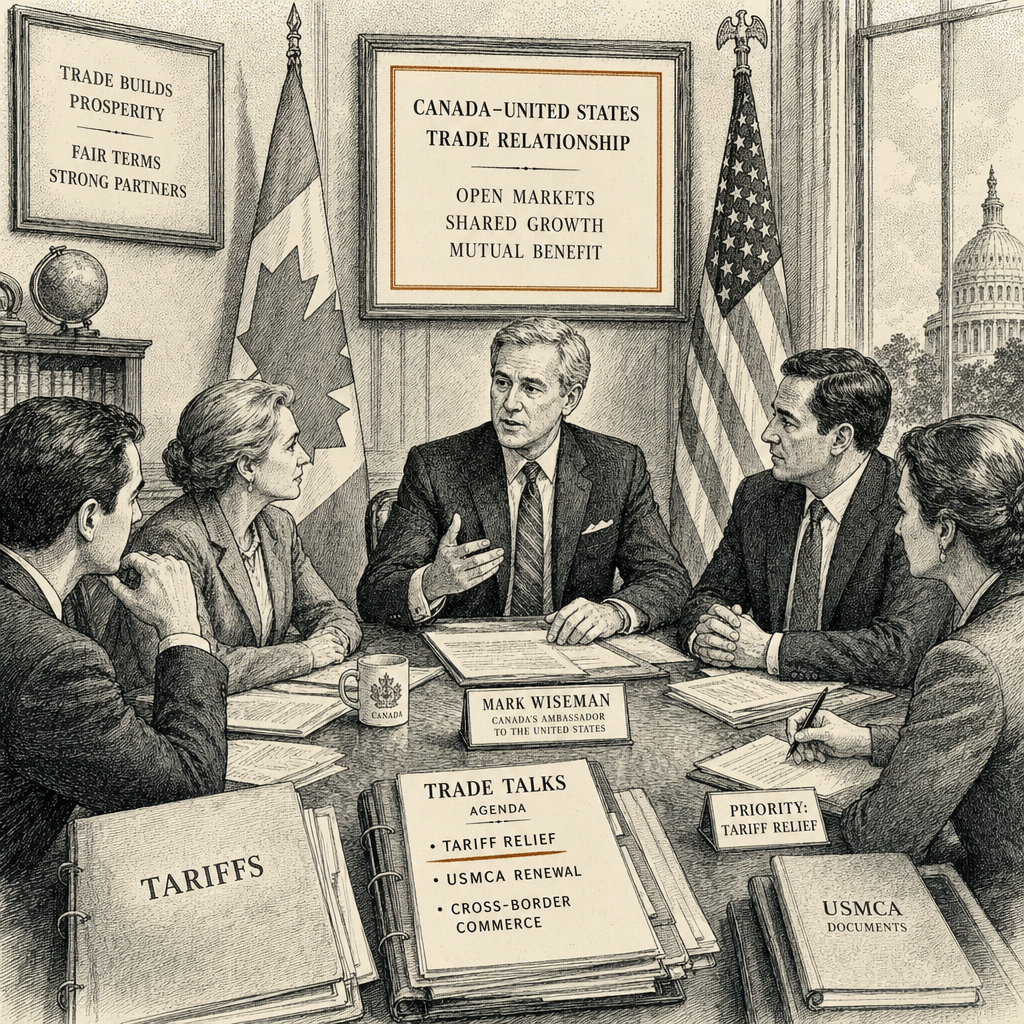
Canada’s Ambassador to the U.S., Mark Wiseman, said Tuesday that Canada’s primary objective in ongoing negotiations with Washington is relief from hefty U.S. tariffs on steel, aluminum and automobiles, rather than the formal review of the USMCA trade pact set to begin July 1. Speaking to a business audience in Toronto, Wiseman urged Canadians not to focus too heavily on the upcoming joint review of the three-nation trade agreement, downplaying its immediate significance.
Wiseman, a former pension-fund and BlackRock executive, said senior Trump administration officials led by U.S. Trade Representative Jamieson Greer have indicated they are eager to keep the USMCA intact, though with changes. Even if no agreement is reached after the July 1 review, he noted, the pact’s terms will remain in force for another decade, until 2036.
“Those tariffs are the ones that are biting in terms of impact on the Canadian economy,” Wiseman said, referring to the sector-specific duties. “We need to find a path forward on quickly” on those sectoral tariffs, “because unlike everything else under USMCA, the default is they’re staying in place, and they are incredibly, incredibly painful to wide sectors of the Canadian economy.”
The U.S. tariffs on Canadian steel, aluminum and automobiles, some reaching 50%, have squeezed the country’s manufacturing sector. Business investment in Canada has declined for five straight quarters, and policymakers have said that trend must reverse to support an economic recovery. The uncertainty surrounding the tariffs and the broader USMCA review has prompted many Canadian businesses to cancel or delay spending and hiring plans.
Dominic LeBlanc, Canada’s chief minister for U.S. trade, has stated that Ottawa is unwilling to agree to changes to USMCA or other policies—including a province-led ban on U.S. wines and spirits—until the sector-specific tariffs are eased. Canada is the largest foreign supplier of steel and aluminum to the U.S. and the fourth-largest supplier of light-motor vehicles.
Trade lawyer Mark Warner, who practices in both the U.S. and Canada, said Wiseman is trying to de-emphasize the annual review process as a way to reduce the uncertainty that executives are facing. “But for investors and traders, the annual USMCA reviews will likely be what they focus on, when they try to calculate and assess risks and uncertainties as they make significant strategic decisions,” Warner said.
Wiseman echoed comments made last month by Prime Minister Mark Carney, who said in a video address in April that Canada’s economic ties to the U.S. had become a source of weakness. Wiseman said Tuesday that Canada had become too complacent about its economy, relying too heavily on trade with the U.S. as its main engine of growth.
“I think that’s what the Prime Minister has said,” Wiseman said. “We need to diversify our sources of demand for our products.”
At the same time, Wiseman played down any suggestion of a rift. He said Canada’s strategy of pursuing new trade markets should not be interpreted as turning its back on the U.S. economy. “We, as Canadians, are privileged to be next door to the world’s most dynamic economy,” he said during a question-and-answer session with Bank of Montreal Chief Executive Darryl White. “We should not seek to trade that for anything.”
Wiseman added that talks with U.S. officials are proceeding on an almost daily basis, describing them as “productive, serious, informed, and respectful.” Behind the scenes, he said, “stuff is getting done.” Most trade watchers do not expect the U.S. to agree to a USMCA renewal on July 1, arguing that the current policy uncertainty gives Washington negotiating leverage.