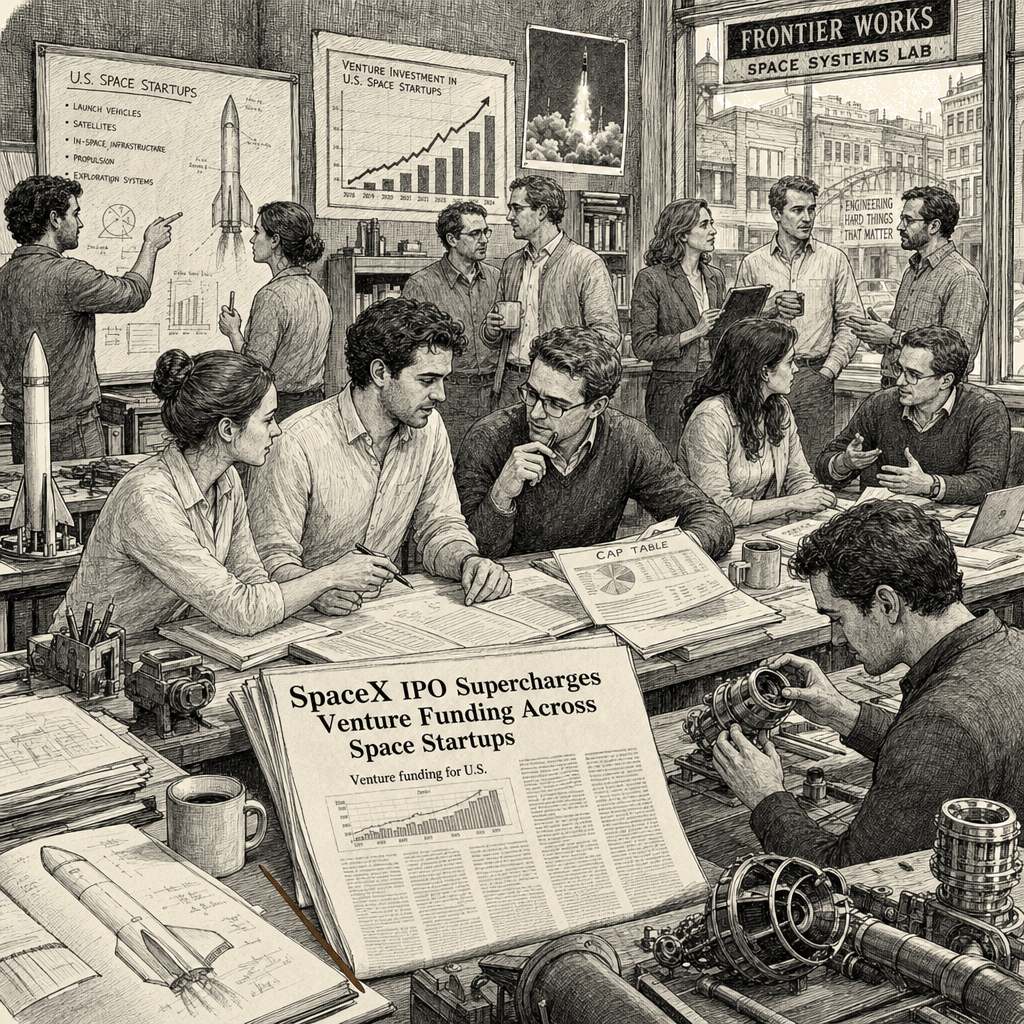
Venture funding for U.S. space-technology companies excluding SpaceX shot up to $7.1 billion in 2025 from $2.5 billion a year earlier, according to data provider PitchBook. Last year’s haul was the strongest since companies raised almost $4 billion in 2021, PitchBook found. The broader surge in private investment — spanning satellite makers, ground systems, orbital mobility, and in-space power — comes as SpaceX’s record-setting IPO last week sealed a victory for long-term shareholders who bet on ideas that once sounded like science fiction, including a fleet of roughly 10,000 satellites.
Public-market investors poured $75 billion into the Elon Musk-led company in its debut, a milestone for a company that nearly went out of business during its early years. The IPO also appears to be catalyzing new capital for startups across the sector.
“Space was getting pretty hot, even before the SpaceX IPO was announced, but I think it just got supercharged,” said Tom Mueller, a former top SpaceX executive who recently raised $500 million for Impulse Space, the in-space mobility company he founded.
More investments have rolled in this year. Observable Space, which is focused on laser communications and sensing, recently raised $90 million. Ground-system startup Northwood Space pulled in $100 million, and CesiumAstro, a maker of space systems and electronics, recorded $470 million in equity and financing. Star Catcher Industries, a startup developing a power grid in orbit, also recently landed new capital, according to its CEO Andrew Rush.
“There’s just so much more you can do from space,” said John Gedmark, CEO of Astranis, a maker of smaller satellites that orbit more than 22,000 miles from Earth. The company recently raised capital from Franklin Templeton and others. “Investors are finding there are real business models in space and money to be made,” Gedmark said.
Rush said that many big venture investors in the past would not touch space-related deals unless a company was led by someone like Musk, who had generated returns. That has changed because the space sector has demonstrated it can deliver, according to Rush.
The wave of deals comes with risks that are heightened by the challenges of building devices capable of operating in orbit. Space is a harsh environment where the margins between success and failure are thin, executives said. While sector giants such as SpaceX and Jeff Bezos’ Blue Origin can survive a big setback — Blue Origin is racing to rebuild a Florida launchpad wrecked by an explosion — smaller startups often cannot, investors say.
Some far-out business models will remain too speculative for many investors, according to industry figures. “I do think it helps to be in this current moment as a mature company,” said Delian Asparouhov, a Founders Fund partner who co-founded Varda Space Industries, which conducts pharmaceutical experiments in low-Earth orbit. “People can go look at a lunar hotel but there’s no revenue, there’s no path to revenue,” Asparouhov said.
Investors have been burned before. In 2021, a number of space-related firms raised capital and went public by merging with blank-check companies but performed poorly. Virgin Orbit, which used a plane to launch satellites, went public in such a deal in 2021. Less than a year and a half later, the company filed for bankruptcy and then shut down.
Executives at many space startups said they are pairing real demand with calculated bets on developing technology. A target customer for many is the Pentagon, which might be in line for a historic budget increase that would shower space programs with billions of dollars in new funding.
Startup K2 Space, which is building powerful satellites that can weigh roughly 2 tons, has built momentum by showing traction among commercial and government customers, said CEO Karan Kunjur. It had $500 million in signed contracts across those clients at the end of last year and aims to build even more powerful satellites for communications, military applications and other purposes. A former consultant, Kunjur co-founded K2 with his brother Neel, who spent more than five years working on SpaceX’s Dragon spacecraft earlier in his career.
Neel Kunjur is one of many former SpaceX employees taking a crack at a startup. Engineers and executives who cut their teeth at the Musk-led company have been fanning out as space-industry founders and investors, and the IPO is expected to prompt newly wealthy staffers to make similar leaps, former employees said.